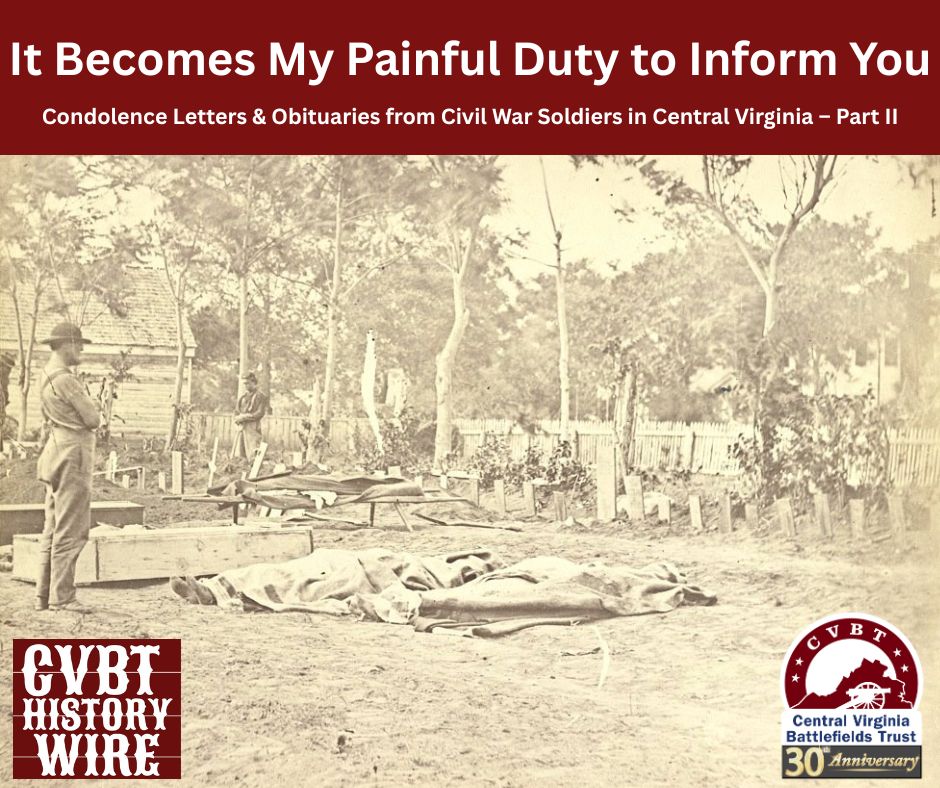
One wonders if any of the loved ones of the deceased soldiers shown in this May 1864 photograph recevied condolence letters.
(Library of Congress)
Introduction
Many things changed in central Virginia during the Civil War. Some people’s early-war hopes that the conflict would be short were long gone by the spring campaigns of 1864. Similarly, slavery as a labor system, although not yet dead in central Virginia in what would be the war’s final year, was left much damaged after extended periods of Federal military occupation in the region. The army’s proximity, in turn, offered numerous opportunities for freedom seekers to leave old lives behind. Along with the Union and Confederate armies’ extended presence in 1862 and 1863, an amount of destruction had been visited upon the farms, fields, forests, and towns that would have been unimaginable in the war’s opening days. Additionally, the number of deaths in the area skyrocketed with the war. Whether due to sickness and disease, battle wounds, accidents, or a combination of factors, death stalked the armies’ camps and battlefields claiming victim after victim.
The severing of mortal ties between soldiers and their family members and steadfast friends during a time of war proved particularly difficult. Distance and unyielding military commitments often placed numerous obstacles in the way of those wishing to perform traditional grieving practices. Period ideals of propriety—in some ways significantly different from our current ones—often viewed it as one’s obligation to send written sympathies to those close to the recently deceased. As we saw in Part I, condolence letters helped fulfil the sender’s sense of duty by reporting the death and offering commiserations, while at the same time providing a measure (if only a minuscule amount) of consolation and closure.
This Part II CVBT History Wire will continue to explore condolence letters but shifts its focus to those involving deaths tied to the Battles of the Wilderness and Spotsylvania Court House that occurred in May 1864.
The Battle of the Wilderness
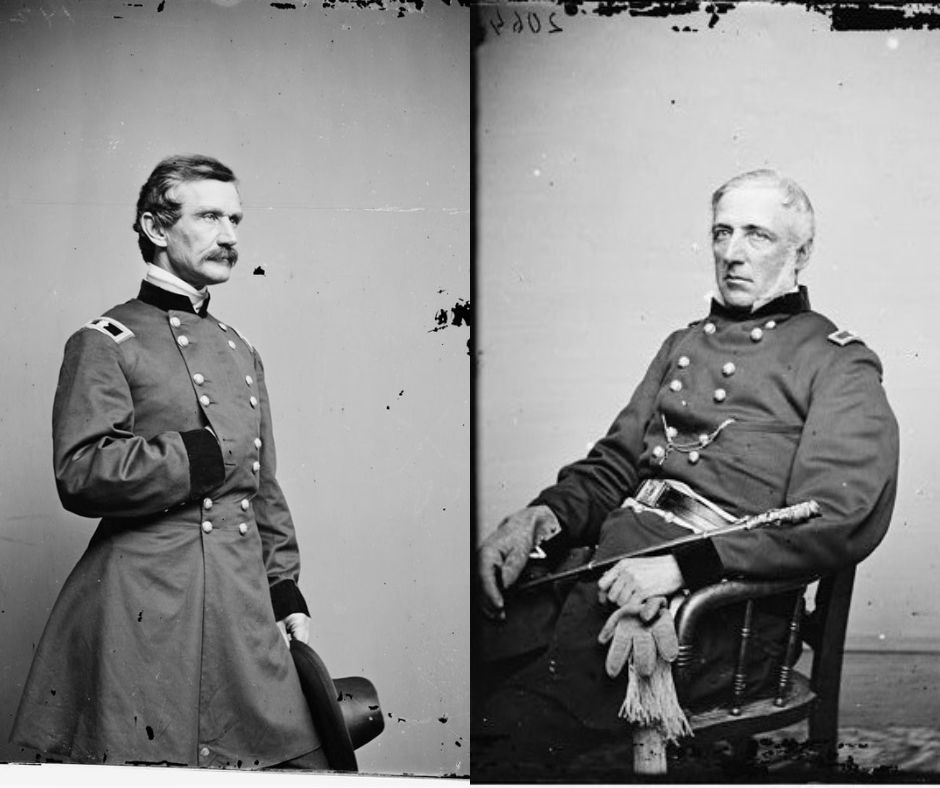
(Library of Congress)
One of the most well-known general officers to meet his demise at the Battle of the Wilderness was Brig. Gen. James Wadsworth, who commanded a division in the Fifth Corps. During the May 6, 1864, fighting near the Orange Plank Road, Gen. Wadsworth was struck in the head and mortally wounded. He died two days later. Due largely to his military service, wealth, and notoriety, Wadsworth’s wife, Mary Craig Wharton Wadsworth, received many letters of condolence expressing sympathy for her loss during her time of mourning. One of these letters arrived much later than the majority of the others. This particular letter came from the pen of her cousin, Brig. Gen. Andew Atkinson Humphreys, who served on Maj. Gen. George Meade’s staff at that time. Humphreys did not write his letter until almost five months after Wadsworth’s death.
Writing from Petersburg, Humphreys explained his delay: “In the first moments of your affliction I would not obtrude upon your grief with sympathy, though heartfelt,” however, he believed “it would be a wrong to the memory of my friend if I did not at some time, say to you how deeply his loss was felt in the Army to whose reputation his noble bearing on the field added luster, and with what sorrow he was mourned by the many friends of his manliness, sincerity, and generous qualities had won in this Army.” Humphreys recalled that “In the two days of desperate fighting that followed our crossing the Rapidan, he was conspicuous beyond all others for his gallantry, prompter than all others in leading his troops again and again into action. In all these combats he literally led his men who inspired by his heroic bravery continually renewed the combat, which but for him they would have yielded.” Gen. Humphreys felt that all of Wadsworth’s brother officers were “loud in expressions of admiration at his noble conduct and of sorrow at his loss.” Humphreys, too, was counted among them: “I have felt his loss deeply, not only as a soldier but as a friend who stood fast by me when attacked by bitter, powerful enemies.” He wanted Mary to know that “I should not feel satisfied to remain altogether silent, and not give some expression to my sincere sympathy for your affliction, and my sorrow for the loss of a true friend.”
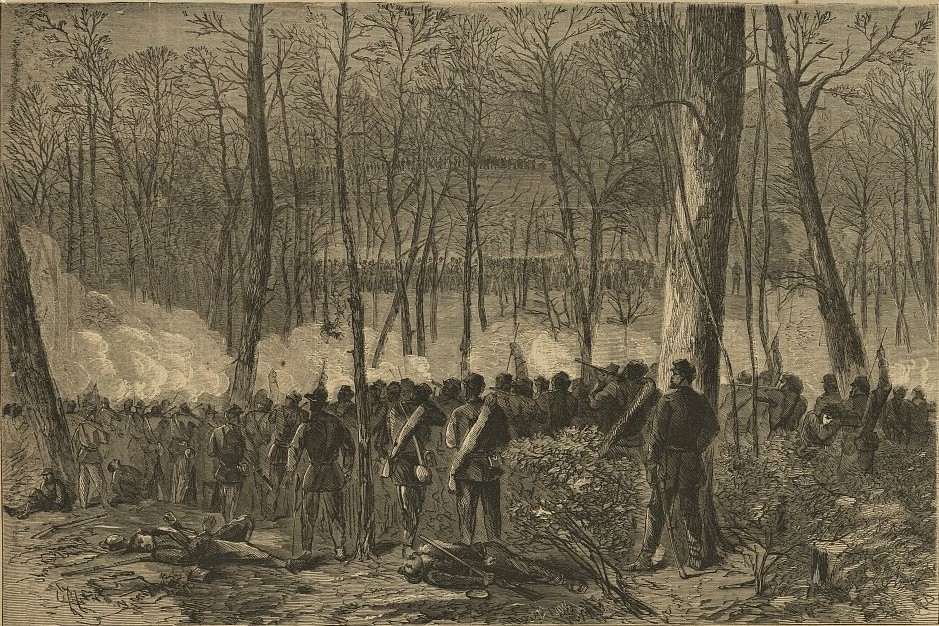
June 4, 1864, Harper’s Weekly woodcut based on a sketch by Alfred Waud
(Library of Congress)
As shown in Part I, condolence letters and memorial obituaries were not reserved solely for the well-known. Someone, perhaps one of the officers of the deceased Sgt. A. L. Presnell, and who only offered the three initials J. D. T. as an identifier, wrote to the Fayetteville, North Carolina, Semi-Weekly Observer sharing words of condolence “FOR THE BENEFIT OF HIS RELATIVES AND FRIENDS.” The eulogistic obituary, placed seven months after the 46th North Carolina soldier’s death on May 5, noted that Presnell “fell while nobly defending his country on that bloody field at [the] Wilderness. . . .” J. D. T. explained that “On [May] the 8th [Presnell], with many of his brave comrades, was buried on the victorious field where he fell.” Like many soldier obituaries, Presnell’s provided a very brief biography of the fallen soldier: “He was a native of Randolph county, aged 21 years. He joined the army in May 1862, and served his country faithfully, with unshrinking valor and energy, with satisfaction to all his officers and comrades, and with honor to himself and country.” Also as is common in condolence letters and obituaries, the notice emphasized the positive aspects of the departed’s personality: “The deceased exhibited traits of character which entitled him to be numbered among the consecrated dead who have perished for Southern independence.” The obituary included that Sgt. Presnell was his parents’ third son who “has been torn from them by the relentless hand of war.” One son, “Serg’t Josiah Presnell, Co. I, 22d N. C. T. was killed at the battle of Chancellorsville, Va. . . while making a gallant charge on the enemy’s lines.” “The other Allen Persnell, Co. F, 46th Reg’t, died in hospital at Richmond, Va., on the 4th of May 1864.” The final sentence stated that Sgt. Presnell “was a brave patriotic son, and is remembered with regret by all his officers and friends in arms.”
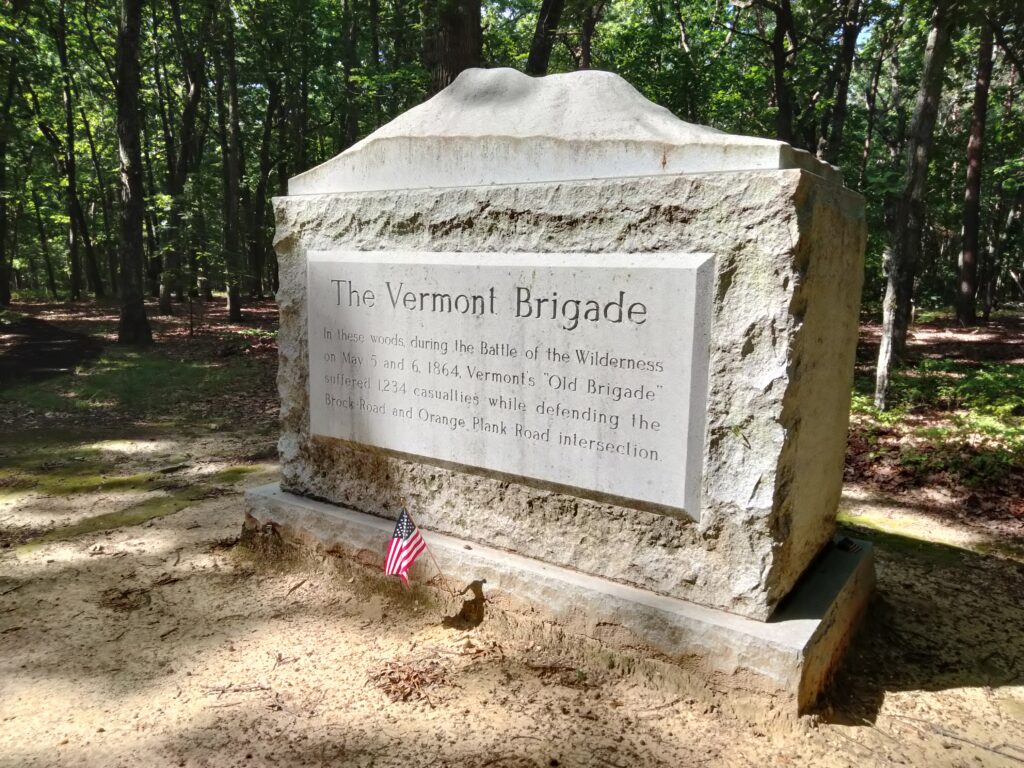
(Tim Talbott)
One of the many Vermont Brigade soldiers who was mortally wounded at the Battle of the Wilderness on May 5, 1864, was twenty-five-year-old Lt. William Henry Martin of the 4th Vermont. Lt. Martin went by Henry. Henry’s brother Francis also served, but as a private in the 2nd Vermont, also in the Vermont Brigade. Apparently, soon after the battle, Francis sent a letter home informing his parents of Henry’s death. That letter unfortunately never arrived. The brothers’ parents wrote Francis on May 22 letting him know they had read about Henry’s wounding and subsequent death in the newspaper. “We wish you to give us all the information you can,” they pleaded. They particularly wanted to know “whether his body can be obtained.” They added, “I presume you can anticipate in some measure the sad feeling which Henrys death must produce upon us but we hope & pray that your life may be spared that we may not be left childless. May this affliction be the means of preparing us to meet in that better world where we hope & trust he has gone.” Francis had not yet received his parents’ letter by the time he wrote to them again on May 28 from Fredericksburg. Francis, himself, was wounded in the neck at the Wilderness—something he apparently did not tell his folks until later—and then it seems he stayed to help nurse the Federal wounded in Fredericksburg. Francis wrote, “It is very sad to loose Henry and I feel deeply for you at home and wish that I might be able to do something to comfort you. . . . The best I can do is to advise you to seek the aid of Him who is Almighty and infinite in mercy compassion & goodness. Our trials are severe but let us put our trust in Him.”
Apparently, not quite content with what limited news that Francis had provided to that point, his parents wanted even more information about Henry’s death. Finally, in September, Francis wrote giving additional details as he knew them. He explained that while at the field hospital he learned Henry had been wounded, so “I went to him and remained with him while he lived.” Henry told Francis, “I want you to take care of me. I do not wish to have strangers handle me.” Francis explained that Henry made “no special dying message . . . not from disregard or indifference but because when he was able to talk his attention was to a great extent necessarily occupied with other things. . . .” Francis then added in a traditional condolence letter tone: “Although I can transmit no messages from him to you I can testify to his noble manly and Christianlike appearance and assure you that but few regard their friends with such deep affection as he did. I am very thankful that I was with him. . . .”

(Tim Talbott)
Sometimes regimental chaplains handled the responsibility of writing condolence letters for their unit. A day after the death of the 152nd New York Infantry’s Sgt. George Kidder at the Wilderness, the regiment’s chaplain, Hiram V. Talbot, wrote a jumbled letter in haste to Kidder’s wife about her husband’s death at a field hospital. Talbot started with a common opening, “It becomes my painful duty to inform you of your husband’s death,” and explained, “He was wounded early in the morning of the 6th [of May] and died about 3 o’clock P.M.” Talbot also provided some details about Kidder’s painful wound and burial: “He was shot, the ball entering the fore part of his left shoulder and coming out the same side of the spinal column about midway. He suffered extremely. We have buried him and marked the place. I think it impossible to send him home.” Knowing that it was the type of final moments information that most family members would want to hear, Chaplain Talbot included his last conversation with Kidder: “I asked him if he had any messages he wished to communicate to you. He said ‘Tell her I die for my country, my family and my God.’ I pointed him to Jesus as his only hope. He said he trusted in Him and was not afraid to die. Let me commend you to the same Jesus that comforted him in his last hours,” Talbot penned. Briefly switching topics to provide an update on the regiment, Talbot wrote that it “is badly cut up. We are fighting desperately. So far we are victorious.” Realizing that in his rush the letter may be difficult to understand, he added, “If you cannot make out his note carry it to my wife. Tell her I am well.” Then, getting back to the point of the letter, Talbot penned, “George said, ‘Tell my wife not to mourn for me, I die for my country.’” Ending the stream of conscious missive, the chaplain finished, “George was a brave soldier, after he was wounded he fought until he fell from loss of blood. He soon was taken to the rear and cared for [the] best we could. I remained with him most of the time till he died.”
Appearing on May 25, 1864, in the Portland Daily Press, an unnamed officer of the 17th Maine offered a bit of an unusual obituary for 1st Sgt. Charles Vanhorn of his regiment. It may be that the newspaper actually quoted directly from a condolence letter written by or received by the unknown sender. “Poor, brave Charlie! I say ‘poor’ because so noble a man is lost to his country,” the post opened. It continued: “He received his wound on the morning of the 6th inst. (Friday), as our lines were gallantly advancing on the enemy; the ball striking his breast, penetrated his lungs, causing his death at half past two on the following day (Saturday). Immediately after he fell he was conveyed to the hospital where every attention was shown him by the surgeons attending—for his genuine goodness and patience won all hearts as ever.” The obituary noted additional details that helped readers sympathize with the writer’s loss: “About three hours before he died the Surgeon came in and looked at him and told him he could not live. He received the death sentence calmly, bravely, as do so many of our gallant soldiers who give ALL for the supremacy of our beloved flag. The chaplain, Rev. Mr. Loverin, attended him, soothing his last moments, and directing his thoughts to that bright land which he was so soon to enter, and of which he so often sung. His last words were, ‘TELL MOTHER I DIED AT MY POST!’ What could be more touchingly beautiful than this? Love for his mother so sweetly blended with devotion to his country to the very las. His spirit passed gently away.”
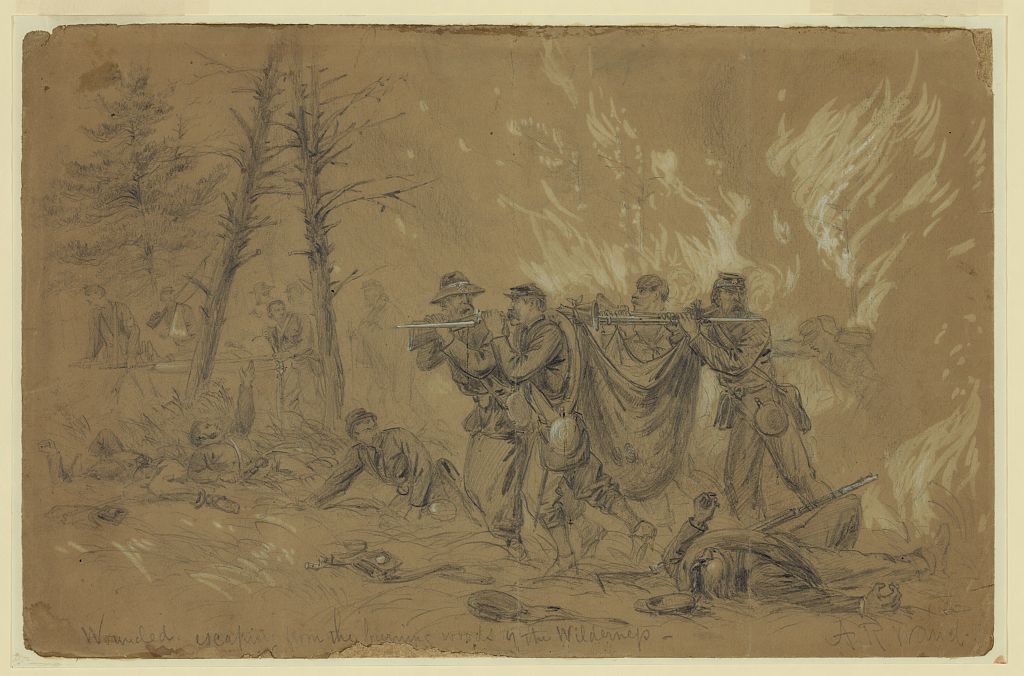
Sketch by Alfred Waud
(Library of Congress)
Most of the condolence letters shared here and in Part I came from someone associated with the armies of the men who were being eulogized. Officers, comrades, surgeons, nurses, and chaplains all shared with soldiers’ family and friends the terrible news of their loved one’s death. However, in family correspondence that has survived, it is not unusual to find condolence letters. or at least similar sentiments, coming from one civilian family member to another.
The following example came from the mother of 14th Georgia soldier, Capt. Simeon David, who was killed in the Wilderness and who had the unenviable task of informing a daughter of her brother’s passing. In a June 1, 1864, letter, Thirza David shared with her daughter Pillina that she had just returned from her daughter-in-law’s home where she learned that Thirza’s son “our Dear Simeon was killed on the evening of the 5th May about 2 hours by sun [evening] by a Minnie ball entering below the left eye. [He] died allmost without a Struggle never Spoke a word.” Thirza noted that “I am so thankfull that he did not suffer long. I have no doubt but that our and his country’s loss is his eternal Gain.” Thriza turned to religion to soothe Pillina’s expected grief. Noting that Simeon’s wife had received a letter from him written two days before his death, he told her about the revivals then going on in their camps. “So my dear Pillina,” Thirza explained, “he is not dead but Gone before us from this poor world. . . .” Thirza also shared that “I have heard of sevral letters in Forsyth C[oun]ty in which [Simeon’s] Men lament for him like he had been their Father. The Dear Child was going into Battle before his men encouraging them when no doubt a Sharp Shooter Singled him out.” She reported that Simeon’s brother Horatio, who served as a lieutenant in the 16th Georgia, escaped the Wilderness unharmed. Ratio, as they called him, had informed Thirza “don’t grieve about Brother, he is better off than you or I. but for his poor little children I could bear it better thoug[h] we are compelled to bow.”
A similar family death notification situation occurred for the 7th South Carolina Infantry’s Pvt. Andrew Boyd, but with somewhat different details. Wounded by a bullet that passed through his back near his spine and out above his hip bone while fighting in the Wilderness on May 6, Pvt. Boyd was sent to a Lynchburg hospital to recover. While there he contracted measles. The disease, combined with his weakened condition from his wound, killed Andrew on June 3. A letter sent from Andrew’s brother Daniel on June 17 to their parents informed them of their loss. After assuring his parents that “I am well at this time,” he sadly added that “I am sorry to inform you that brother Andrew is dead.” Daniel explained that Andrew died four days after contracting measles, but probably in an attempt to comfort them, he noted that Andrew died with his friend James Blanchett by his side. Blanchett apparently informed Daniel that Andrew “was well attended to but [despite] all they could do, they could not save his life.” Again, Daniel probably hoped that his parents would be somewhat comforted knowing that Andrew received proper care. Daniel trusted his brother had gone “to a better world where he will rest in peace. Where there is no wars nor rumors of wars.” Likely recognizing the spring 1864 campaign’s new relentless style of war, one involving almost constant contact with the enemy, Daniel thought, “It seems like they are going to take all of us. It seems like my time is close at hand, but I hope that I may be spared to get through and to get back home once more.” Undoubtedly, his parents hoped he made it home, too.
The Battle of Spotsylvania Court House
The two weeks of fighting near Spotsylvania Court House proved to be a dangerous time for enlisted men and officers alike. Several casualties even occurred among the armies’ general officers. Those losses included Brig. Gen. Thomas Greely Stevenson, who commanded a division in the Ninth Corps. Stevenson apparently became the victim of a freak stray bullet on May 10, the day after Sixth Corps commander, Maj. Gen. John Sedgewick was killed. In remembrance of their son’s sacrifice, the Stevenson family compiled a memorial book containing his biography, a sample of his war letters, and letters of condolence from Stevenson’s civilian and military friends.
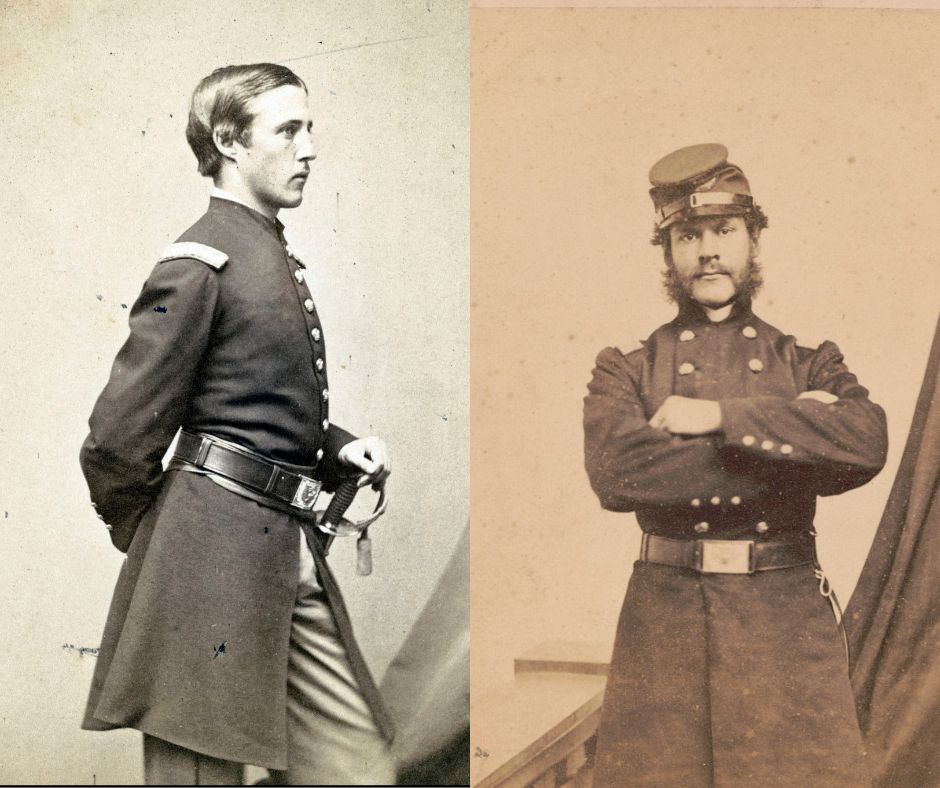
(Mills image courtesy of Find A Grave / Stevenson image couresty of the Library of Congress)
Capt. Charles J. Mills, a member of Stevenson’s staff at the time of his death, penned one of the letters addressed to Gen. Stevenson’s mother. Although only serving with Stevenson for about three weeks, it is clear that Mills grew quite attached to the general. Capt. Mills had apparently enjoyed a visit with Mrs. Stevenson while he was home on a recent leave and thus thought she “may be glad to receive one more tribute to his memory from one who, however inferior in rank, knew and loved him well.” Mills felt that he could “appreciate, perhaps better than almost anyone else, the loss which those excellent but unfortunate troops, as well as, more generally, the army and the whole country, sustained in consequence of his death. He was the most gallant, brave, and thorough soldier, the most kind-hearted, generous-spirited man, the most just and considerate chief, and one of the most agreeable companions I ever knew. I always had liked him, and while I was on his staff I became very deeply attached to him. He did everything for me that a man could do and always thought of my lameness.”
Instead of providing details of Stevenson’s death or last words, Mills chose to praise the many positive characteristics that he found in the general and the bright future that was extinguished with his death. For example, Mills explained that Stevenson “was the most conscientious man in the performance of his duty. The least trifles he would attend to himself, always doing twice as much as could be expected of him,” and added, “He would have been, in my opinion, with the experience of large operations, which he would have gained so rapidly and so thoroughly in the campaign of 1864, one of the best, if not the very best division commander in the Army of the Potomac. When I think of what his Division subsequently went through, and what it might have done, had he been there to command it, it becomes doubly hard to bear his loss.” Mills also hoped that sharing his personal connection with the general would ease his mother’s grief. “With no other General have I felt, as I did with him, that officially I could never expect anything but the strictest justice, while privately I was with the most kind, congenial, and agreeable friend. I might say much more, but feel that I have written enough to show that, although with him only for a short three weeks, I had learned to love and admire him as much as every one who knew him must have,” the captain concluded.
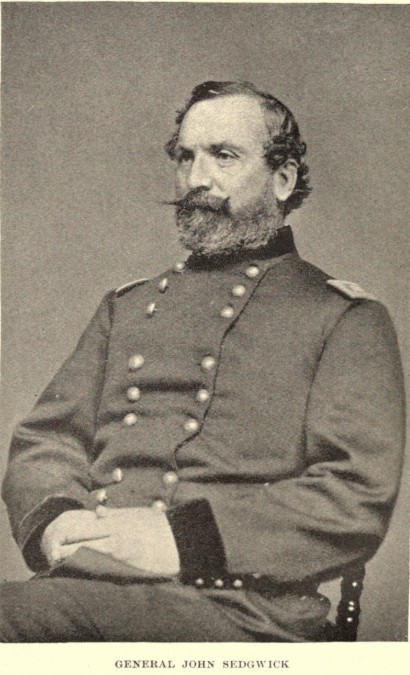
As previously mentioned, Maj. Gen. John Sedgwick was killed on May 9. In its May session, the Connecticut General Assembly passed resolutions honoring the fallen Sixth Corps commander that included sentiments normally found in more traditional condolence letters. It opened that “Connecticut is again called to mourn the loss of one of her noblest sons and one of the most gallant and accomplished leaders of the national army. Wise in council, of large experience, with rare talent to command, prompt and determined in action, the soul of valor on the battle-field, honoured by his superiors and associates, and beloved by all who served under him, his loss in a crisis like the present, cannot be severely felt, while we bow in resignation to the blow which has deprived the country of a tower of strength.” Additionally, it sought to “tender to the relative and personal friends of the late General Sedgwick deep sympathy in their bereavement, and request that an opportunity may be afforded of paying due honours to his remains, by receiving them at the Capitol, and making suitable provision for the funeral ceremonies.” The resolutions closed by requesting “a copy of these resolutions be transmitted, by the Secretary of State, of the friends of the deceased.”
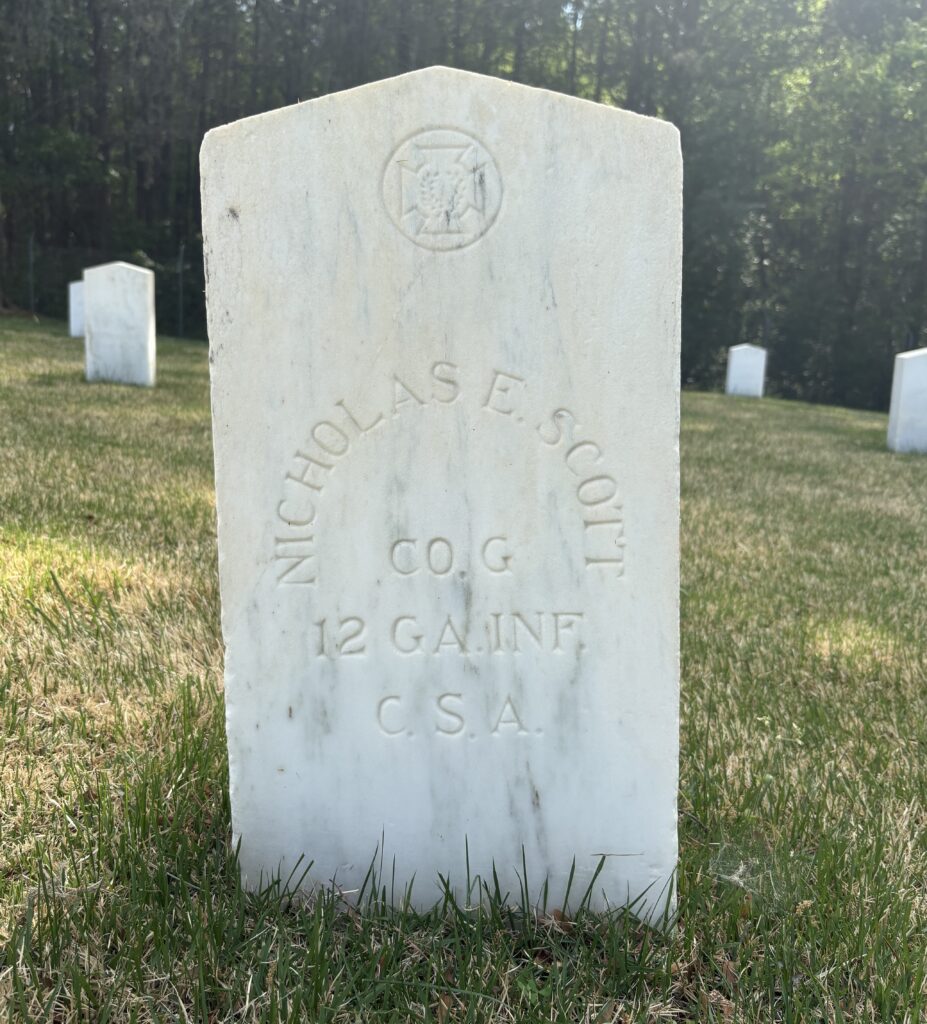
Another example of a family death announcement letter comes from two missives sent by Lt. Irby Scott of the 12th Georgia Infantry. His letters ring familiar with some common themes often found in condolence letters, but being written about a family member, they also have some special elements. On May 16, 1864, Lt. Scott wrote to his family explaining, “In my second letter I wrote you of Buds [younger brother, Nicholas E. Scott’s] death he died fighting gallantly for his Country and his rights. I had him buried in a garden at the house of Mr. McCool [McCoull] about two miles north of Spotsylvania Court House. His name was marked upon a board at the head of his grave.”
Spotsylvania Confederate Cemetery
(Tim Talbott)
Lt. Scott followed up with another letter about 10 days later, after the armies had left Spotsylvania. It gives more details about his brother’s death and burial. “You have no doubt, if not from my letters, learned the heart rending intelligence of Buds death. He was killed May 10th in the evening about dark the ball entering his head above the left eye, passing out the back of the head. I did not know he was dead until the next morning. I made inquiries that night and was told that he was safe,” Scott explained. Unable to search for Bud that night, Lt. Scott got word the following morning from his comrade Bob Jenkins, who found Bud dead. “I cannot describe my feelings when I learned of his fate. I try to console myself that he died in a good cause, fighting gallantly for his country. He was a brave boy and a more gallant soldier never lived,” Scott proudly penned. Lt. Scott “sent four men to bury him in a garden near by. He had no coffin but I had him wraped in a new tent and a blanket. I have since been to his grave. He is buried at the house of Mr. Neil McCool [McCoull] two miles north of Spotsylvania Court House. At his head upon a board is N.E.S., Co G 12th GA Regt. So it is, he is no more.” Despite Bud’s passing, and as one might imagine, the lieutenant grieved heavily: “I think of him every hour in the day and feel lonely for I always had an eye to his comfort. More than for myself. I would rather if it had been the will of God for him to have been spared.” Instead of proving to be of cathartic help to his grieving process, of his writing, Scott noted, “I must stop writing upon the subject and try to dismiss it from my mind. It makes me feel so sad. Do not give way to your grief more than you can help. I know this will be hard to do for I loved him as much as you.”
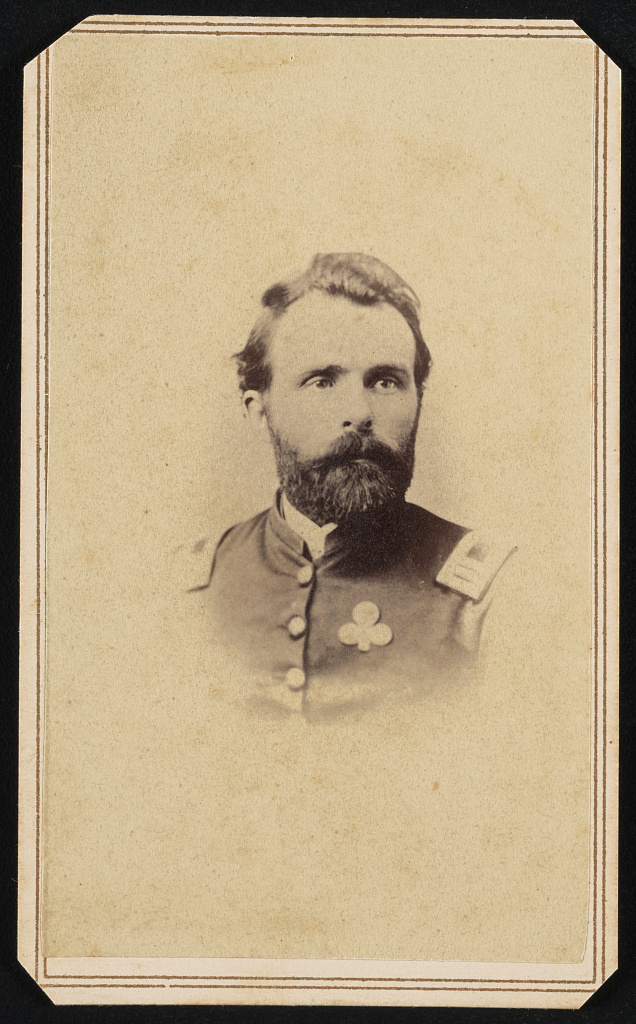
Mortally wounded on May 10, 1864, in fighting near the Po River, an obituary called Capt, Munson “a true soldier.”
(Library of Congress)
An obituary written by P. E. S. for the 126th New York’s Maj. Ira Munson appeared in a Senaca, New York newspaper on September 1, 1864. It explained that Munson, who was promoted to major just before his death on May 14, 1864, had enlisted in 1862 as a lieutenant of Company F and had “shared in all the hardships and vicissitudes of that unfortunate regiment except the battle of Gettysburg, as at the time he was ill.” During the May 10 Spotsylvania fighting at the Po River, Munson was part of the “terrible skirmish line, and he was struck by a ball in the hip, while cheering on his men. He was borne off the field by his faithful men, and after a weary ride of 48 hours in an ambulance, reached Belle Plain, whence he was sent to Washington, where he lived but a few hours.” The obituary labeled Munson as “a true soldier, brave and intrepid without being rash or imprudent. He was generous and kind as a father to the men of his command; courteous and respectful to his superiors in office, and as a consequence he was loved by the former, and honored by the latter.” It also stated that “Many mere boys were entrusted to his care by their parents, for they knew he would be a friend and a guardian to their sons, and their confidence was not misplaced. His elevation in rank did not make him tyrannical. And when advised by his surgeon to resign on account of ill health, he replied that he should never leave the boys whom he had induced to enlist, while he was able to do duty. His fine talents, his noble and generous heart, his cheerfulness and suavity of manners, won him friends wherever he went.” Munson’s body was sent home after he died at Armory Square Hospital in Washington, and at his funeral, “A large circle of relatives and friends mourn his early death. But he died nobly in a noble cause. He loved his country, and like many another hero, he gave to her his life.”
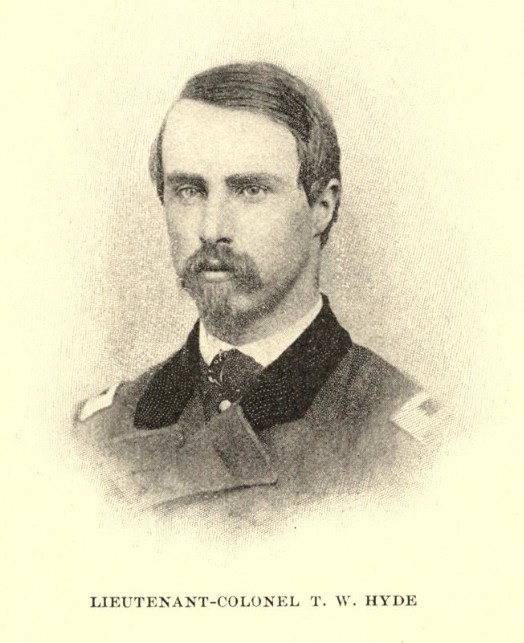
Hyde provided a condolence letter for Capt. Henry Warren of his regiment.
(Following the Greek Cross. or Memories of the Sixth Army Corps by Thomas W. Hyde, published 1894)
Lt. Col. Thomas Hyde had enlisted in the 7th Maine Infantry in 1861. Serving in a number of army roles since then, Hyde had seen plenty of death by the summer of 1864. On June 21, Hyde wrote to J. P. Shaw attempting to provide some information about Capt. Henry Warren’s death. Hyde opened the letter in a matter-of-fact manner: “None of the officers saw Capt. Warren fall. The men say that he was ‘blown all to pieces’ by a ten pound shell. It was on the 18th of May in an unsuccessful assault on the enemy’s works at Spotsylvania. His body was left on the field as were all those that fell and it is very doubtful that it was ever buried,” Hyde explained. The lieutenant colonel then turned a bit more sympathetic, noting, “This is terrible intelligence to communicate, but let me add that never a braver, better man than Henry Warren drew sword in our cause. Already suffering from a wound in the arm, much more severe than had caused many to seek the hospital, he would not leave his Colors, but fell in the most exposed post of danger. His gallantry had been especially conspicuous in the battles of the Wilderness [and Spotsylvania]—everyone rewarded it.” Hyde even injected a hint of a recent conversation with Capt. Warren, but fell short of revealing its main point: “I had an hour’s talk with him on the day proceeding that of his death, and shall never forget the last words he said to me—Sometime I hope to be able to personally communicate to you many things that my time will not allow me now,” Hyde wrote. He closed by offering “deep sympathy for yourself and all his family.”
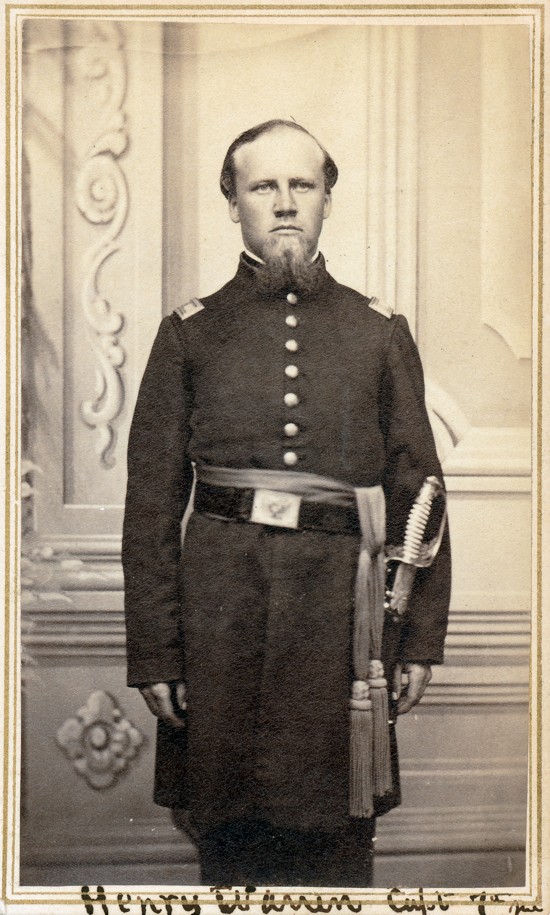
(Digital Maine Repository)
Another example of a chaplain’s efforts to console a soldier’s family comes from the pen of H. L. Calder of the 7th New York Heavy Artillery. Calder, who perhaps finally found a few minutes during the later stages of the Overland Campaign, wrote on June 5, 1864, to the wife of Capt. Charles McCulloch. McCulloch fell on May 19, 1864, during the fighting at Spotsylvania’s Battle of Harris Farm, a portion of which is preserved by CVBT. Mrs. McCullough had apparently sought more information from Calder about her husband’s death, as he began the letter: “I have just this moment received your letter and in the midst of the roar of Artillery and Musketry I get a scrap of paper and pencil sit down on the ground to answer as far as I can your request.” He explained that on “The night on which your husband was killed we were taken by surprise. Our Reg. with the 1st Maine [Heavy Artillery] were resting on their Arms when less than half a mile from us our train of wagons was attacked by the enemy in great force. The two Regiment[s] pushed into the Battle at double quick. Saved the train but at the expense of many precious lives, among them your Dear Husband.” Calder continued that “I was near the Battle—too near, they say, but I felt agitated for my Regt. all the night after the Battle, I was looking after the dead and wounded. towards day light I found the men who had carried Capts. McCulloch & Morris in to the hospital ground. I got the two Capts. and had them Buried together with head boards, and there names and there regiments well printed thereon.” Calder wrote that soon after that unpleasant duty they received an order to move out “& marched 17 hours without refreshments. Great are the fatigues we have to endure times.” Calder was able to secure the captain’s sword, revolver, and the $5.60 that was in his pockets. The chaplain had the money but explained that it may be difficult to get the captain’s remains at present “so awful are the ravages & victims of this war.” He closed by asking her to “Accept with deepest simpathy My condolences and prayers for you in your bereaved State. I Am unwell myself, and I hope you will excuse this imperfect scratch. this is all I can do.”
Whether long and verbose, or brief and to the point, condolence letters and obituaries conveyed points that the author felt were important for the intended audience to hear. In a very short obituary in the December 22, 1864, edition of the Fayetteville, North Carolina, Semi-Weekly Observer, H. Y. M. memorialized Capt. Nevin Clark, who commanded Co. E of the 28th North Carolina Infantry. Fighting as part of Gen. James Lane’s brigade, Clark’s regiment battled Ninth Corps attacks on the east side of Spotsylvania’s Muleshoe salient on May 12. Capt. Clark was killed that day. H. Y. M.’s sympathetic notice stated that Capt. Clark was 29 years old and “a native of Montgomery county, where he resided until he joined the army in the Spring of 1861.” According to the pseudonymed author, Clark “was noted for his christian virtues, a whole-souled, generous man, who never forsook a friend. In his company (Montgomery Grays) all mourn his loss and revere his memory.” In its closing it emphasized the captain’s Christian character by mentioning that “He was a consistent member of the Presbyterian Church at Mt. Carmel.”
Conclusion
Boiled down to their essence, condolence letters and obituaries were primarily about offering sympathy and remembrance of the fallen. Perhaps in some cases they offered an idealized memory, but more often they honestly chose to share positive attributes about the deceased, because, after all, no matter who was writing it, that is likely how they themselves would want to be portrayed and remembered. It is not surprising that authors of these types of missives chose to accentuate the positive and usually minimize or altogether eliminate the negative. No one wants to hear that their loved one cursed in camp, gambled away his pay, lied to his comrades, or was a coward in battle. Offering such information would be disrespectful to the departed, as well as the receiver of the letter. The themes and tone that senders usually attempted to convey in condolence letters are those that were of extreme importance at the time and that hopefully provided comfort to the recipient of the letter. Knowing a loved one died doing his full duty, persevered under the many demands of soldier life, exhibited manly and Christian qualities during their service, and were mourned by their comrades, is about a much consolation one can provide to family and friends separated by great distances and with few other options to communicate the sad news. These surviving letters are a testament of individuals’ empathy and sympathy at a time in American history when both of those qualities were often difficult to find.
Sources and Suggested Reading
Drew Gilpin Faust. This Republic of Suffering: Death and the American Civil War. Alfred A. Knopf, 2008.
Christopher Hager. I Remain Yours: Common Lives in Civil War Letters. Harvard University Press, 2018.
Ashley Mays. “’If Heart Speaks Not Heart’: Condolence Letters and Confederate Widows’ Grief” in The Journal of the Civil War Era, Vol. 7, No. 3 (September 2017), 377-400.
Mark S. Schantz. Awaiting the Heavenly Country: The Civil War and America’s Culture of Death. Cornell University Press, 2008.
Parting Shot
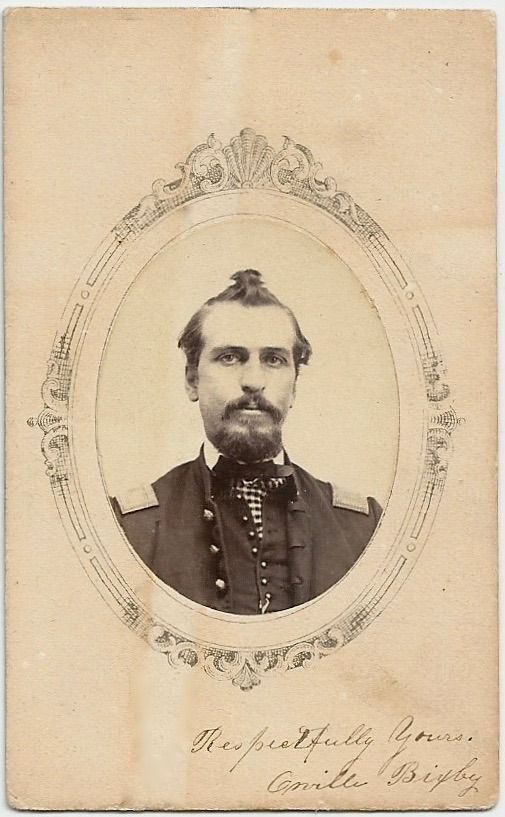
Capt. Bixby was mortally wounded at the Battle of the Wilderness. His passing left a widow and fatherless son.
(Find A Grave, Rob Grandchamp)
Mrs. Bixby
It becomes my painful duty to inform you of the death of your husband Capt. Bixby[,] although I understood the Chaplain of the 2nd Regt. has already written to you before this. He was mortally wounded in the 5th of May [1864] by a ball in the head. We supposed him killed instantly. I took his watch[,] Diary[,] Pocket book containing $63, several letters and other things all of which I gave to Mark Sergent for safe keeping until I could send them to you. Finding him still alive I sent him to the Hospital where he died that night. His trunk is with the train at Fredericksburg which I will send to you the first opportunity if you will write to me where to send it.
It will be some time before we can get it as we are constantly on the move.
Mrs. Bixby[,] I and the Soldiers of this Co. and Regt. mourn the loss of so brave and good officer for he was beloved and respected by every officer and soldier in his command.
[Lt. Henry Haywood, Co. E, 2nd Vermont Infantry]
NEWSLETTER SIGN-UP
Join our community! Sign up for our newsletter to receive exclusive updates, event information, and preservation news directly to your inbox.
STAY UP TO DATE

Celebrating 30 Years and Over 2,000 Acres of Battlefields Preserved