
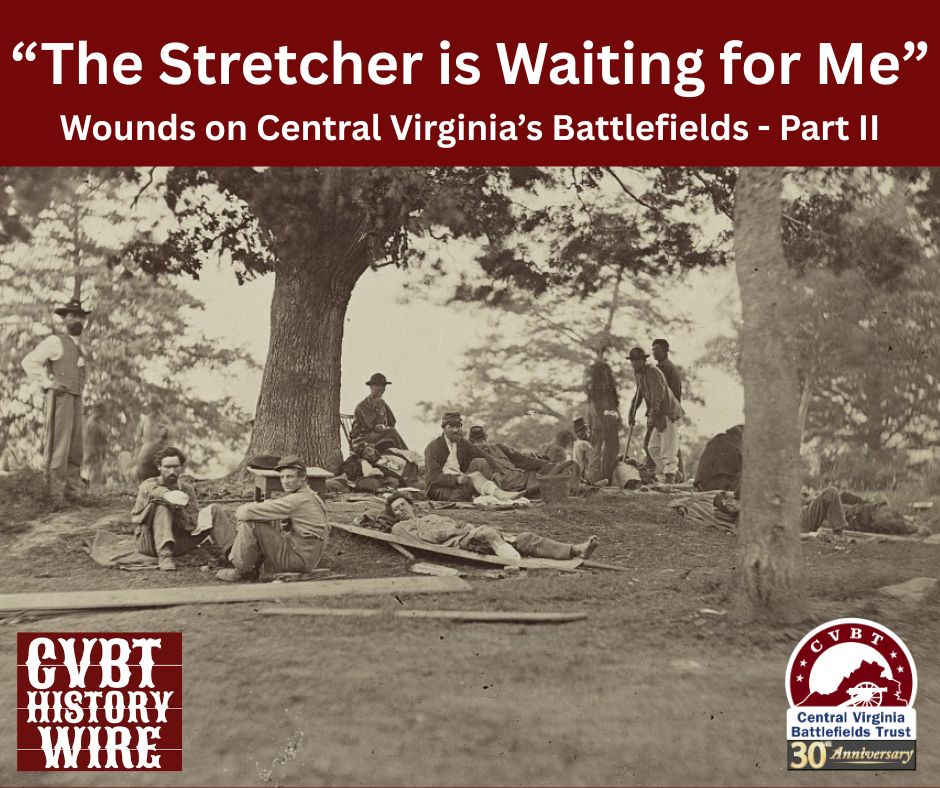
Shown here are men being treated for wounds received at the Wilderness and Spotsylvania and recovering at Brompton on Marye’s Heights, which served as a Ninth Corps hospital.
(Library of Congress)
Introduction
Most counts estimate that around 470,000 soldiers received wounds during the Civil War. It was not uncommon that soldiers received multiple wounds during their enlistments. Such was the case for Lt. Richard Lewis of the Palmetto Sharpshooters.
During the horrific fighting on the evening of May 12, 1864, at Spotsylvania, Lt. Lewis received a serious wound to his left wrist and hand. Due to the rain and darkness, he was unable to locate a field hospital in town or find anyone who could tell him where he could receive some treatment. Lewis wrote to his mother that, “I had to camp all night in the rain around a camp-fire with some men.” After trying to perform his duties, but being unable, Lewis ended up at a hospital in Richmond from where he explained he hoped “to get off home in a few days” to recover.
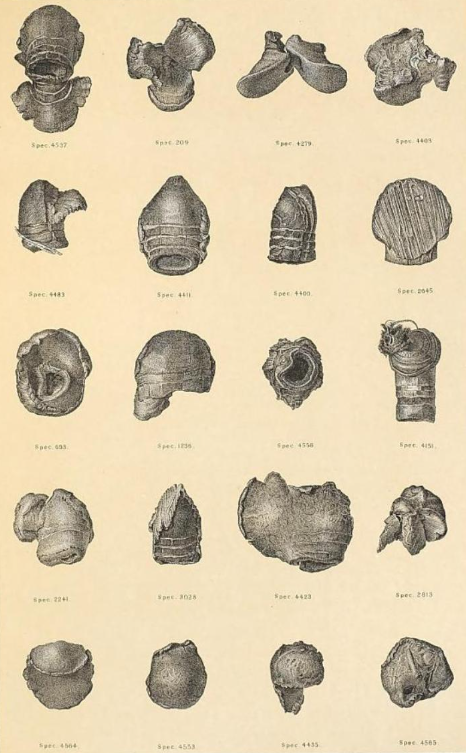
(Medical and Surgical History History of the War of the Rebellion, Part III, Vol. II, 1883)
Lt. Lewis returned to duty in early September 1864. However, in mid-September he wrote home about his Spotsylvania wound which still troubled him: “I am not able to carry my hand without support as yet, and I am sorry to say have been suffering some inconvenience from it.” If Lewis had not already suffered enough, he was wounded in the left leg on October 7 near Richmond and captured. His wound required an amputation below the left knee, and he endured a significant recovery at a hospital at Fort Monroe. While at there, Lewis wrote of his good treatment and that “My wounds on the hand and wrist have healed up but I have no use of my hand yet. My [leg] stump is doing very well, but the doctor makes me carry it in a sling yet.”
After returning home, Lewis eventually became a judge. He committed suicide in 1892 at about 50 years old. His obituary noted that, “Continuous suffering and prostration of the nervous system is the supposed cause of his suicide.”
Unfortunately, Lewis’s situation was far too common among Civil War soldiers, and for those who served in later conflicts.
In this month’s CVBT History Wire we will continue to explore accounts of men who were wounded on the battlefields that we work to preserve by focusing on those of the second half of 1863 and the spring of 1864.
The Mine Run Campaign
(Library of Congress)
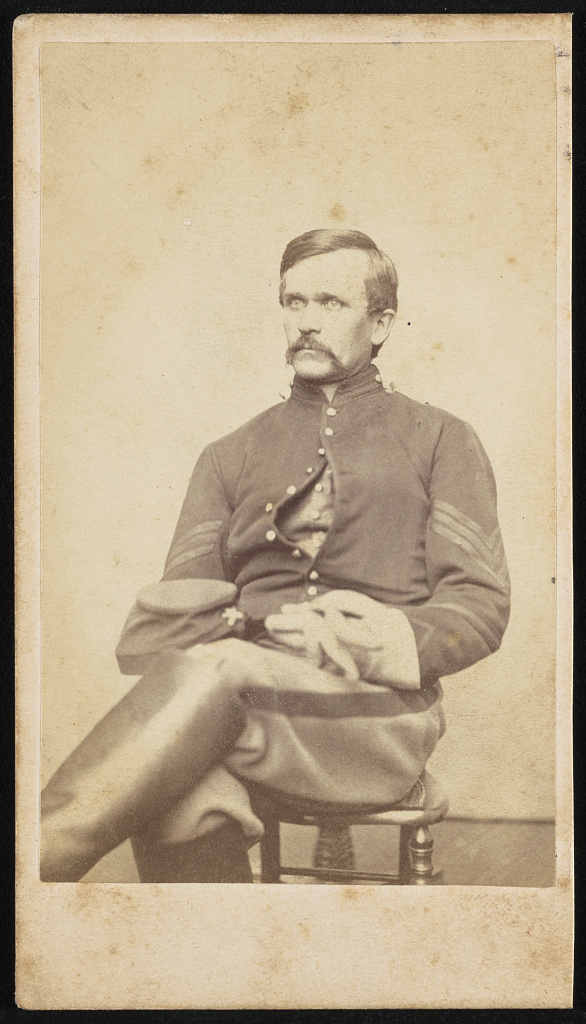
Like Lt. Lewis, Henry D. Scott of the 5th Massachusetts Light Artillery also received multiple wounds. Scott enlisted in the fall of 1861 as a sergeant. He received promotions to second and then first lieutenant in 1862. Lt. Scott’s first wound came during the Battle of Gettysburg. On July 2, 1863, while helping move an artillery piece by hand after all the horses had been shot down “a bullet struck him in the face passing through both cheeks, and breaking the roof of his mouth.” The wound fortunately missed his eyes and teeth. After an amazingly short recovery, Scott returned to his unit that fall. However, Scott’s bad luck continued at Mine Run on November 27, 1863. While fighting near New Hope Church, an artillery shell fragment wounded the lieutenant’s left hand. After recuperating, Scott served as captain of the 18th Massachusetts Light Artillery beginning in March 1864. The unit served mainly in the Washington D.C. defenses and mustered out in summer of 1865.
Another wounded victim at Mine Run’s New Hope Church was Lt. Charles Longfellow, the son of the well-known poet and writer Henry Wadsworth Longfellow. On November 27, while serving in the 1st Massachusetts Cavalry, Lt. Longfellow and his comrades were skirmishing with Confederate cavalry when he received a serious bullet wound in the back. Taken to New Hope Church for treatment, he was eventually sent to an Alexandria, Virginia hospital. Allowed to go home for further recuperation, Longfellow wished to return to his regiment, but received a disability discharge on February 14, 1864.
(Library of Congress)
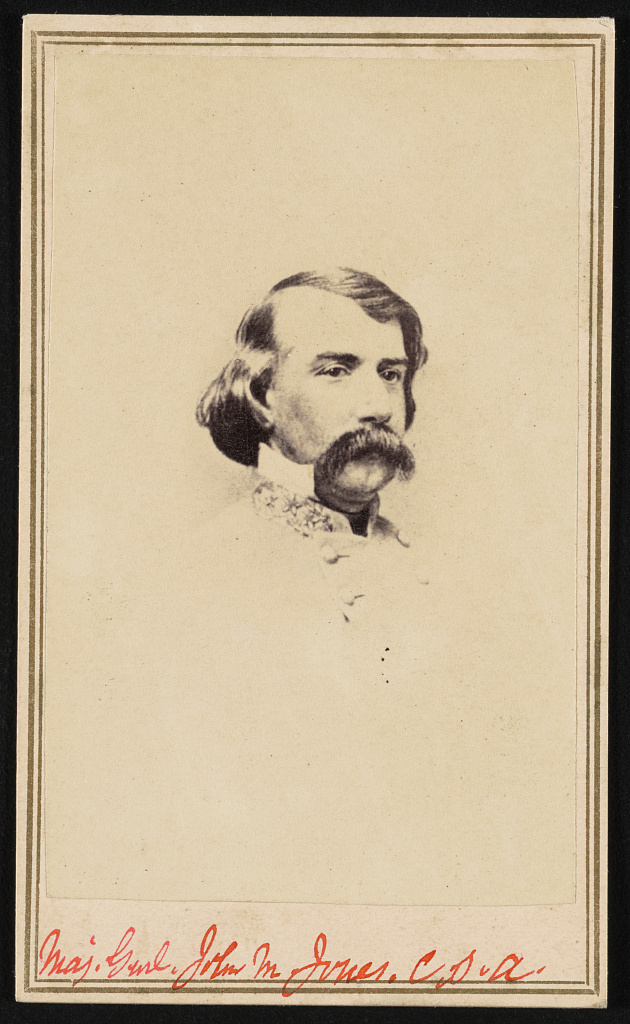
During the November 27 fighting at Payne’s Farm, Brig. Gen. John Marshall Jones of Maj. Gen. Edward “Allegheny” Johnson’s division received a serious wound to the head early in the action. Col. William A. Witcher of the 21st Virginia, who took over command for Jones, wrote in his report of the battle that during the fighting “it became necessary for our brigade to wheel rapidly [to the left]. . . . About the time the wheel was completed, and we had formed upon the line of the division, General Jones, while gallantly exposing himself, was struck down by a shot in the head. . . .” In his report, Gen. Johnson noted that “General Jones reported for duty a few days afterward, before he had sufficiently recovered to justify his doing so, on hearing that a general engagement was imminent.” Once he recuperated properly Jones did return, only to fall killed on May 5, 1864, at the Wilderness, just a few short miles from his Mine Run injury six months earlier.
Yet another officer in Johnson’s division that fell at Payne’s Farm was the 2nd Virginia’s Lt. Col. Raleigh T. Colston (not be confused with Gen. Raleigh E. Colston). Gen. James A. Walker, who at the time commanded the “Stonewall Brigade,” noted in his December 8 report that he sent Colston and his regiment “to deploy . . . in my front and advance his skirmishers through the woods, which he did, and his regiment remained in front, gallantly holding the enemy in check until the brigade advanced to its support.” The 2nd Virginia’s chaplain, A. C. Hopkins, who was bringing up additional skirmishers, was near Colston when he was hit. Hopkins remembered, “He threw up his hands, his large sabre fell, his reins dropped on the neck of his mare, and she, as if conscious, stopped and stood still. He was riding along the line, his left side to the enemy, and I was meeting him. He exclaimed, Oh, my God, I am shot and his countenance blanched in a way which showed intense pain. I feared he was killed, dismounted instantly, handed him my canteen, from which he drank, learned the nature of his wound, braced him up on his horse and led him back. But so pale was he, that just as soon as others could be had I took him off, discovered that the ball had gone directly into the left leg and broke the powerful [femur] bone. . . . We had him taken to the rear.” Gen. Walker added in his report, “I regret very much that Colston lost his leg while commanding the line of skirmishers, as he is a gallant and efficient officer, and his services are very much needed with his regiment at this time.” But Colston was not to return. On December 23, he died while recovering in Charlottesville from his amputation.
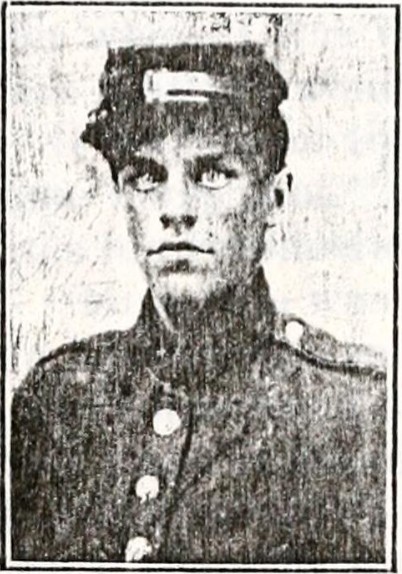
(Chronicles of the One Hundred fifty-first Regiment New York State Volunteer Infantry, 1862-1865, published 1911)
The 151st New York’s Pvt. Elwin Scutt remembered his Mine Run wounding for his unit’s regimental history. He recalled that “A funny incident in connection with my getting shot through the ankle was that John Donahue, who was 60 years old, but gave his age as 45 at enlistment, was lying on the ground in rear of me on a little higher ground than where I was standing, the bullet after passing through my ankle, plowed its way into the ground directly under John’s head, who yelled out that he was shot. As I turned around to see him, I realized that I was hit.” Pvt. Scutt’s wound earned him a disability discharge in February 1864.
The Battle of the Wilderness
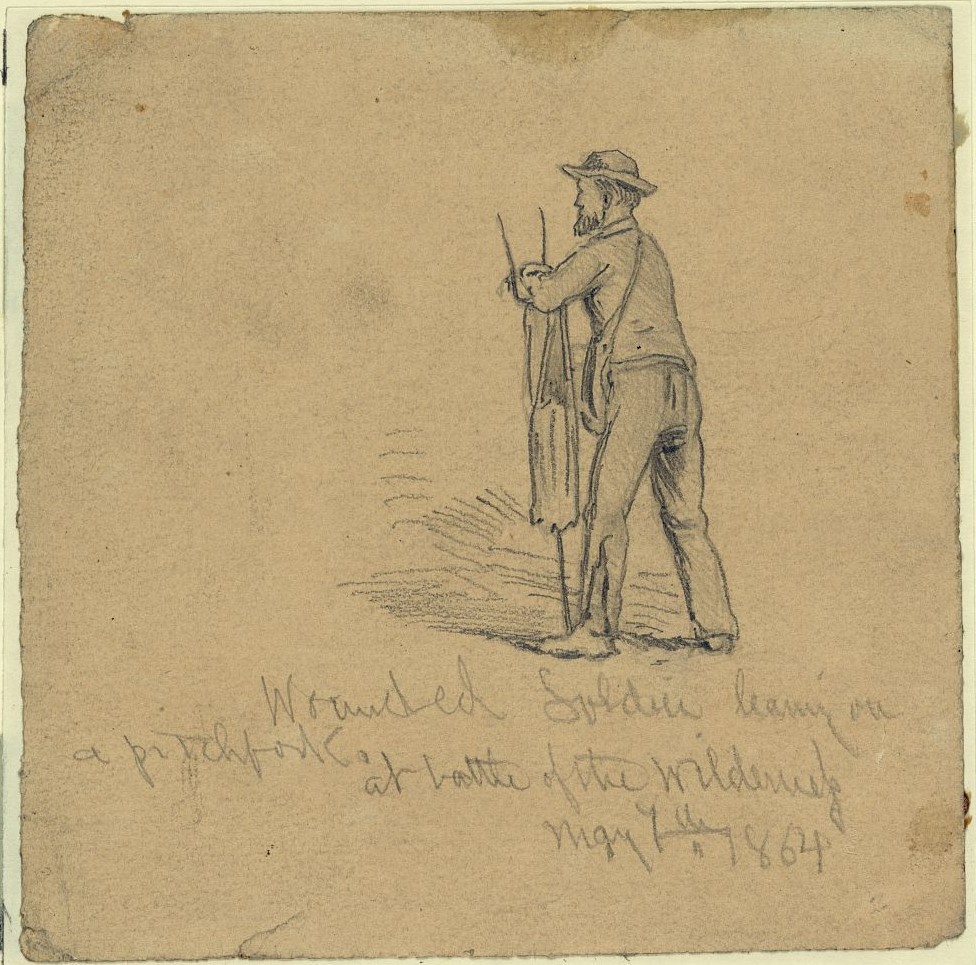
Sketch by Edwin Forbes
(Library of Congress)
The 20th Maine’s eighteen-year-old Pvt. Theodore Gerrish was among the thousands wounded during the Battle of the Wilderness. In his memoir, Army Life, he recounted his experience: “I was wounded, a minie-ball passing through my left ankle. It is impossible to describe the sensations experienced by a person when wounded for the first time. The first intimation I had that I was wounded was my falling upon the ground. My leg was numb to my body, and for a moment I fancied that my foot had been carried away; but I soon learned the true condition of my situation.” Fortunately, Gerrish was able to hobble-run his way back behind lines and then received transportation to Fredericksburg for treatment. He eventually returned to his regiment and mustered out in the summer of 1865.
(Find A Grave)
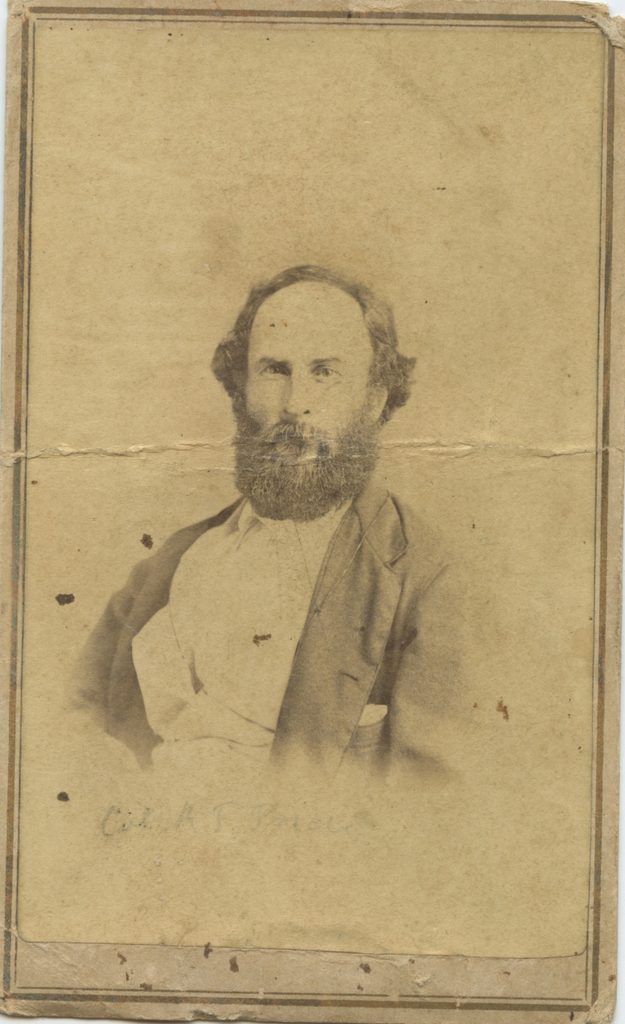
Rodolphus Pride, who held several officer positions during his time with the 31st Georgia, was reportedly wounded five times during the Civil War. Three of those injuries were severe and occurred at Second Manassas, the Wilderness, and Fisher’s Hill. Pvt. Isaac Gordon Bradwell remembered Maj. Pride’s Wilderness injury. “Pride was the last man to jump into the gully, and as he did so he ordered us to rise and charge [the enemy]; but we knew better than to undertake to do this. . . . Only one man responded, and he was shot down immediately. Standing by the side of [Maj. Pride], loading my gun, I heard the sound of a ball striking him in the stomach. This ball passed through his body and came out at his back between the buttons of his military coat. His ruddy face became pale immediately, and he reeled and fell,” Bradwell recalled. Evacuated off the field by some of his soldiers, Pride was hospitalized in Richmond. Amazingly, he recovered and was wounded again in the fall of 1864. Pride died in 1869 of pneumonia at age 41.
In writing his history of Kershaw’s Brigade, Capt. D. August Dickert of the 3rd South Carolina Infantry described a scene just behind the lines at the Battle of the Wilderness: “In the rear of a battlefield are scenes too sickening for sensitive eyes and ears. Here you see men, with leg shattered, pulling themselves to the rear by the strength of their arms alone, or exerting themselves to the utmost to get some place where they will be partially sheltered from the hail of bullets falling all around; men with arms swinging helplessly by their sides, aiding some comrade worse crippled than themselves; others on the ground appealing for help, but are forced to remain on the field amid all the carnage going on around them, helpless and almost hopeless, until the battle is over, and if still alive, await their turn for the litter-bearers.”
After being wounded on May 6, 1864, at the Battle of the Wilderness, the 7th South Carolina’s Pvt. Andrew Boyd wrote to his father from a Lynchburg hospital. After explaining that “I am in good health but I am wonded,” Boyd proceeded to give some details about his injury. “The ball went in close to my back bone an came out just above my hip bone. It is a flesh wond, it did not gow to my insides,” he noted. As with most soldiers who had a limited view in the Wilderness fighting and little contact with comrades afterward, Andrew penned “I can not tell you mutch about the fight. I have not herd mutch about the fight since I left. I get very litel news from the army.” However, Andrew’s hospital stay reunited him with some wounded and sick comrades. He also hoped to get a furlough home for his wound.
(Library of Congress)
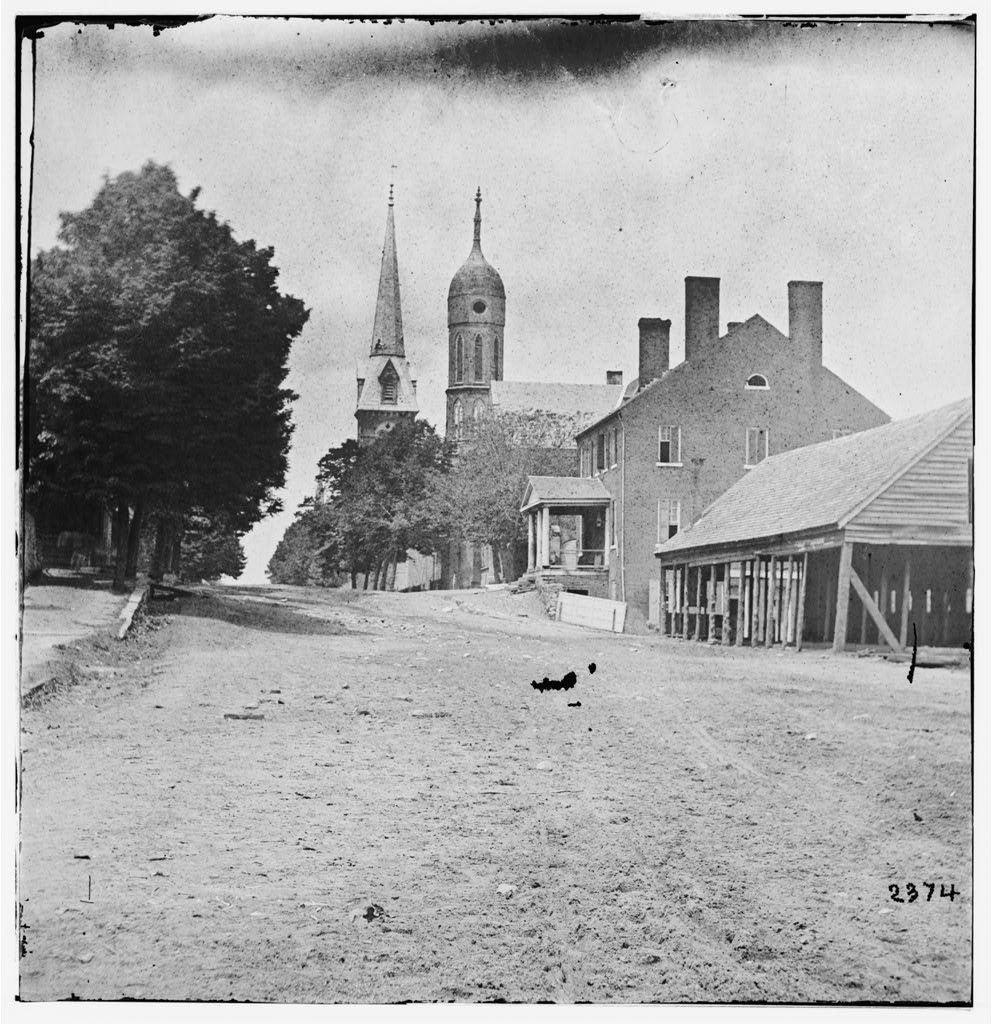
Shot through the body at the abdomen during the Battle of the Wilderness, Corp. Josiah B. Hall of the 57th Massachusetts recalled part of his hospitalization in Fredericksburg and the kindness of a visitor: “For the first few days at Fredericksburg it was almost impossible to obtain bandages. The women with a few exceptions were bitter rebels and would do all they could to prevent us from finding or buying a single piece of cloth. The bandage with which my own wound was bound up was part of the white skirt belonging to an elderly lady who brought roses into the [St. George’s] Episcopal Church where I was lying, a Mrs. McCabe. Seeing the need of a bandage, she loosed her skirt, cut it into strips, and handed it to my father, who proceeded to dress my own and the other soldiers’ wounds.” Corp. Hall amazingly survived his wounds and lived until 1934, when he died at age 92.
After being wounded on May 5, 1864, at the Battle of the Wilderness, Pvt. John McClure of the 14th Indiana wrote to his sister from the Queen Street Hospital in Alexandria, Virginia. McClure explained that “My wound is not a bad one. I got a slight wound on my right breast and a flesh wound through the arm. My wounds are getting a long fine.” McClure thought “I will be able to come home with the regt.,” with the expiration of their three-year enlistments. Due to his injury, he noted “I cant write much with my arm and you cant expect a long letter.” He closed by giving his “best wishes” to those at home. Pvt. McClure survived his wounds, returned to Knox County, Indiana, married his sweetheart, raised a family, and died in 1923.
Wounded on May 5, 1864, the 33rd Virginia’s Corp. Thomas G. Read, wrote to his wife the following day from a field hospital. A comrade actually started writing the letter for Read, but perhaps after reading over what his friend had written, and seeing the man’s bad spelling, Read took over explaining he could write, “by taking time. . . .” Read’s wound was to his left thigh near the hip. He explained he received it “while sitting down loading” and that he “suffered great pain yesterday, but today it is much easier.” On first inspection Dr. Hunter Holmes McGuire thought the bullet was still in Read’s body, but another surgeon, Dr. Caspar Henkel, “looked at it, ran his finger in the hole, & felt around to find out whether the ball was in, but concluded that it was not, & thinks it rebounded.” The doctor concluded it was “not a dangerous wound” and Corp. Read hoped it would get him a furlough home. After providing a list of some of the wounded officers in his regiment, Read wrote, “the fighting was severe[,] thank God I came out as well as I did; if the ball had not been spent some, where it struck it would have shattered my thigh to pieces but through the great mercy of God, I am alive. . . .” Read survived his wound, was later captured at the Battle of Cedar Creek, and then exchanged in March 1865. He was paroled on April 20, 1865, at New Market, Virginia, and died in 1895.
(Library of Congress)
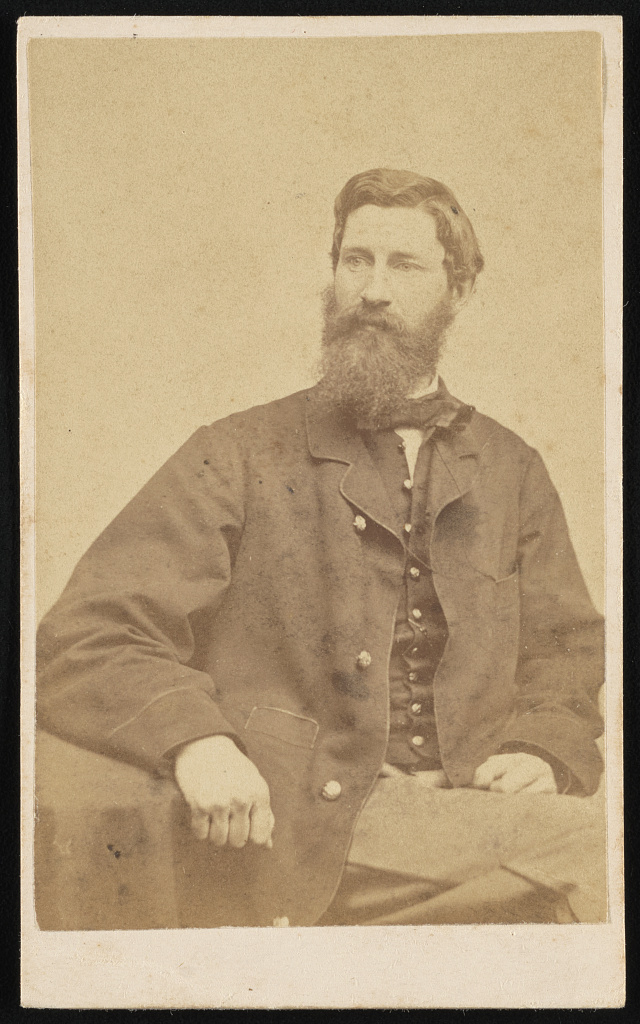
Formerly a surgeon in the 32nd Massachusetts who had exhausted himself into a discharge, Capt. Zabdiel Boylston Adams reenlisted as an officer in the 56th Massachusetts. At the Battle of the Wilderness, Adams and his regiment found chaotic fighting at its worst. Years later, he remembered that May 6, 1864, day well: “Then there was some confusion . . . we were ordered by Lieutenant Colonel [Stephen M.] Weld to fire a volley, and soon after I noticed that my men were falling down or quitting the ranks wounded. My first sergeant, Sanderson, acting as lieutenant, . . . standing at my side in the road, threw up his hands and fell forward on his face. My second sergeant, Frederick G. Weale, . . . stepped up to me, saluted, and pointing to a wound in his breast (of which he died, I am told, the next day) asked permission to go to the rear.” Adams’ colonel, Charles Griswold, soon fell killed. Adams also went down. A bullet broke both bones of his lower left leg. A comrade named Beals tried to help him off, but Beals was wounded and could assist no further and Adams received another wound in the left knee. Eventually, Beals hobbled off using his rifle as a crutch and Adams became a prisoner of war. Paroled, he received a discharge, but again reenlisted in the 56th Massachusetts before the end of the war. Adams died in 1902.
Wounded on May 5, 1864, at the Battle of the Wilderness, Lt. James A. Graham of the 27th North Carolina Infantry wrote to his mother four days later from a hospital in Gordonsville, Virginia. At about 4:00 pm and fighting in what Graham described as “the thickest forest of little trees I ever saw,” he explained, “the enemy advanced upon us three lines deep and soon we were at it hot and heavy.” With their brigade (Cook’s) flanked on their right, “Walker’s Brigade was thrown in . . . and brought us all right again,” Graham penned. In addition, just then Kirkland’s Brigade arrived as support. About that same time, Graham “was struck by a minnie ball about two or three inches above the knee.” He noted that “The ball has not been extracted yet, but I am getting along splendidly. . . .” After giving a report on his company’s casualties, he tried to assure his mother: “Do not be at all uneasy about me as I have only a flesh wound and am doing first-rate.” Graham returned to service, received a promotion to captain, and surrendered at Appomattox.
(Medical and Surgical History of the War of the Rebellion)
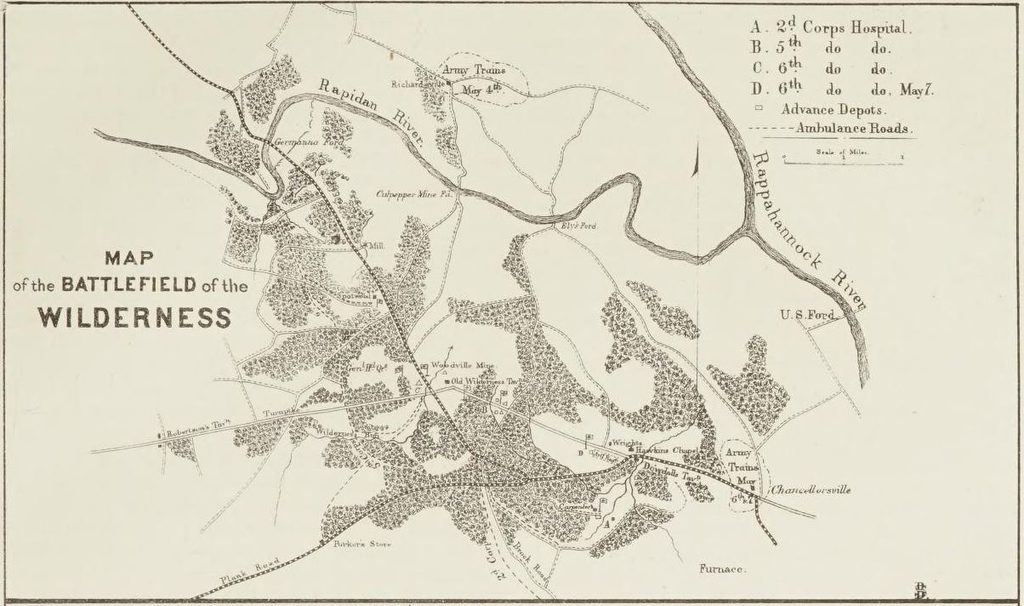
The above map, printed in the Medical and Surgical History of the War of the Rebellion, shows the locations of various Army of the Potomac field hospitals during the Battle of the Wilderness. Two locations appear to be on parts of land that CVBT has preserved. The Army of the Potomac’s Medical Director, Dr. Thomas A. McParlin noted in his report about the Wilderness that: “The stretcher-bearers of the ambulance corps followed the line of battle closely, and displayed great gallantry in their efforts to bring off the wounded lying between the lines, but with very little success, it being almost impossible to find wounded men lying scattered through the dense thickets, and the enemy firing at every moving light or even at the slightest noise.”
(Library of Congress)
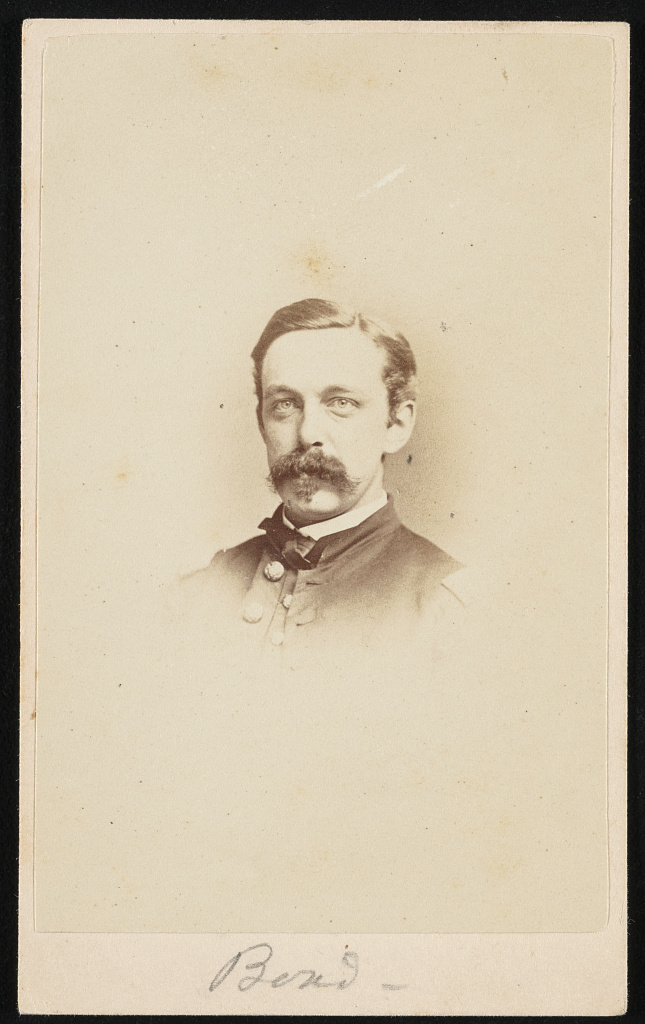
War’s cruel fate played out far too often in central Virginia in May 1864. It seemed as if death stalked soldiers wherever they went. Such was the case with Lt. Henry May Bond of the 20th Massachusetts Infantry. Wounded in the face and breaking his right jawbone during the Battle of the Wilderness, Bond refused to leave his regiment while the fight remained undecided. Eventually receiving medical attention at Fredericksburg, Bond was evaluated and designated for transfer to Washington for further treatment and recovery. Early on May 12, as an ambulance transported Bond and two of his wounded comrades across the Stafford County countryside enroute to Belle Plain, their conveyance was stopped by Confederate guerrillas wanting the horses. After a guerrilla fired a shot, Bond asked for a comrade’s pistol. Before receiving it, Bond was shot in the back, the bullet going through his lung. The guerillas made off with the horses and left Bond and his comrades stranded. Found the following morning by passing soldiers, Bond was sent on to Washington where his father, coming from Boston, met him. According to his service records, Bond died on May 14. He is buried in Mount Auburn Cemetery in Cambridge, Massachusetts.
The Battle of Spotsylvania Court House
(Pamplin Historical Park and the National Museum of the Civil War Soldier)
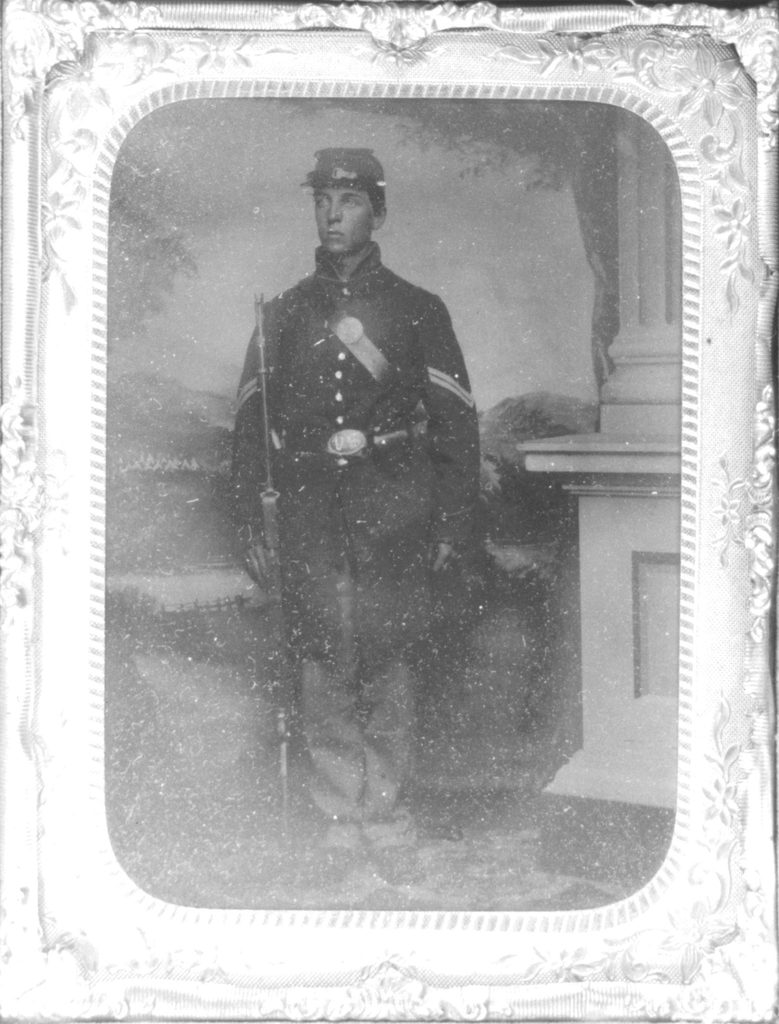
Charles Hunter enlisted in 1861 as a 21-year-old and served with the Army of the Potomac through its many campaigns. While fighting in the 88th Pennsylvania (Fifth Corps), on May 8, 1864, near the Spindle Farm at Spotsylvania, Sgt. Hunter received a painful groin wound. Evacuated from the battlefield, he received treatment at the Mansion House Hospital in Alexandria, Virginia. During his hospital stay, as he had while on campaign, Hunter sent and received letters from family back home and friends at the front keeping him abreast of happenings. Like other soldiers, Sgt. Hunter relied on his communication networks as a support system that helped him maintain a balance through the morale highs and lows of a soldier’s life. The connection with those that truly cared for him, and his wellbeing, helped sustain Hunter and other soldiers through some of their most difficult times.
Pvt. George Bucknam, an artillerist in the 3rd Massachusetts Light Artillery found himself in a hot place on May 8, 1864, during the opening of the Battle of Spotsylvania Court House. With the ground shrouded by the smoke, his officer on horseback saw Confederates attacking. “Boys give them Hell,” the officer shouted. As “the smoke in front of our guns [was] lifting we see the Rebs right on us,” Bucknam remembered. As they limbered up, “two lead horses . . . got a bullet through them and killed them both in their tracks . . . we cut their traces and left the horses where they fell. . . .” Upon moving to the rear and attempting to navigate through a farm gate opening, two of their artillery pieces got locked together. As the enemy closed on them, a lieutenant ordered “to double shot each gun and rip them apart which we did with good effect and went down the road flying,” Bucknam recalled. Later in the day, according to his service records, Pvt Bucknam was wounded. His casualty sheet reads, “One hand shot away, and all but the thumb and one finger of the other caused by the premature discharge of [the] gun while in action.”
As part of Gen. Stephen Ramseur’s brigade, 21-year-old Pvt. John W. Bone and his comrades in the 30th North Carolina received the call to counterattack the Federal assault on the Confederate “Mule Shoe” defenses at Spotsylvania on May 12, 1864. During the move toward the threatened works, Bone remembered, “I was . . . wounded by a ball striking me in the right breast passing through my lungs and coming out beside my backbone, and lodging in some clothes that I had on my back.” Bone cut off his cartridge box and attempted to make his way to the rear. Going a short distance, he had to stop and was hit by another bullet. Again, trying to muster his energy, he got up and was hit yet again. With the battle raging into the night, no one was able to assist Bone to a field hospital. He lay on the wet ground for three days before he was able to move closer to the new Confederate line, helped in, and received medical aid. Amazingly, Bone recovered and returned to service about five months later. He surrendered at Appomattox and lived to be 93 years old, dying in 1936.
Barely two weeks into the Overland Campaign, the wear and tear on the soldiers was clearly evident in their letters. Sgt. Isaac Lefevers, 46th North Carolina, wrote home to his wife Catharine on May 19th from “Spotselvania Coart House,” explaining that “this is 7 Days that the most Desporate Battle has bin going on and Stil no Sine to sease.” Lefevers noted that he missed the first two days while attending to the wounded. However, “Since that time I have bin with the Regt wat few is left.” In the fight of the previous evening, Lefevers “Received a slite wond in my left Shoulder al tho I am Stil with the co” and trusting Providence that would escape unharmed. “I tel you their neaver has bin such a Sloughter in men Since the war commenced we have lost a menny a good man,” he wrote. Apparently on the skirmish line at the time, Sgt. Lefevers closed that he “would like to Rite more but cant at this time we air loocken for the yankes Every minute they air Stil in site I wil Rite a gain in a few Days If I am permited to.” Sgt. Lefevers died at a Richmond Hospital about a month after receiving another wound in a nearby skirmish on June 15, 1864.
(Dayton Metro Library)
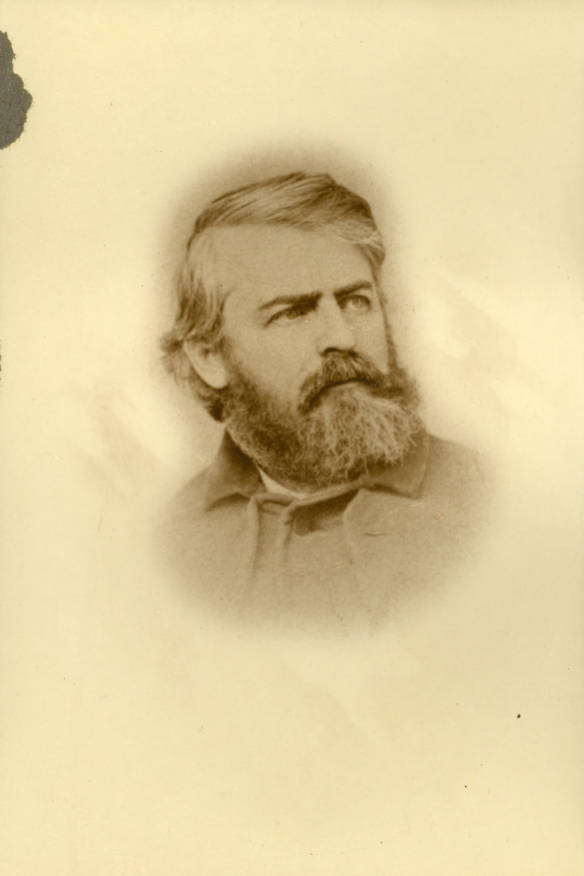
Maj. Luther Bruen of the 12th U.S. Infantry wrote to his wife Augusta from Spotsylvania on the morning of May 13, 1864, telling her, “I have escaped untouched so far, altho eight officers out of seventeen have been killed or wounded and one half of my men are killed, wounded or missing.” Maj. Bruen wrote again a couple of hours later, but this time the news was not so good. Bruen explained, “the rebs began throwing shells at troops moving in our rear and also some in a piece of woods in our front. The fire was very hot and while I was hurrying up the men who were throwing up entrenchments a shell exploded near me and a piece struck me just under the cap of the left knee, making a wound about an inch deep and one and a half or two long.” Bruen tried to not worry Augusta by closing: “Now, Dear, don’t fret about me—I am not much hurt and in good spirits, thinking I have got very cheaply compared with some others.” Sent to Washington D.C.’s Douglas Hospital, Bruen’s leg was later amputated, and he died on June 21, 1864. He was 41 years old.
Corp. Isaac H. Chandler, a 21-year-old soldier who originally served in the 50th Massachusetts, a nine-month regiment, reenlisted in the 59th Massachusetts on February 1, 1864. Within three months, Chandler and the 59th were battling in the brutal Overland Campaign. On May 12, while fighting in the Ninth Corps at Spotsylvania, Chandler received a wound to the left thigh that fractured his femur. Enduring a trip by ambulance and then boat ride to Washington D.C., Chandler received care at Armory Square Hospital in the capital city. Upon his death on June 20, 1864, an inventory of his personal possessions recorded a diary, a pocketbook, and a watch and chain. Following Corp. Chandler’s passing, his mother, Catherine C. Hurd, wrote to the hospital to try to obtain Chandler’s possessions as keepsakes; she noted that they were of “no value to anyone but me and i hope I shall get them he was one of the best of Boys.” She also requested to “thank the nurse for me for his kindness to my Dear son he wrote to me how well he was taken care of . . . you all will accept my sincere thanks for what was done to make him comfortable his loss is very great to me.”
(Find A Grave)
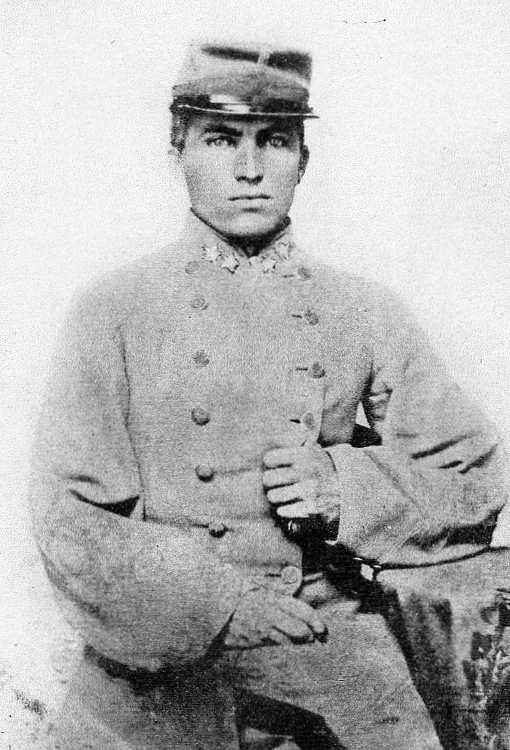
Most Civil War rifle muskets and their prescribed cartridge loads produced a muzzle velocity of about 950 feet per second. However, various factors might influence the power at which the common minie ball arrived at its intended target and resulting in a “spent” bullet. Although not usually deadly, spent bullets could be extremely painful to experience. While fighting at Spotsylvania on May 12, 1864, Lt. Col. William H. Stewart, 61st Virginia Infantry, remembered that “Our regiment, occupying the center of the brigade, struck an open field, and on advancing up the hill behind which we had been deployed for the charge, were met by a volley of musketry. I was struck on the right arm by a minie ball, which felt like a red-hot iron crushing through the bones.” He recalled, “I was thoroughly demoralized, and believing my arm was broken, exclaimed: ‘I am ruined.’ Capt. B. H. Nash . . . ran to me, and when we examined it, found it was only a slight flesh wound, and then we proceeded at a run to catch up with the regiment.”
After making it through battles like Antietam, Fredericksburg, and Gettysburg unscathed, the 104th New York Infantry’s Pvt. Charles Barber’s good fortune finally ran out when he was wounded at Spotsylvania on May 10, 1864. Barber wrote a short letter to his family from his division’s field hospital the following day. Pvt. Barber mentioned that he had received “a slight wound on my hip.” Explaining that he had been in three fights since his last letter—referring to the Wilderness (May 5), and Spotsylvania (May 8 and May 10)—Barber shared his experience in the fight. “I loaded and fired my gun till it was so hot I could . . . hold it only by the stock and strap[.] it was so foul[ed] I could hardly ram a ball down [the barrel],” Barber wrote. Stopping their fire to let their guns cool, clean them, and obtain more cartridges, they were ordered to “charge on the rebel breastworks.” Barber had only gone a few feet when “a cannon ball brushed my left hip and knocked me full ten feet against a pine tree.” Carried off the field by two comrades, he was taken by ambulance to the field hospital. He admitted he fainted twice during the ordeal, likely suffering from shock. Barber was eventually sent to Alexandria’s St. Paul Church, a hospital, where he recovered and then helped care for the wounded. He returned to this regiment at Petersburg in early September and served out his enlistment in October. He died in 1898 at 72 years old.
(Library of Congress)
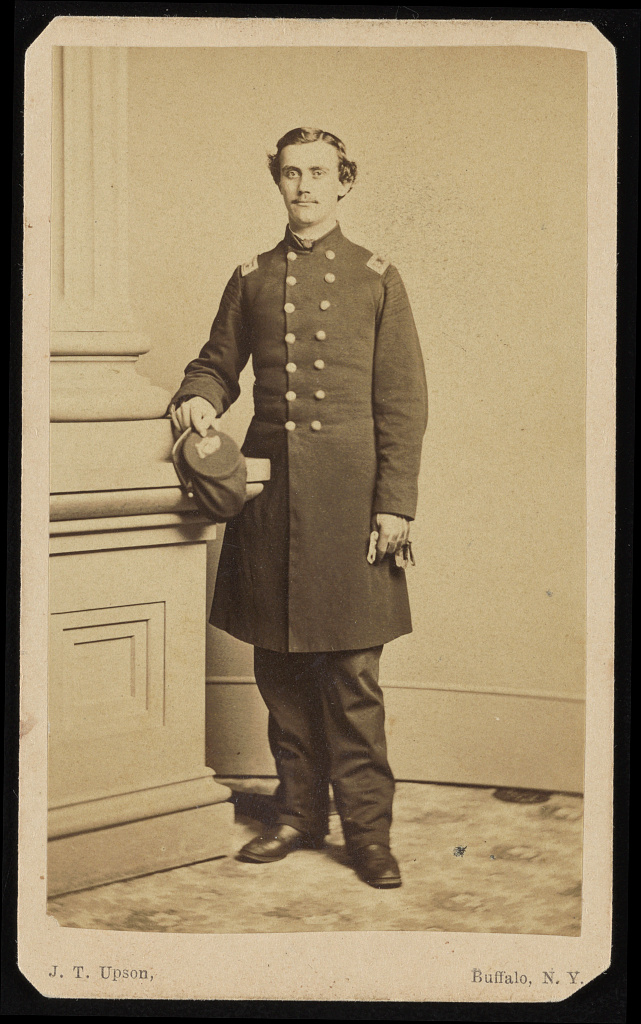
The 49th New York Infantry’s Maj. William Ellis received a grievous wound on May 12, 1864, at Spotsylvania from a ramrod that went through his left arm and severely bruised his left side. After receiving treatment in Fredericksburg and then recuperating at Washington D.C. and home, he amazingly returned to the army in July as a staff officer for Maj. Gen. David Russell, who commanded a Sixth Corps division. In great pain, but not complaining, Ellis went about his duties until on the morning of August 4, 1864, he fell dead at 22 years old. Upon performing an autopsy, it was learned that a sharp piece of rib bone, broken by the ramrod’s impact, worked its way into his lung and killed him. Ellis’s body was sent home to Buffalo, New York for burial.
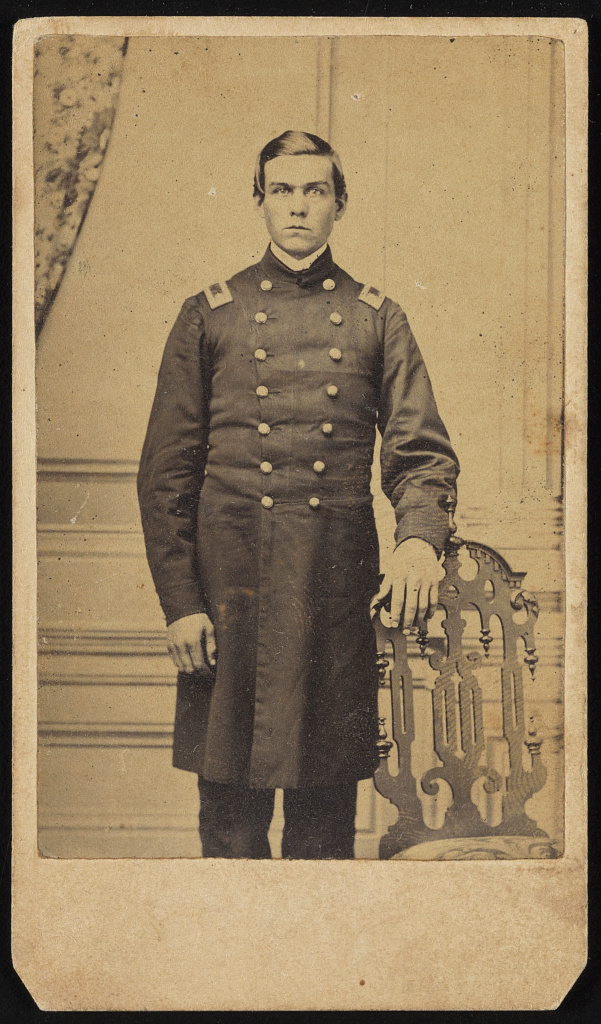
On May 12, 1864, Fifth Corps troops assaulted Confederates positions at Laurel Hill to keep the southerners from helping defend against Second, Sixth, and Ninth Corps attacks occurring at the Mule Shoe salient. One of the regiments in Col. Peter Lyle’s brigade that participated that day at Laurel Hill was the 16th Maine. During the attacks, “Again and again did the brigade charge, and as often came those terrible sheets of flame shot out in our faces, while solid shot and shell enfiladed our lines. The crash which followed the fearful blaze swept away men, even as the coming wind would sweep away the leaves from the laurel overhead,” wrote a participant. Among the mortally wounded was the 16th Maine’s Maj. Arch Leavitt, a bullet passing through his upper chest. Leavitt was removed from the field and eventually transported to Douglas Hospital in Washington where he died on May 30, only a couple of weeks short of his 24th birthday.
Conclusion
On May 8, 1864, Fifth Corps division commander Brig. Gen. John C. Robinson and Col. Andrew Woods Dennison, who led the Maryland Brigade, rode side by side leading the Marylanders into battle during the early assaults across the Spindle Farm at Spotsylvania. In their way were South Carolinians who had arrived on the scene just in time to block the attacking Federals. A soldier who was there later wrote that “At points where the enemy’s fire was most concentrated the drone of bullets blended into a throbbing wail, like that of a sonorous telegraph wire, pulsing in a strong wind, punctuated by the pert zip of the closer shots.”
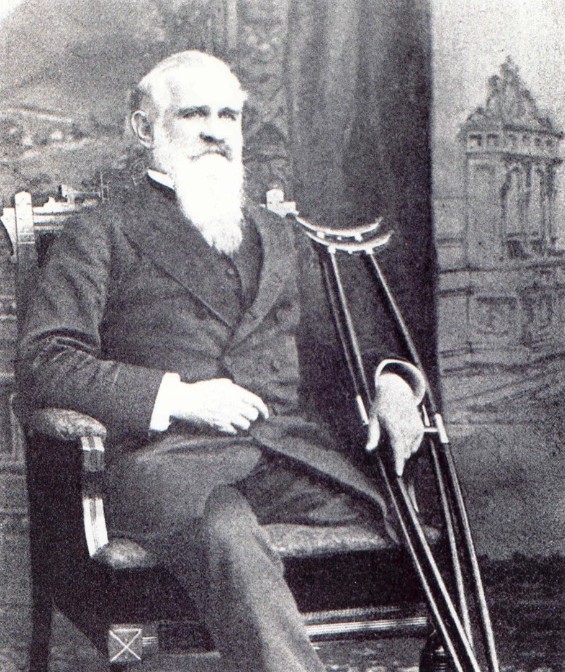
(Congressional Medal of Honor Society)
Being mounted, the two men made inviting targets for the Rebels. Quickly Gen. Robinson received a bullet wound to his left knee. Almost immediately after Robinson’s wounding, a bullet struck Col. Dennison in the right arm shattering the bones. Robinson would have his leg amputated, and Dennison his arm. Robinson’s war service was over, but he received the Medal of Honor in 1894. His citation reads: “Placed himself at the head of the leading brigade in a charge upon the enemy’s breastworks; was severely wounded.” Dennison returned to serve in the Fifth Corps and was wounded again on March 31, 1864, at the Battle of White Oak Road near Petersburg. Dennison died in 1877, and Robinson eventaully followed in 1897.
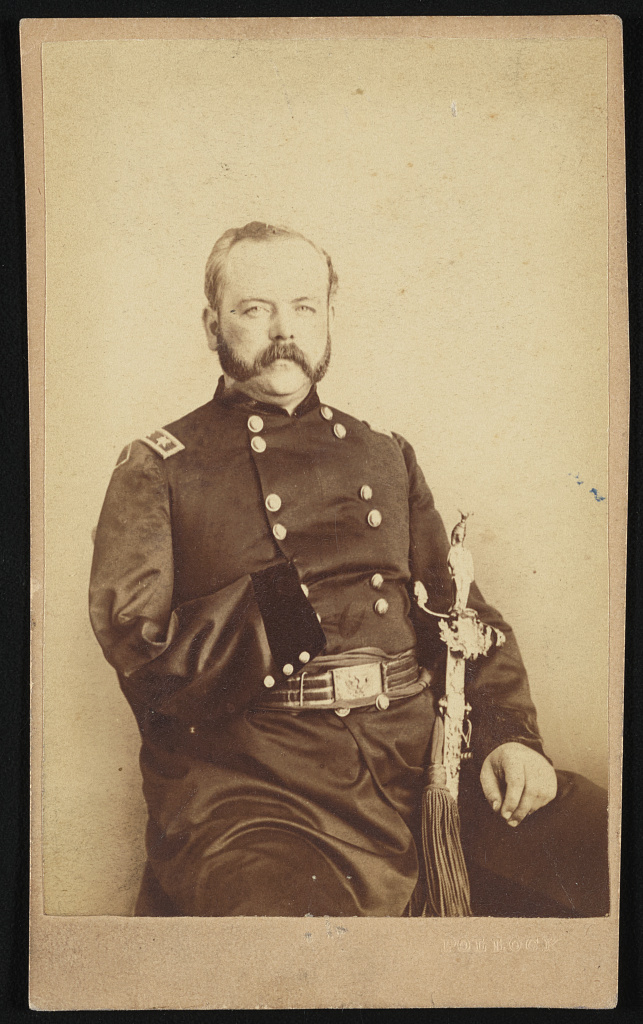
(Library of Congress)
Photographs of men like Robinson and Dennison who were missing limbs due to their service became all to common following the Civil War. These images serve as a vivid reminder that all wars cast a long shadow far beyond the years of actual fighting.
It has been said that when a soldier receives a wound, not only he suffers injury. His comrades, concerned with his wellbeing, are pained, too. His family, worried that he may be suffering from want of care or that may even die without someone there to comfort him, also bear agonies only they can imagine. His friends, his former co-workers, and his community all hurt in their own way as well.
Parting Shot
(Library of Congress)