
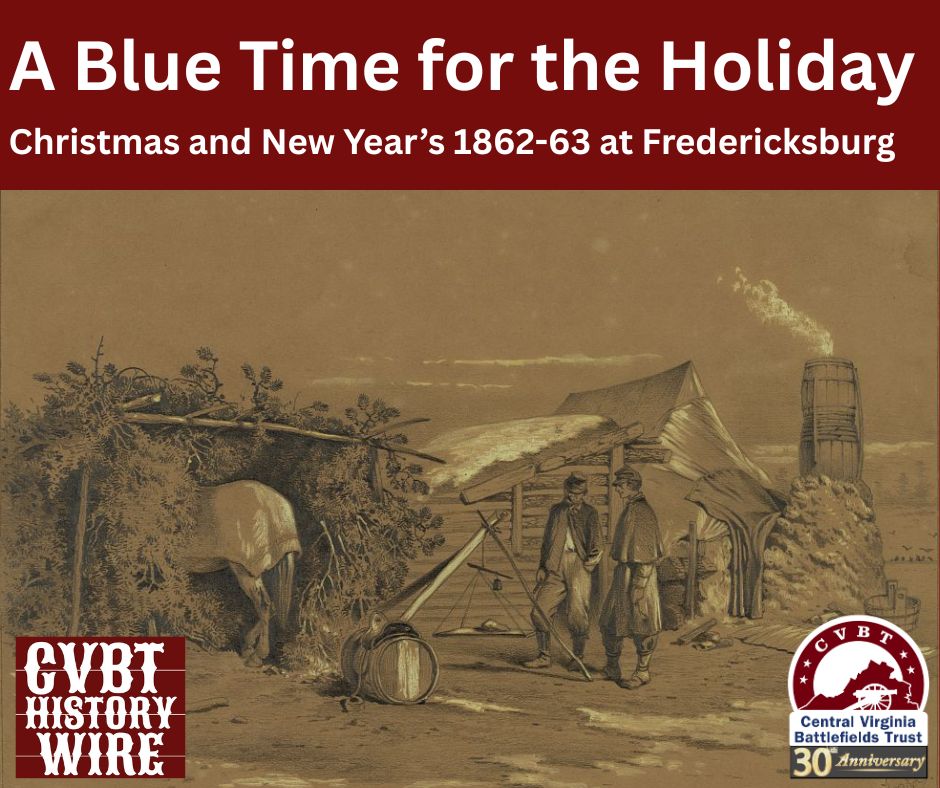
Sketch by Edwin Forbes
As one might expect, food is often mentioned in soldiers’ letters written during the holiday season of 1862-63 at Frederickburg.
(Library of Congress)
Introduction
At the outbreak of the Civil War, many of the various traditions that we today typically associate with Christmas were relatively young in America. However, these seasonal customs had firmly taken hold and were practiced more or less in both divided sections of the nation. The men who went off to war carried their Christmas practices and holiday expectations with them into the contending armies.
The holiday season of 1862-63 at Fredericksburg brought mixed feelings from the tens of thousands of soldiers camped on opposite sides of the Rappahannock River.
For some soldiers, like the 15th New Jersey’s Lt. John D. Trimmer, it was a time used to send sympathy to a fallen comrade’s wife. On Christmas Day, Lt. Trimmer penned a letter of condolence to Sarah Mulvey, wife of Pvt. Michael Mulvey from his Sixth Corps camp at White Oak Church. In it, Trimmer explained that Pvt. Mulvey “was killed in action near Fredericksburgh Va Dec 13 . . . he was shot in the forhead and killed Instantly[.]” Trimmer called Mulvey “a good soldier,” noted that “his loss is mourned by those who knew him,” and added that “the last words he spoke were this[,] (Jerseymen never Retreat[).]” Trimmer politely advised Mrs. Mulvey, “I would point you for consolation to [H]im who has promised to be a Father to the Fatherless and the widows God”. Perhaps expecting that Sarah would want to know more about her husband’s death, the lieutenant kindly included in closing that, “Anything I can do for you or any information that you may desire I will gladly give you[.]”
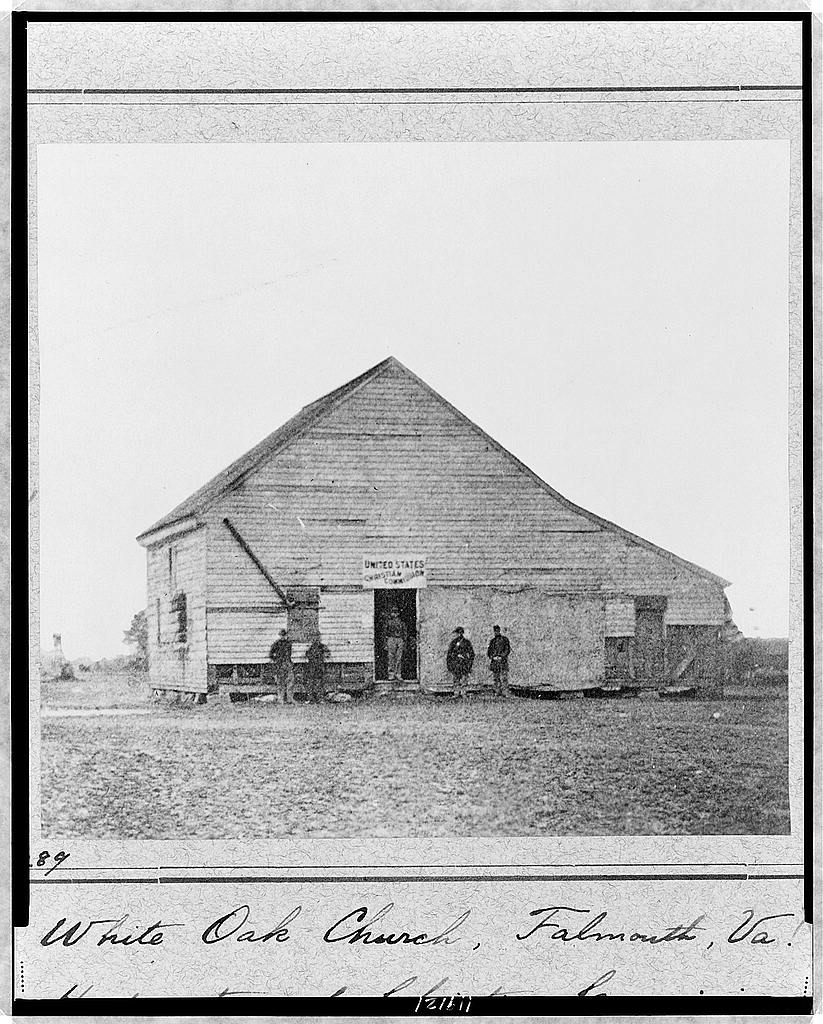
Lt. Trimmer wrote his condolence letter from his winter camp near White Oak Church in Stafford County.
(Library of Congress)
For other soldiers, like the 48th North Carolina’s Pvt. Constantine A. Hege, Christmas 1862 also caused reflection, but in a different way than that of Lt. Trimmer. The nineteen-year-old Pvt. Hege wrote to his parents in Davidson, North Carolina, on Christmas Day explaining he was held out of the Battle of Fredericksburg due to being shoeless. He felt it was providential that his box of clothes and shoes did not arrive in time, otherwise he may not have survived. Turning to the holiday, he wrote: “Christmas has come once more and it is a very beautiful morning here. But Oh! how changed the scene to what it was last Christmas. Here I am in the army today and today twelve months ago I was at home where I could enjoy the blessings of a comfortable house and home of parents and friends and of religious worship, but this Christmas I am surrounded by warriors, cannons, guns, and all kinds of unusual sounds and actions to which I never was accustomed to. But I hope and pray that the good Lord in His tender mercy may soon bring this state of things to an end and restore peace and prosperity to our beloved country again, and turn the hearts of the rulers to peace forever instead of war.”
Due to the large number of enlistments in the spring of 1862 for the Confederates as conscription neared, and in the summer and fall of 1862 for the Federals as President Lincoln called for more men, the war was still relatively fresh for the vast majority of the soldiers on both sides during the 1862-63 holiday season. Most, like Pvt. Hege, still longed for home. Whether they had won or lost a mere two weeks earlier at Fredericksburg, they missed the comforts that home brought. Some went there in their minds, remembering family, friends, the food and frolics, while others attempted the next best thing, writing and requesting letters from home, as well as tangible and sentimental treats to ease the difficult situation they found themselves in from their sense of duty and national need.
This CVBT History Wire post will examine a number of soldiers’ comments about Christmas 1862 and New Year’s Day 1863 while encamped near Fredericksburg. Reading their letters and diaries, where they shared their personal and community thoughts and wishes to friends and family far away, reminds us of the costs of war, the importance they placed on loved ones, and their commitment to their respective causes.
Christmas, December 25, 1862
Many soldiers described their Christmas of 1862 as “dull.” Such was the case for the 8th Georgia Infantry’s Lt. Sanford Branch. Writing to his mother back in Savannah on Christmas Day, Branch wished her a “very merry Christmas.” He explained that as part of George T. Anderson’s brigade that “we are now encamped between the Railroad & River sending a strong picket to the River and a guard to the Railroad Station everyday.” Turning to the holiday season, Lt. Branch wrote, “This is a very dull Christmas to us all. Most of the boys are at the station buying ginger cakes which sell at the remarkable price of 3 for a dollar, and scarce at that. I breakfasted with George Snider who is a clerk for the Surgeon. We had big Homeny which was quite a treat.”
Pvt. William Cowan McClellan of the 9th Alabama concurred with Lt. Branch. Writing from camp to his father three days after Christmas, Pvt. McClellan explained, “This is Christmas and about the dullest one I ever saw.” Apparently, holiday merriment in the army did not compare with that at home. McClellan complained, penning, “Nothing to drink nothing to eat save beef and cow.” However, McClellan noted, the day before, “me and the mess dispatched an old Turkey Gobbler that cost us six dollars,” which at least brought a taste, and perhaps happy memories, of home. Despite the cost, and probably its small portions, he noted, “We intend repeating the experiment to morrow.”
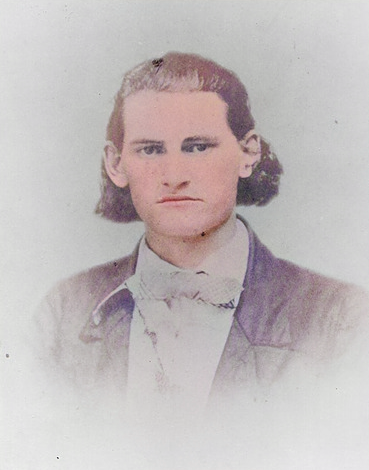
Without the merriments of home, like most soldiers in the their early twenties, Pvt. McClellan found Christmas in camp dull.
(Find a Grave – Brian Atwood)
Dull was also the word of choice for Pvt. Samuel Pickens of the 5th Alabama to describe Christmas Day. Pickens jotted in his diary on December 24, “Christmas Eve & a dull pros[pect] for to-morrow.” His prophecy rang true as the following day he noted, “Dull Christmas[,] less like one than any [I] ever saw.” Not all soldiers spent the whole day leisurely in camp, some had duties to perform. Such was the case for Pickens, as he also wrote sarcastically, “Ed., Pasteur & I are to spend it in the delightful way of standing guard.” When their duty was done, it appears they in fact have a little fun. Pickens explained that “A fiddle which has been introdu.[ced] into camp & which some one is jerking at is [the] only thing that reminds me of what Chr.[istmas] formerly was.” Later that evening some treats arrived that brought a little more festive joy to an otherwise uneventful day, although his Christmas disappointments did continue. “This eve. Ellison came & brot a little Christm[as]. Never saw such a crowd collected around him. Our mess got 12 Doz.—Cakes (sugar) & some ginger bread, $2 candy, $5 sugar, bundle Confed[erate] coffee, $2 pepper (lb. Butter. He was to bring us the materials for an Egg nog—but he sorely disappointed us in that—[this is] about the first Ch[ristmas] ever spent without egg nog,” Pickens scribbled.
A soldier’s level of literacy did not hinder his desire to communicate with loved ones on the home front, especially at Christmastime. Thousands of semi-literate Federal and Confederate fighting men put pen or pencil to paper and scratched out their thoughts and feelings as a way to connect while away from home during the holiday season. Pvt. William H. Brotherton of the 23rd North Carolina Infantry, wrote to his Catawba County family the day after Christmas, 1862, from his camp near Fredericksburg. After opening by expressing that he was doing well, hoping they were the same, and having “nothing mutch to write to you,” he explained how he spent Christmas. “We had anice chrismus I started on picket chrismus day and come in yestoday eaving,” Brotherton wrote. “We was [picketing] on the Raphannoc River I cood see the yankee pickets on the other side . . . I tell you I am living and learning ever day.”
Lt. Charles Kelly of the 44th New York Infantry did not describe Christmas as dull; he instead called it “blue” several times in his December 25 diary entry. Blue connotes a somewhat different mood, one of melancholy rather than boredom. Kelly wrote in his diary, “Christmas in old Va and a Blue day it is for me and the Boys feel Bad and blue for Christmas[.] the capt and Lieut are quite sick and have Been sick for sometime[.] the capt is trying to keep up all that he can[.] it is a blue time for the Holiday.”
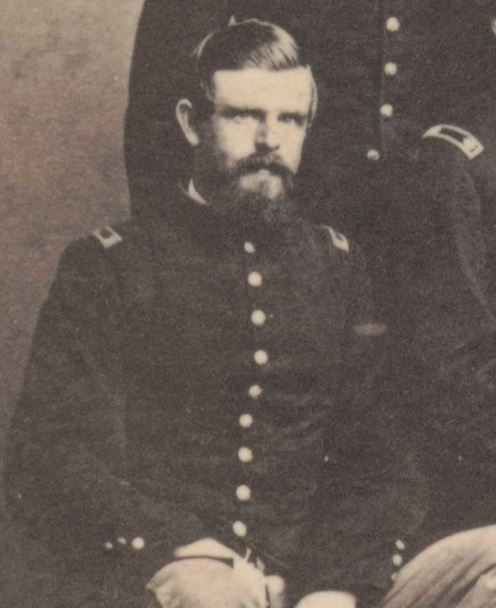
Kelly referred to his 1862 Christmas as “a blue time for the Holiday.”
(Library of Congress)
Another soldier who was a bit in the dumps was twenty-year-old Lt. Theodore Dodge of the 119th New York Infantry. Dodge wrote in his journal the day before Christmas: “Christmas Eve has come again, and here we are in camp still. No sign of festivity seen anywhere, and it might be any other day of the year for ought you could see in any change in camp routine. We have not been able to get even the extra issue of flour and dried apples expected for the men; and the whiskey promised us is not yet forthcoming. I heartily wish we could get a little something to celebrate on, but there seems to be no chance of it.” However, before the day was over, some of Dodge’s comrades drummed up some Christmas spirit. “Some of the men this evening have manufactured Xmas trees. One of them is illuminated with 3 bits of tallow candle, and is hung all over with hard biscuit. Another is decorated with bits of salt pork. The Brigade drums are going about serenading this evening (there are some 30 in all), and such a din you never heard. The men of our Company are singing a German Te Deum just outside my tent, which is pleasant to hear,” the lieutenant wrote.
On Christmas Day itself, Lt. Dodge was still not in the celebration mood. “I have really no spirit to write on Xmas day, so little like Xmas is it to me,” he noted. Dodge rode with another officer in the morning to try to find something to eat and came across a farm owned by an old lady who had a large flock of poultry. She “refused to part with any for our Xmas dinner, for love or money . . . so “we had to feast our imagination on the fowls,” Dodge explained. “However the cooks of the mess managed better than we expected. They gave us a piece of salt beef and potatoes, besides a cracker pudding and rice ditto, and a dessert of apples. All of this was enriched by a bottle of champagne, which the Colonel had nourished up in his truck to be drunk after our first fight; but as that don’t seem to be forthcoming, we made merry over it. So you see we ate heartily and did not starve after all.”
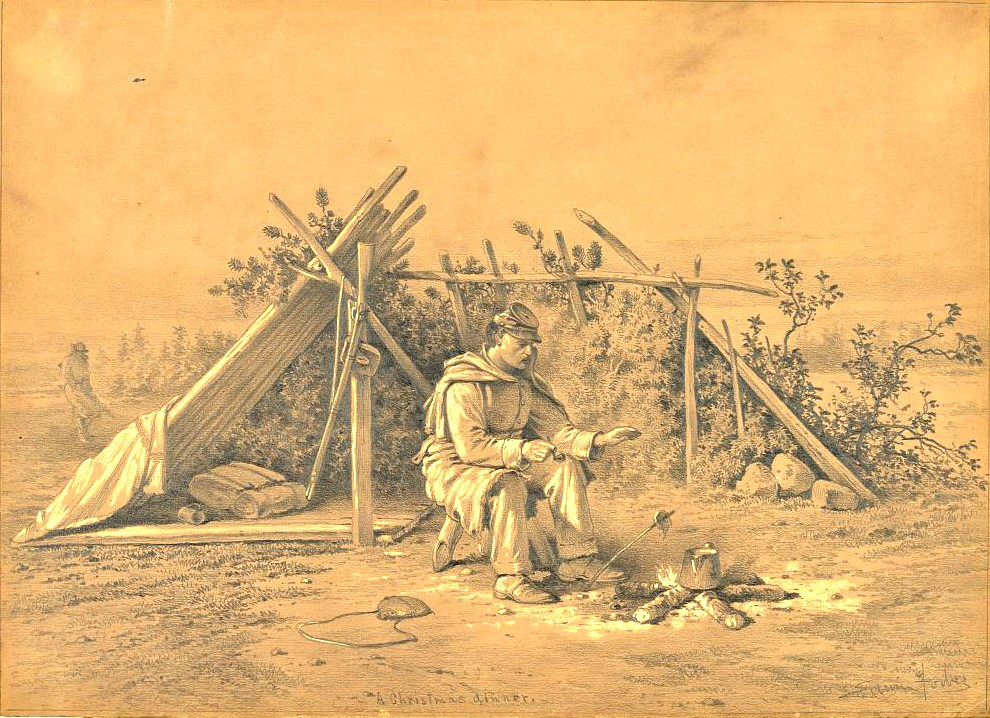
Food was on the mind of most men almost all the time during the Civil War, but even more so at Christmastime. In a December 26 letter to his father, Pvt. Josiah Kirkbride asked him, “What do you think I had for my Christmas dinner? Why I had some fried beef and 6 hard tack fried in the gravy. That was what my Christmas consisted of. Oh how I thought of the many happy Christmases I had spent at home. I longed to be there but I could not so I had to be contented.”
Sketch by Edwin Forbes
Most soldiers camped around Fredericksburg had their usual fare for Christmas dinner.
(Library of Congress)
Writing the same day as Pvt. Kirkbride, Pvt. Edward King Wightman of the 9th New York Infantry told his brother about some of the Christmas consumables he and his comrades dined on in his camp near Falmouth. “We enjoyed Christmas hugely here. There were multitudes of sutlers around with everything that nobody wanted to buy. Some, though, had eatibles, as for instance, butter at 75-$1 per lb; cheese 50 or 75 per lb; sausages, 50 per lb; apples, 6 for a quarter, etc. On Wednesday [Christmas Eve] I got a pass and went to Falmouth but could get nothing for a Christmas dinner but a haversack full of meal at 5 [cents] per lb. and 3 small papers of black pepper for 40 [cents], which made our pork very palatable. Our dinner consisted of fresh meat boiled and spiced with pepper sauce, crackers buttered and crowned with toasted cheese sprinkled with black pepper, boiled pork cut up in pepper sauce, 2 onions in vinegar, and a pan full of warm mush. The whole was washed down with ½ bottle of what was called port wine, the ½ bottle costing $1. In the evening, some of the boys having received boxes, one of them made a mess pan full of punch and was pressed by invitation to ‘smell the mug’ and look on at the proceedings. The usual stories were told, songs sung, etc.”
The 93rd New York’s Lt. Robert S. Robertson, wrote in his diary on Christmas Day that he “Had a Turkey for our Christmas dinner and entertained some guests from the 2d N.Y. It is not like Christmas of former days, still, we had a pleasant time.”
After wishing his sister-in-law Philena a Merry Christmas, Pvt. Joel Molynuex of the 141st Pennsylvania Infantry, asked, “What do you think I had for dinner?” Molyneux then went on to explain that he did not have “Roast turkey, chicken, mutton, potatoes, green cellery, all kinds of wines, etc.” but that “Gen. [David] Birney and staff ate ‘em,” and Molyneux “had hard work to keep from making a charge upon the whole pile of officers and all, but at last made a masterly retreat and dined on coffee and hard tac. Why, Fide, I’m getting fat as a little fox down here on such high living,” he wrote sarcastically.
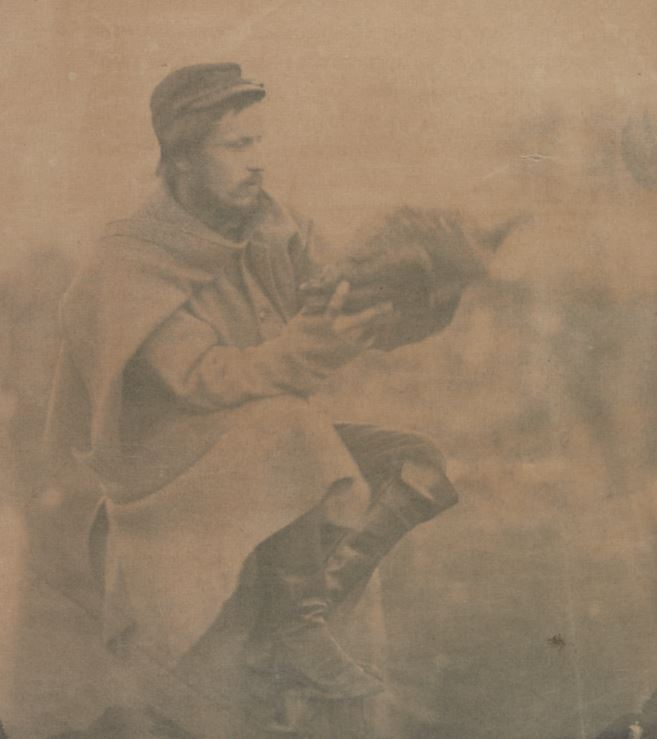
Capt. Charles B. Haydon of the 2nd Michigan Infantry also had a rather normal soldier’s Christmas dinner. He explained, “We made Christmas dinner on beef, hard tack & coffee. I had fortunately completed my meal when Moore made a discovery which checked him midway in his, viz that the hard tacks were full of bugs & worms. This is no uncommon thing of late but his wry face was the most laughable thing of the day.” Soldiers manufactured humor where they could find it.
(Library of Congress)
With his tongue firmly in his cheek, Capt. Louis R. Fortescue, Army of the Potomac Signal Corps, wrote in his journal: “What a man wants to do about this Christmas time of year in camp is to solemnly rise in the morning, peep out between the flaps of his tent, and commune with nature. That is, the kind of nature Virginia furnishes. Dancing torrents all around the outside of your frail habitation, with moist rheumatic vapors floating around inside, to be supplemented a few hours later by the feathery snow-flakes that send chill after chill chasing merrily down your spinal column, until you have reached that degree of coldness supposed to exist only in the latitudes adjacent to the Polar regions.”
Some soldiers spent Christmas Eve and Christmas Day trying to make their camps more comfortable by constructing winter quarters of various types. Such was the scene for Capt. Charles Haydon of the 2nd Michigan. After describing in his diary his Winter quarters, which consisted of an “A” tent stretched on a log stockade with a chimney that “draws stoutly, blazed cheerfully & fills the whole tent with a genial warmth,” Haydon got sentimental for home. “There are no ornaments only swords & pistols but they gleam brightly in the firelight & have as the times go an eager & useful look. There is no conversation of friends or cheerful voices, no sounds save of bugles or drums or the soldiers [outside] wrangling rudely over their cards,” he confided. Pvt. George Perkins, Sixth New York Independent Battery, wrote in his diary: “Christmas. Quite warm. Helped [Pvt. Matthew] Kiely build his log house. On guard, 3d relief. Commenced to cut logs for a house of my own.” The 30th Virginia’s Robert Knox Taylor wrote to his mother and sister that although he wanted to be in church on Christmas, as he had not been since August, he explained that “Our men are busy all around me throwing up brush huts covering them with dirt, making themselves comfortable as possible.”
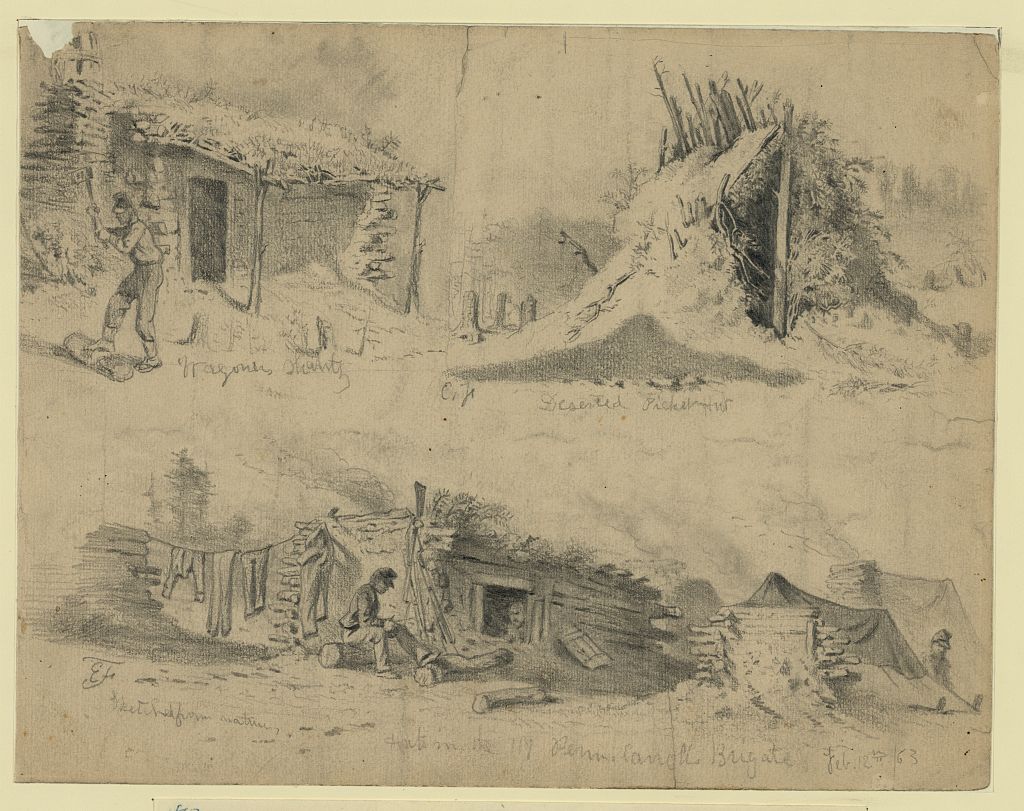
Some soldiers spent their 1862 Christmas constructing winter quarters of various designs.
(Libary of Congress)
More than one soldier mentioned alcohol or drinking to help find some holiday merriment. The 16th Mississippi’s Sgt. James Johnson Kirkpatrick noted in his diary on Christmas Eve: “Pleasant. Nearly everyone searching for liquor. Prices range from fifty to one hundred dollars per gallon; quality from bad to worse. Went out in the country to add to my mess commissaries. Purchased meal at four dollars per bushel and flour at twenty-five cents per pound.” Apparently, some of Pvt. Kirkpatrick’s comrades found libations, as the following day he wrote, “Some of the boys drunk this morning.” But he could not help but make comment about the difference between Christmas at home and in the army: “Quite a contrast from the merry Christmases once enjoyed. May gentle peace soon smile over our land again, Bought some apples, the only luxury I enjoyed.” Edmund Dewitt Patterson of the 9th Alabama Infantry scribbled in his journal that he had hoped to get home for Christmas to visit with friends, but he “could not get even a three day leave of absence.” Since he was unable to make it, he figured “I won’t have any turkey or chicken, or pie or ‘sich,’ but still I will have a leetle drop of the crathur [slang for whiskey] and have an egg-nog.” The 6th North Carolina Infantry’s Pvt. Barlett Yancey Malone was not as fortunate; he wrote in his diary that “Christmas morning was foggy but soon cleard off and was a pritty day but I didnt have nothing to drink nor no young ladies to talk too so I seen but little fun.”
Receiving Christmas gifts was a rare thing in the army, but at least one soldier had a fortuitous day when a box from home arrived with comforts for body and soul. “Christmas day I had the pleasure of receiving a full suit of clothes from home, besides other things quite as acceptable. I can now bid defiance to the winds and rain,” wrote Pvt. Alva Benjamin Spencer, 3rd Georgia Infantry, in a letter to his sweetheart.

(Library of Congress)
Soldiers could be quite eloquent in their writing about Christmas. For example, Pvt. Taliaferro “Tally” N. Simpson of the 3rd South Carolina Infantry wrote a letter to his sister that included these heartfelt lines: “This is Christmas Day. The sun shines feebly through a thin cloud, the air is mild and pleasant, a gentle breeze is making music through the leaves of the lofty pines that stand near our bivouac. All is quiet and still, and that very stillness recalls some sad and painful thoughts. This day, one year ago, how many thousand families, gay and joyous, celebrating Merry Christmas, drinking health to the absent members of their family, and sending upon the wings of love and affection long, deep, and sincere wishes for their safe return to the loving ones at home, but today are clad in the deepest mourning in memory to some lost and loved one in their circle.”
Similarly, Capt. Haydon, a Michigan officer mentioned above, wished in his diary, “May Santa Claus to night fill the stockings of all the little ones as he used to mine in the days of old & may ‘Merry Christmas’ be no idle words but full of truth & meaning and good health & good cheer make glad the household.”

Capt. Brown died on Christmas Eve 1862 from the effects of the wound he received during the Battle of Fredericksburg. His remains were buried in Erie Cemetery.
(Terry Rensel)
Of course, during a time of war, and especially following a large battle like Fredericksburg, Christmas could be a time of great sorrow. Many of the soldiers injured in the fighting at Fredericksburg lingered in hospitals and homes trying to recover but ultimately succumbing to their wounds. Capt. Washington Brown of the 145th Pennsylvania Infantry was unfortunately among that number. Just before going into battle at Fredericksburg, Brown scribbled a quick note to his wife. He had penned a letter to her two days before expecting to see action then but thought he should write again just in case the worst happened. After explaining that “This is the only paper I have with me,” he wrote, “I will do my best to serve my country” and said goodbye to her, his daughter, and his mother. “God bless you and if we meet no more in this world we will meet in heaven,” Brown hopefully noted. During the fighting, Capt. Brown received a wound in his upper right arm. A comrade eventually applied a tourniquet and Brown continued to lead his company until he fell faint from the loss of blood. Infection caused doctors to remove Brown’s arm on December 18 at Falmouth and he died on Christmas Eve. Brown’s father, who was with him at the time of his death, made arrangements to take the captain’s body back to Erie, Pennsylvania, where he was buried. For the Brown family, and numerous others, Christmas was indeed a blue time for the holiday.
New Year’s Day, January 1, 1863
Like Christmas, New Year’s Day served as both a time of reflection and looking forward for Union and Confederate soldiers camped near Fredericksburg. But the soldiers worded their reflections differently than that of Christmas. When soldiers thought back about Christmas, they seemed to think of it as they knew that specific day at home in previous years. When it came to the New Year, they more often reviewed the past year as a whole. For most, despite hardships and setbacks, a hope for future success, the end of the war, and for peace pervaded their writings.
New Yorker Lt. Robert Robertson gloomily jotted in his diary on New Year’s Eve: “A year is ending. A year of eventful history! A year of battles, of marches, of victories and defeats! A year of hardships and ease! Of pleasure & pains—of plenty, & of hunger & privations—of warm friends made and companions lost—of idleness in camp and long weary marches! And what is the result of these weary marches & bloody battles? We have accomplished nothing of the object for which was set out. We have traversed a country, leaving desolation & graves to mark our track, but we have gained absolutely nothing!” However, Lt. Robertson added, “Thus we close, and bid farewell to 1862, and look forward to a year of success and glorious victories, at least we hope it will prove so.”
Capt. Haydon carried similar thoughts into his journal: “This being the first of the New Year one naturally feels very much inclined to review the past & dream of the future. The last 12 months have been eventful ones with me & I may say with gratitude very fortunate ones. Many friends, comrades & acquaintances have fallen while I have remained uninjured, he explained.” He added, “As for myself, I shall be content if another New Year shall find me as well off as now. Thanking God for the past I commence the new year with fixed determination & unwavering hope.”
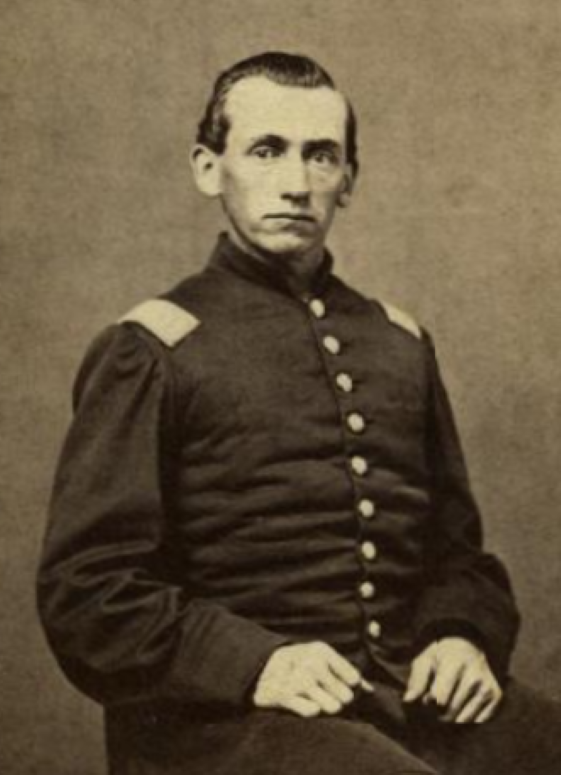
Like so many other soldiers on both sides, Haydon was thankful for his safety during the past year and hoped it continued in the coming year.
(Find A Grave)
Hopes for an end to the war in 1863 proved premature, but many Confederate soldiers expressed thoughts like Pvt. Samuel Pickens, who wrote in his diary on New Year’s Day that “This is the opening of a new year—may it prove a prosperous and happy one! It is the third year of the war and I trust may be the last one.” William Cowan McClellan concurred in a letter to his sister that day. He penned, “The sun has set for the last time in the Bloodiest year the world ever saw. 1862 will only be remembered and associated with sighs and regret by the American people. Many a fond parent will turn aside from the perusal of the History of this horrid year of war and Bloodshead with the sad remembrances of the loss of a beloved son, Husband, or Friend. Oh that we could blot out for ever the Bloody deeds of the last 20 months. This morning the sun arose in all the beauties of nature herralding fourth the first day of 1863. God grant that it may be a year of peace-making and the first year of our independence as a nation.”
In a letter to his wife, the 53rd Georgia’s Pvt. William Stillwell was also thankful to survive 1862. Stillwell wrote of his providential good fortune, encouraging her to “Oh, magnify the Lord with me for his mercy endureth forever. Let the hills and mountains and all the inhabitants praise the Lord for he is good and his mercy endureth forever. Oh, let us praise the Lord for he has brought us safe through another year. Yes, he has brought us through dangers seen and unseen.”
Col. Robert McAllister of the 11th New Jersey, too, expressed divine gratitude. He wrote his family: “I wish you all a happy new year and may God spare you to see more. How good He has been to us all to spare our lifes thus long amidst so many dangers in this dark hour of our county’s history—to see the light of this beautiful new year’s day.”
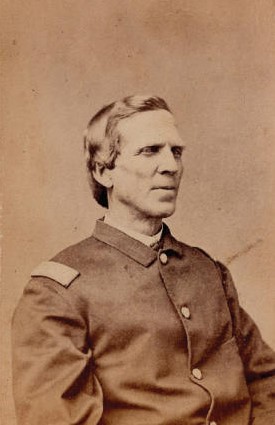
Col. McAllister expressed thanks for his safety on New Year’s Day 1863.
(Find A Grave)
However, some soldiers, like Samuel Burney of Cobb’s Georgia Legion, had more earthly pleasures on his mind as 1863 began. He explained in a letter to his wife that “Last night the Col. said that his wife had sent Jack a little peach brandy & honey, & said we must all take a dram with him—which was his first in 20 odd years. To this we readily asserted and there the veteran’s of Lee’s Army—a few of us with our beloved friend, drank to each other’s health, all hoping that peace might soon be restored.”
Celebrations were the order of New Year’s Eve in many camps, including that of Lt. Theodore Dodge, who noted, “I did not sit up to drink the New Year in last night, but I nevertheless saw ’62 change into ’63. We all went to bed early, but were awakened at 12 o’clock by three vehement cheers in front of the Col.’s tent—the most appropriate place, as the men thought.” Nearby an officer kept “his Company up and cheered the New Year as it came in.” Meanwhile, about the same time “there began the most outrageous discharge of firearms.” Dodge suspected that “many men, as I suppose, had let their allowance of grog get the better of them, and were venting their superfluous spirits in utter disregard for all military rule. It actually went so far as that whole volleys were fired by the exited Dutch soldiery before it was stopped.” Dodge also noted that “A provost guard was patrolling around the camp in order to arrest the delinquents, but I believe they did not succeed.” The lieutenant “caught one man, whom I bound to a tree with his accoutrements, which effectually quenched his mirth. Gradually the excitement subsided, and quiet was restored.”
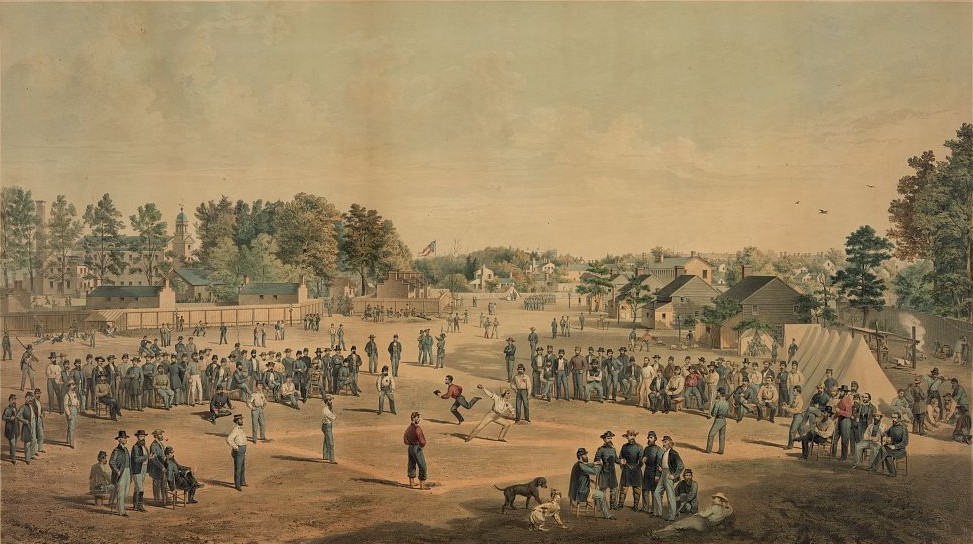
(Library of Congress)
Most soldiers did not enjoy a festive repast as they might have at home. New York artillerist Pvt. George Perkins wrote in his diary that New Year’s Day was “Cold and clear. A very restless day with me. A very poor dinner, viz. desiccated vegetables boiled with salt horse [pork]. Wished for roast pork and apple sauce with boiled apple pudding.” Lt. Charles Kelly’s diary notes his disappointing New Year’s Day 1863 meal as well. After serving on picket duty, Kelly and his comrades headed to camp. He wrote, “the weather is cold and clear it is a very Dull New Year for the Boys they are taken their Breakfast of hardtack and coffie and some of them has not even that for their Breakfast[.] the Meal Being over the order was given to start for camp and away we went at quicktime we traveled to our camp without stoping But once on our way I was never so tired in my Life in fact I was completely worn out.” Another officer that fared poorly was Lt. Col. Richard S. Thompson of the 12th New Jersey Infanry. In a January 4, 1863, letter to his brother-in-law, he wrote, “New Year’s day I dined on an inch of pork fat, two army crackers, some molasses, and a cup of tea. I trust you at least thought of me while eating your fine things at home.”
For Alabamian John Henry Cowan, New Year’s Day only meant a winter’s day of army routine. “The new year came in clear and calm and very cold. The sun came forth in all his brilliancy yet it remained cold all day,” Cowan’s diary reads. Squad drill, battalion drill, and a dress parade filled most of his New Year’s Day. Over on the other side of the Rappahannock River, some Federals got to have a little sport. Porter Farley, 140th New York Infantry remembered that “New Years day, 1863, was celebrated in our regiment by the omission of all drills. Men and officers were allowed to spend the time as they pleased. Ball-playing was introduced as an amusement. The weather was beautiful, the temperature mild and the day, with its relaxation from routine duty, did something toward reviving our drooping spirits.”
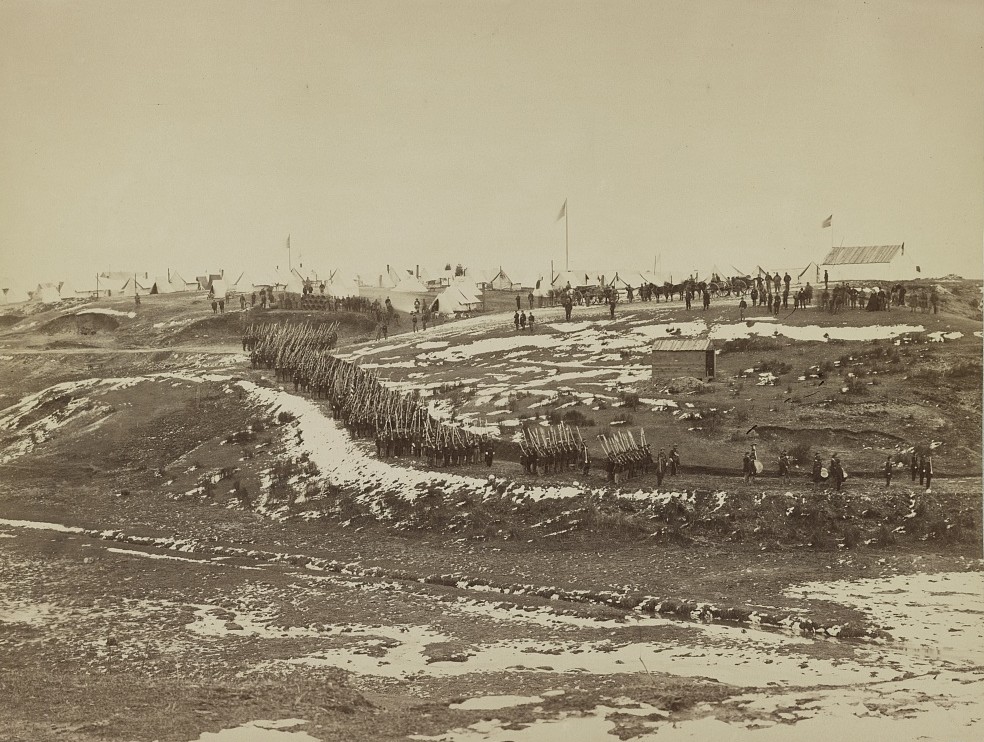
Drill exercises were common in Union and Confederate winter camps, even on holidays like Christmas and New Year’s Day
This photograph shows a regiment drilling near Washington, D.C.
(Library of Congress)
Conclusion
None of the soldiers camped near Fredericksburg during the winter of 1862-63 knew that the war would continue on for more than two years. As the accounts above show, they usually delt with the intrusions that the war brought the best that they could. They tried to find some sense of home, family, and tradition in the warm memories of their past celebrations by adjusting how they practiced their Christmas and New Year’s customs under the armies’ many impositions. They looked longingly to the end of the war and going home in order to become reacquainted with the lives they had put on hold to serve their countries.
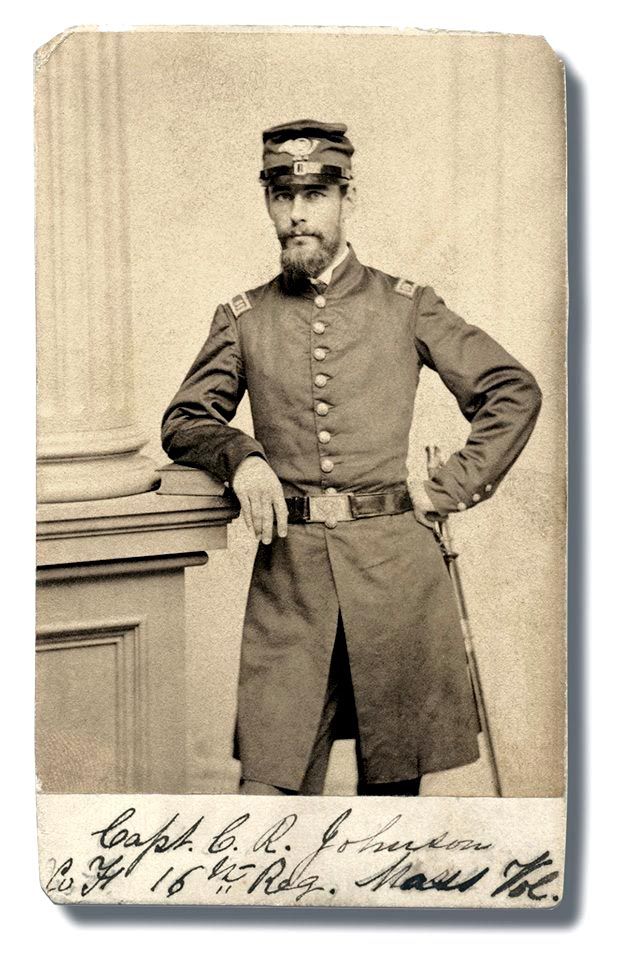
(Find A Grave)
Capt. Charles Robinson Johnson to Nellie from “Camp near Falmouth, Va.” at New Year 1863:
“Gen. Sickles kept an open house[,] the officers of our regiment went in a body to pay their compliment to him. The entrance to his tent was through a wide clean street on either side of which were the tents of his aids, at the entrance were two small flags with an evergreen archway, which archway was covered with wreaths and emblems; and street and officers tents were tastefully adorned and presented a lovely and pleasing coup d’oeil. After drinking to the general’s health and passing a few compliments we passed to a house adjoining where was spread what appeared to my salt pork and hard-tack eyes a miraculus and enchanting sight; on both ends of the table were two finely roasted turkeys, in the middle was a large bowl of punch, the remainder of the table was filled with cranberry sauce & fries and on a side table was a large pail of fine eggnog being topped with foam and nutmeg giving it a very tempting mouth-watering appearance. After taking [a] little taste we left to make room for others. Standing outside we had a good opportunity to see the leading Generals of the army, occasionally 4 or 5 together. Gen. Hooker was there, with his usual smiling face and shaking hands with everyone. I suspect a slight limp in his gait. The entertainment lasted until late at night but few officers showing their bad breeding by either drunkenness or noise. New Years afternoon we has a good game of base ball.”

NEWSLETTER SIGN-UP
Join our community! Sign up for our newsletter to receive exclusive updates, event information, and preservation news directly to your inbox.