(Library of Congress)
Introduction
As we saw in Part I, central Virginia’s battlefields were certainly not error-free zones. Some of the examples that were provided in that article showed that mistakes could occur at alarming speed, with virtually no notice, and could generate additional missteps. Such was the uncertain and fluid nature of Civil War battlefields.
Most commanders understood that dealing with mistakes came with the responsibilities of their position. Yet, knowing so did not always help to avoid them. Those officers who were able to keep cool heads and think clearly despite the mounting pressures caused by missteps, who could quickly process the dizzying array of distractions that seemed to continuously pop up, and then mitigate the level of damage caused by gaffes (self-induced or otherwise), were more often than not those who succeeded on the battlefield and advanced in rank. However, some of those at even the highest levels in the Union and Confederate armies erred, too.
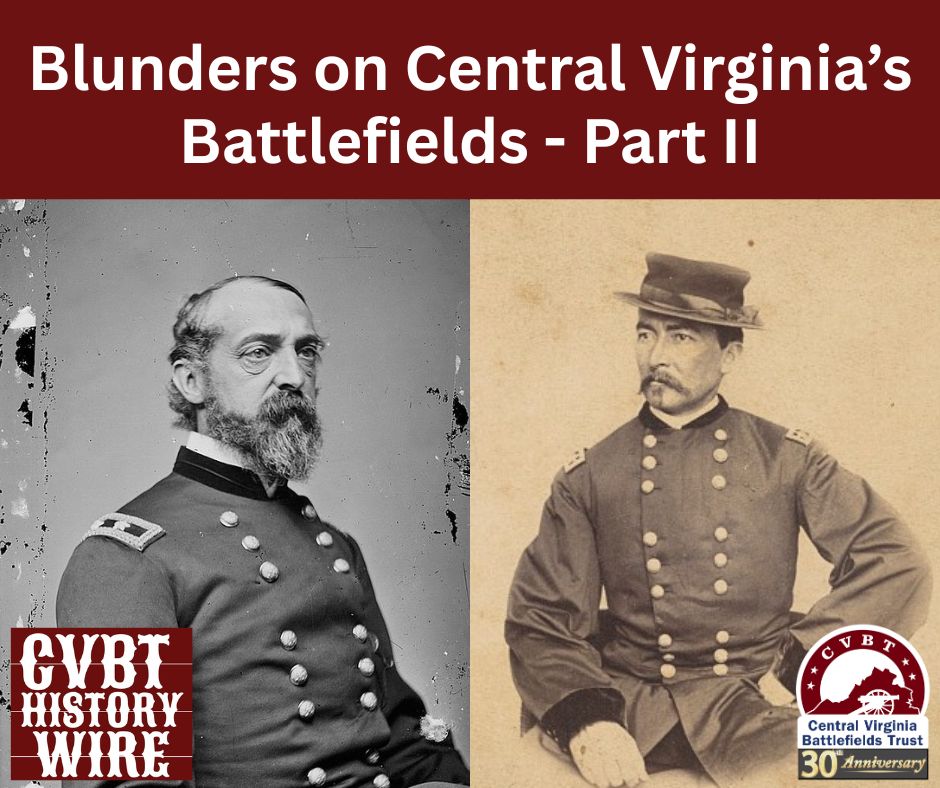
For this month’s CVBT History Wire, we will continue to our look at blunders on central Virginia’s battlefields by examining an example each from the Battle of the Wilderness and the Battle of Spotsylvania Court House.
Battle of the Wilderness
As the armies prepared for what would become the Overland Campaign, many soldiers on both sides wrote about their expectations in their letters and diaries. Some men, like the 126th New York’s Pvt. Eugene Holton, were hopeful that the spring 1864 campaign would be the beginning of the end of the war. He wrote: “Our time is drawing to a close. We have been to the top run[g] of the lad[d]er & are now going down the other side. Every day draws us one step near[er] the end. . . . I suppose you folks at home think that the Rebs are nearly whip[p]ed, but I tell you what, they can fight yet & so can we & will until they lay down their arms & I hope that will be soon.” Pvt. John Linneken, a nineteen-year-old soldier in the 20th Maine Infantry, had similar thoughts. Writing to his sister Hattie, he explained: “We have not moved yet, but I think there will be a move soon, and the soldiers all think that Gen. U. S. Grant will do something when he makes a strike. The men seem to be in good spirits, and all think this war will close next fall, and I hope it will,” he penned. Lt. Col. Walter Taylor, who served on Gen. Robert E. Lee’s staff, wrote to his sweetheart that, “I am very hopeful, feeling confident that with God’s help, we will defeat their last great effort & make this the last year of serious fighting.”
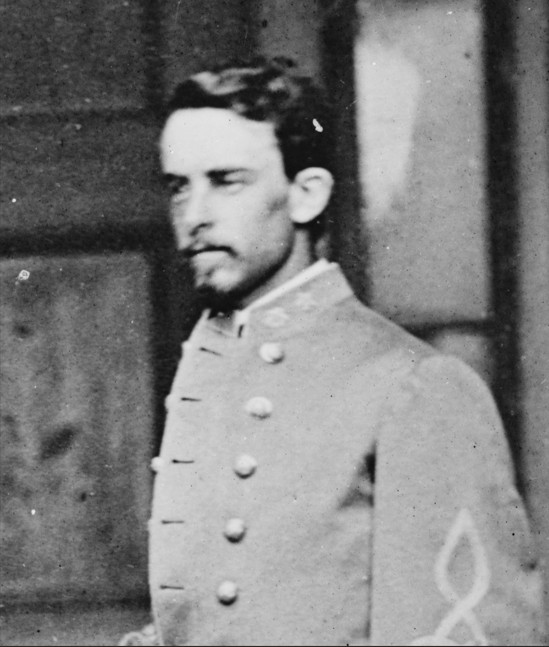
In the spring of 1864, Taylor expressed hope that it would be “the last year of serious fighting.”
(Library of Congress)
Due partly to the fact that 1864 was a presidential election year, there was a common sentiment that much was at stake. Many soldiers on both sides in central Virginia believed that hard fighting was coming, but most probably did not anticipate the level of sustained combat that they would face. Unforeseen obstacles and difficult decisions placed officers of all ranks in uncomfortable and sometimes unfamiliar positions. Unfortunately, the missteps that they made learning new roles often radiated downward to and most affected those of the lowest ranks.
The first day of fighting at the Battle of the Wilderness witnessed brutal engagements at Saunders Field along the Orange Turnpike, and near the Orange Plank Road and Brock Road intersection. See-saw fighting raged in the dense second-growth forest and small farm fields as casualties mounted each minute and with neither belligerent able to claim much new ground at either sector.
The Confederates in particular were fighting May 5, 1864, at a disadvantage, as Lt. Gen. James Longstreet’s corps and Maj. Gen. Richard H. Anderson’s division from Lt. Gen A. P. Hill’s corps continued to make their way from Gordonsville and were still at a distance from the rest of the army. Confederate officers knew their men were exhausted from hard fighting that day.
As the sun began to set and as the picket firing finally quieted with the approaching darkness, concerns mounted about the ability of Hill’s two divisions to maintain their position should the Federals mount an early morning assault. Hill’s corps had experienced a tough May 5, but had managed to hold their own despite fighting against the majority of the Second Corps, which was also supplemented with a division of the Sixth Corps.
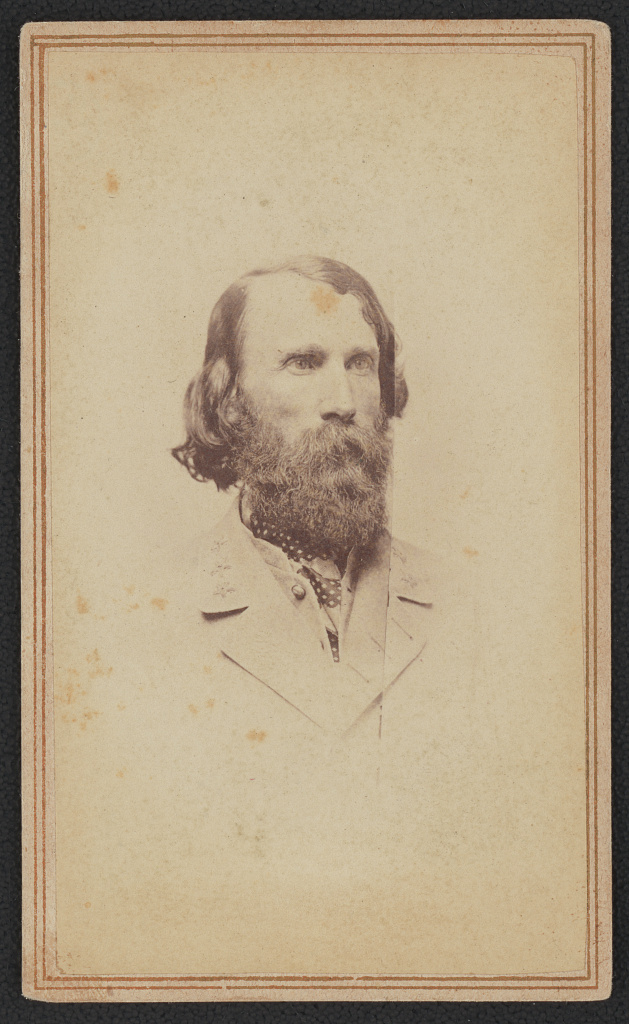
Hill commanded two divisions fighting along the Orange Plank Road on May 5, 1864.
(Library of Congress)
Lee, too, was concerned that Hill may not be able to hold on very long in the morning. As a contingency measure, Lee sent orders to Longstreet adjusting his previous plan. Instead of smashing into the left flank of the Second Corps as he originally intended Longstreet to do on May 6, he ordered his “Old War Horse” to arrive via the Orange Plank Road so as to reinforce Hill. Longstreet responded back that he would get on the road at 1:00 am in order to be there on time. With Lee’s concern still unabated, he sent another message, this one to Maj. Gen. Charles Field, one of Longstreet’s division commanders, to come immediately and support Hill. Despite his men’s fatigue, Field began making plans to head out when he received orders from Longstreet to move at 1:00 am. Field chose to follow his direct commander’s orders. Longstreet probably never knew about Lee’s previous call for Field’s division’s earlier departure.
While all of the drama about getting Longstreet to the army went on, Ewell reported that his corps was in good condition near the Orange Turnpike and that he believed his strong fortified line would continue to hold. Lee’s plan for May 6 was to have Ewell make an early forward push to keep the Fifth and Sixth Corps in place while Hill and Longstreet battled Hancock’s Second Corps along the Orange Plank Road.
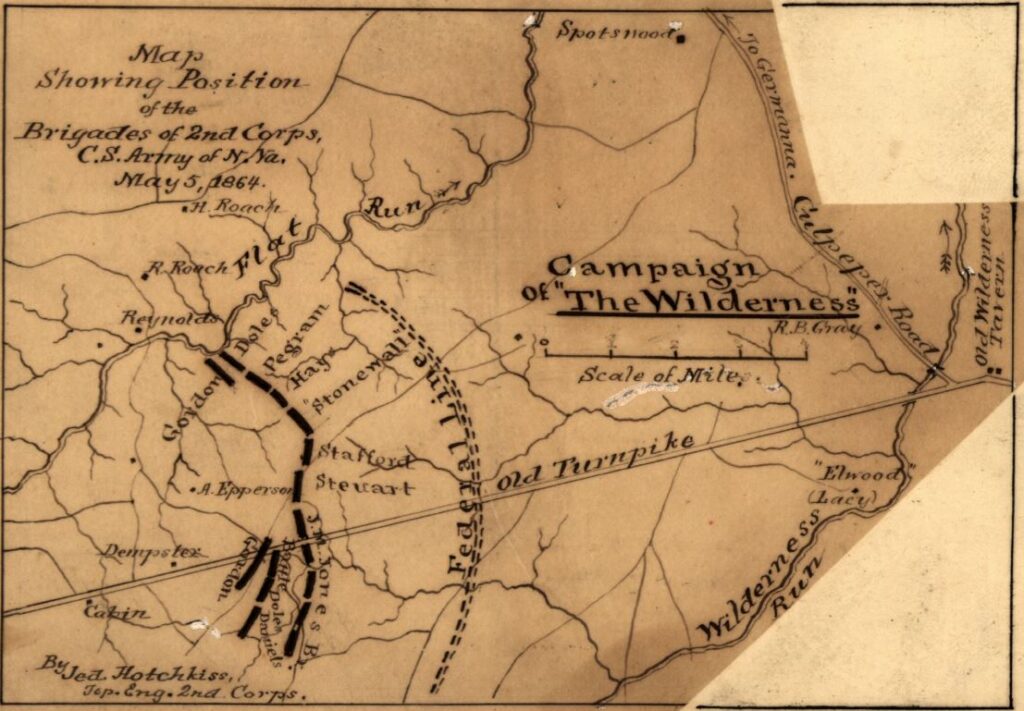
Created by Jedediah Hotchkiss, this map shows the postions of Lt. Gen. Richard Ewell’s brigades on May 5, 1864, at the Battle of the Wilderness.
(Library of Congress)
Unlike Ewell’s soldiers, Hill’s men, despite having an abundance of resources at hand, had received almost no opportunities on May 5 to chop trees and dig in to build a single concerted fortified line. The position of Hill’s corps actually resembled a weak salient rather than a strong line. Its irregular development concerned Hill’s division commanders, Maj. Gen. Henry Heth and Maj. Gen. Cadmus Marcellus Wilcox.
That night Heth and Wilcox carried their worries to Hill’s headquarters, which was not far away at Widow Tapp’s field. According to Heth, Hill was in ill health, yet the corps commander offered congratulations for their determined fighting during the day. Getting to the point of their visit, Heth expressed his fear that with their line being so discombobulated and their regiments and brigades so disorganized that “A skirmish line could drive both my division and Wilcox’s, situated as we are now.” Heth asked permission to “Let me take one side of the road and form a line of battle, and Wilcox the other side and do the same. . . .” Hill, perhaps a bit irritable and maybe not thinking clearly due to his sickness, or maybe just confident that Longstreet would arrive in plenty of time to relive Heth and Wilcox, chose not to heed his subordinate’s recommendation. Instead, Hill explained, “I don’t propose that your division shall do any fighting tomorrow, the men have been marching and fighting all day and are tired. I do not wish them disturbed.”
Hill’s first mistake was not paying greater credence to his generals’ advice. Heth had just come from the front lines, he surely knew the situation there best and what the men were capable of doing and not doing much better than Hill, who had largely remained at his headquarters.
After returning to the front, Wilcox rode to Lee’s headquarters. Jumping the chain of command and bypassing Hill, Wilcox went to Lee to suggest falling back and creating a stronger line, but Lee shared a note from Anderson that his division with Longstreet’s corps would be on site at daybreak. Wilcox left with his suggestion unstated, but that did not keep him from worrying.
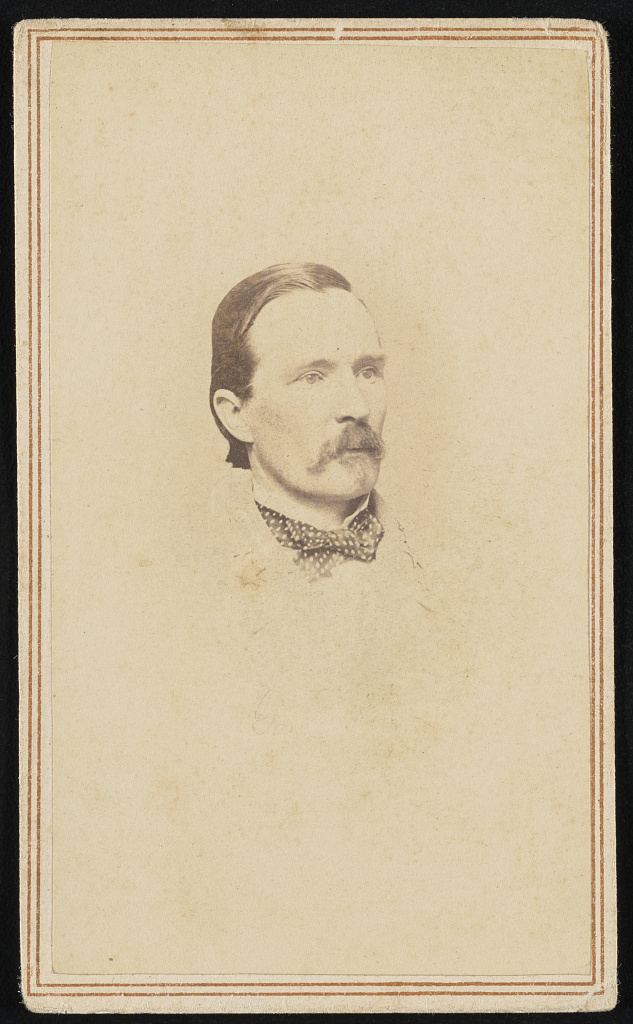
On the night of May 5/6, Heth went to Hill requsting permission to straighten and strengthen the corps lines, only to be denied.
(Library of Congress)
Events throughout the remainder of the day’s fleeting hours and into the beginning of May 6 led Wilcox and Heth to remain anxious about the security of their lines. If Heth is to be believed, and there is no real good reason not to, he went to Hill again, not just once but twice during the night. Getting nowhere on the first return visit, Hill flew off the handle on the second attempt. “Damn it, Heth!” Hill exclaimed, “I don’t want to hear any more about it; the men shall not be disturbed.” Heth tried to find Lee to plead his point but did not succeed in locating his army commander. Both Heth and Wilcox continued to fret during the night as no word arrived about when Longstreet and Anderson would appear.
If Heth did indeed come to Hill twice after the initial rebuff, then Hill’s second blunder was not taking Heth’s concerns seriously enough to investigate his corps position himself, since he seemed to find Heth’s worries unfounded.
Everyone appeared to be on edge throughout the night. As Hill’s chief of staff, Col. William Palmer remembered years later, “We could not sleep, but waited for news of Longstreet; for we knew that at the first blush of the morning the turning attack on our right would open with overwhelming numbers, and, unsupported, the men must give way.”
As feared, Longstreet’s corps was not on hand when the Union tidal wave assault hit Hill’s position early on May 6. Assisted by Maj. Gen. James Wadworth’s Fifth Corps division, which angled in from the northeast, the sheer weight of the attack caused a mixture of Confederate resistance and flight. Pockets of stalwart defenders held up Federal advances in some places, while those units that gave way allowed a steady flow of blue to come through, all causing Hancock’s brigades and divisions to become mixed up.
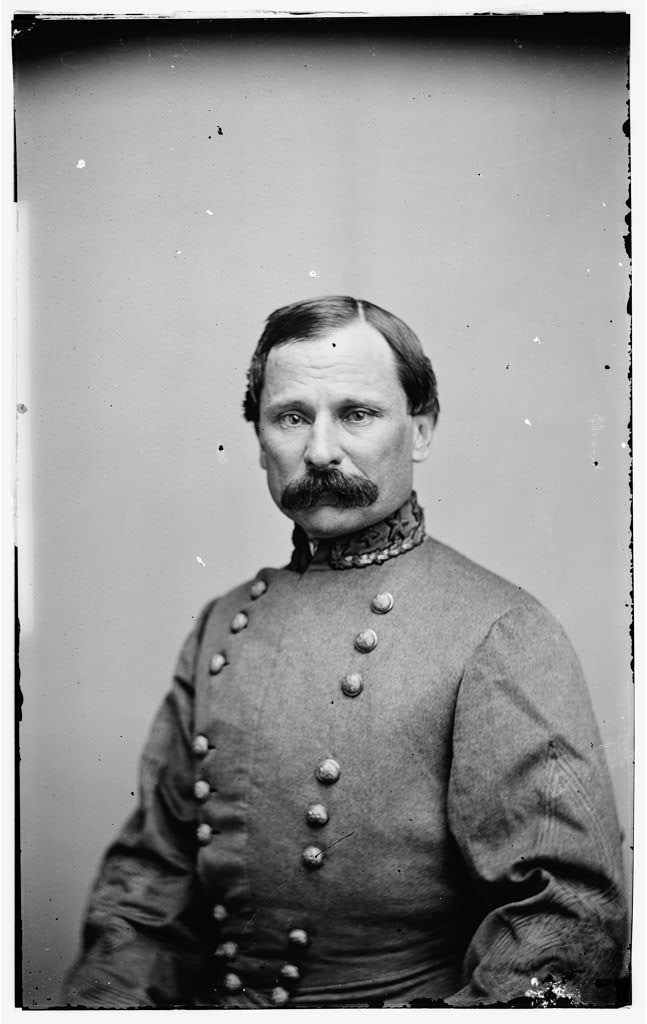
At the Battle of the Wilderness, Wilcox commanded the division that A. P. Hill led earlier in the war.
(Library of Congress)
Soon, however, with Hill’s flanks compromised, Orange Plank Road was full of Confederates heading westward, seeking safety and a piece of good ground on which to anchor and rally. Both Lee and Hill attempted to stop the rout. By some accounts, Gen. Lee himself resorted to a bit of humiliation to try to get units to rally by playing on their perceived cowardice. According to Edward Porter Alexander, who said he got the information from Brig. Gen. Samuel McGowan, when Lee saw the South Carolinians and McGowan, he asked the brigadier, “My God! Gen. McGowan is this splendid brigade of yours running like a flock of geese?” McGowan, probably stung by the insinuation, replied, “No, General! The men are not whipped. They just want a place to form and are ready to fight as well as ever.”
Twelve Confederate artillery pieces placed at the west end of the Widow Tapp field served as the last line of defense. Commanded by Lt. Col. William Poague, the guns fired into the still surging Second Corps attackers. Their rounds of canister helped slow the Federal assault, buying a bit more time for Longstreet’s lead brigades to finally reach the battlefield just in time to provide a counterattack and eventually stall out and then drive back Hancock’s attack.
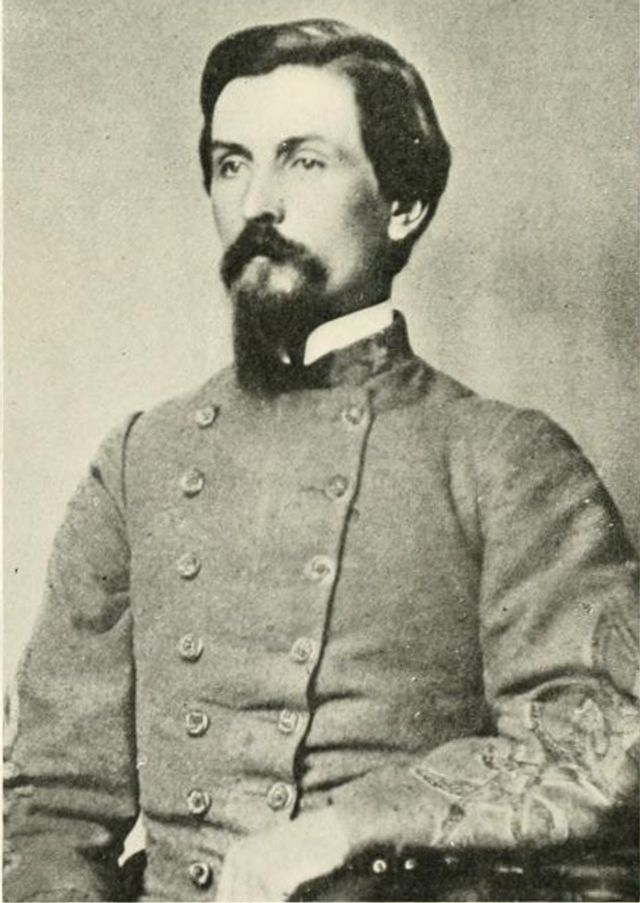
Situated in the Widow Tapp field, Poague’s artillery served as a last line of defense.
(Public Domain)
Due to Longstreet’s just-in-the-nick-of-time arrival on the battlefield, Hill’s dismissive decision to prohibit Heth and Wilcox from straightening and fortifying their line during the night of May 5-6 ultimately did not result in a lost battle for the Army of Northern Virginia. However, if Hancock had chosen to start his assault just a bit earlier, or if something along Longstreet’s route of march had delayed the arrival of his corps for a half hour, the results could have proven absolutely disastrous for Lee’s army. If Hill had heeded Heth and Wilcox’s many admonitions and allowed the divisions to dig in, the earthworks would likely have provided a force multiplier on which to anchor and inflict greater casualties on the attackers. Additionally, if constructed, the works would have also provided Longstreet’s corps with an pre-established defensive line that may have significantly reduced its casualties.
Hill’s Wilderness misstep wasn’t the first, and would not be the last, ill-considered battlefield blunder that plagued his career as a corps commander.
Battle of Spotsylvania Court House
On May 7, 1864, as the two contenting armies transitioned from the horrific fighting at the Wilderness and raced to control the important crossroads at Spotsylvania, issues continued to emerge for each side that tested officers’ patience and inflamed tempers. Due partly to the need for speedy action, some of the resulting mistakes were probably inevitable; others were avoidable with clearer communication and better understanding.
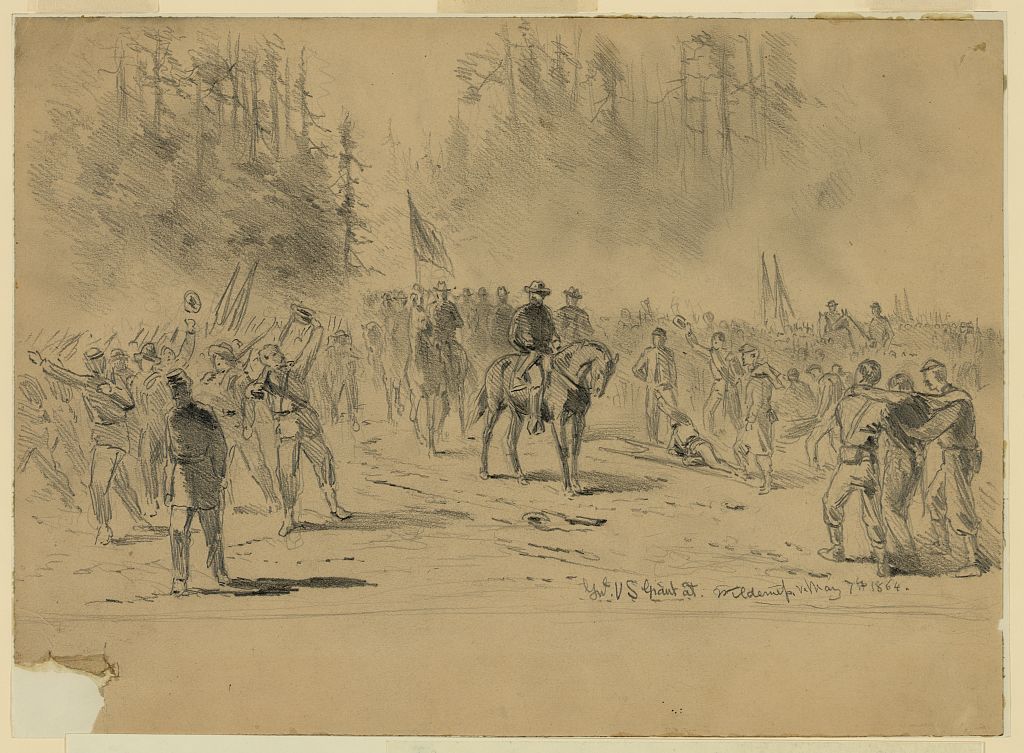
Sketch by Edwin Forbes
Grant’s decision to continue the fighting that started with the Battle of the Wilderness demonstrated his determination.
(Library of Congress)
A determined Confederate cavalry force under Maj. Gen. Fitzhugh Lee stubbornly blocked any chance of an easy Federal passage south toward Spotsylvania via Brock Road. Grant sent his cavalry under Maj. Gen. Philip Sheridan to break the clog, which would then allow Maj. Gen. Gouverneur K. Warren’s Fifth Corps to march by that route.
Exhausting back and forth fighting by the opposing horsemen occurred along Brock Road and near Todd’s Tavern throughout the morning of May 7. The Confederates felled trees in the road and often fought dismounted behind these protective barriers as they grudgingly gave ground. Fitzhugh Lee’s cavalry continued to fight during the afternoon just south of Todd’s Tavern and still held control of the road when the sun mercifully set, putting an end to the day’s combat. That night, Sheridan, for some reason, had his troopers fall back. This move not only opened himself up to being attacked, but it also gave the Confederate horsemen the night hours to strengthen their position.
Sheridan corresponded with Meade’s headquarters at 6:15 pm that “I attacked the rebel cavalry at Todd’s Tavern this afternoon, and, after a sharp and hotly contested action, drove them in confusion toward Spotsylvania Court-House. Our cavalry behaved splendidly.” Almost two hours later Sheridan sent another message from the same location repeating much of the previous report, but he added “They had constructed barricades and rifle-pits, which we charged and captured.” His correspondence made it appear that his men had accomplished his mission of clearing the road, brushing away the defenders. But that was far from the exact truth of the matter.
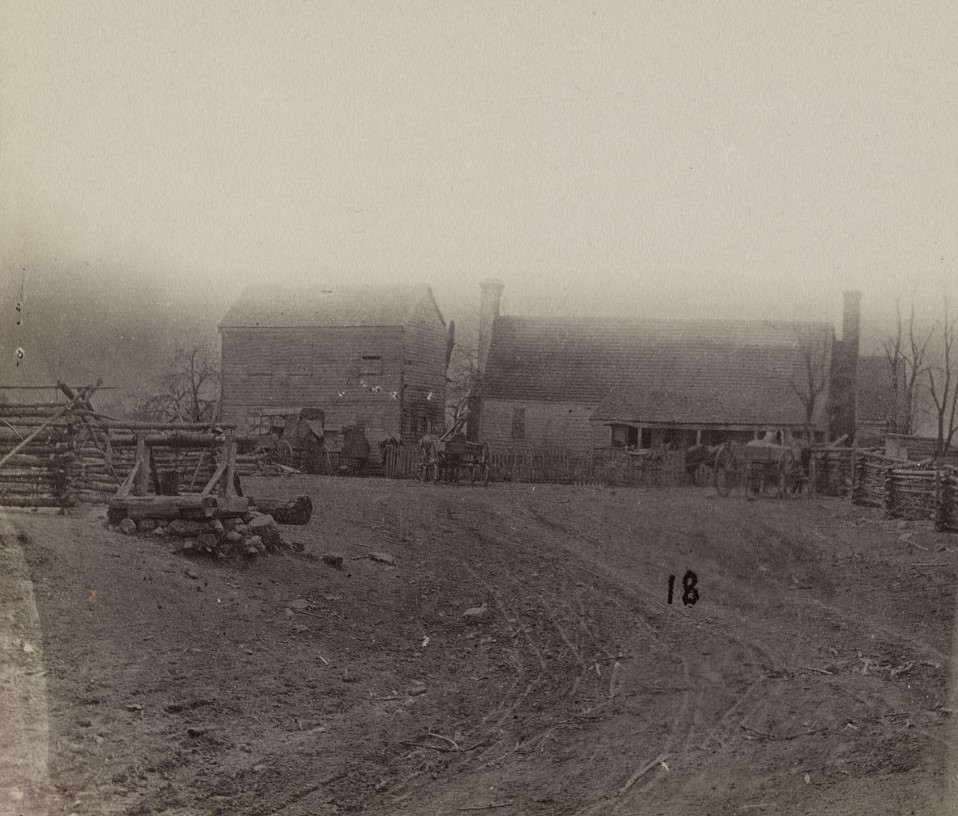
Located on Brock Road, heavy cavalry fighting occurred around Todd’s Tavern on May 7, 1864.
(Library of Congress)
Meade set the Fifth Corps in motion for a night march to Spotsylvania thinking Brock Road was now clear. Early on May 8, Sheridan sent his troopers orders to reengage at 5:00 am. Riding at the head of the column, Meade and Grant arrived at Todd’s Tavern at about 1:00 am, and apparently before Sheridan’s orders arrived. There they discovered two of Sheridan’s divisions under Brig. Gen. David Gregg and Brig. Gen. Wesley Merritt and also found that the road was not clear. It is an understatement to say that Meade was not happy.
Bypassing the army’s cavalry commander, who was not on site, Meade assigned both Gregg and Merritt orders. Shortly after 1:00 am, Meade tersely messaged Sheridan: “I find Generals Gregg and [Merritt] without orders. They are in the way of the infantry and there is no time to refer to you. I have given them the inclosed orders, which you can modify to-day after the infantry corps are in position.”
This was not the first show of angst by Meade toward Sheridan. On May 5, at the Wilderness, Meade was not pleased with Sheridan’s performance. The issue basically boiled down to how each man thought cavalry should best be employed. Meade wanted Sheridan and his cavalry to guard his vulnerable wagon train and protect his army’s flanks. Sheridan, on the other hand, wanted to attack and if possible heavily damage the Army of Northern Virginia’s cavalry force.
On the early morning of May 8, Sheridan had different plans in mind for Gregg and Merritt and was in the process of sending them orders when Meade ordered the cavalry division commanders to carry out their new instructions. Merritt drew the tough task of clearing the Confederate cavalry resistance on Brock Road. When Warren and the Fifth Corps arrived at Merritt’s position at about 3:30 am the road was still not clear.
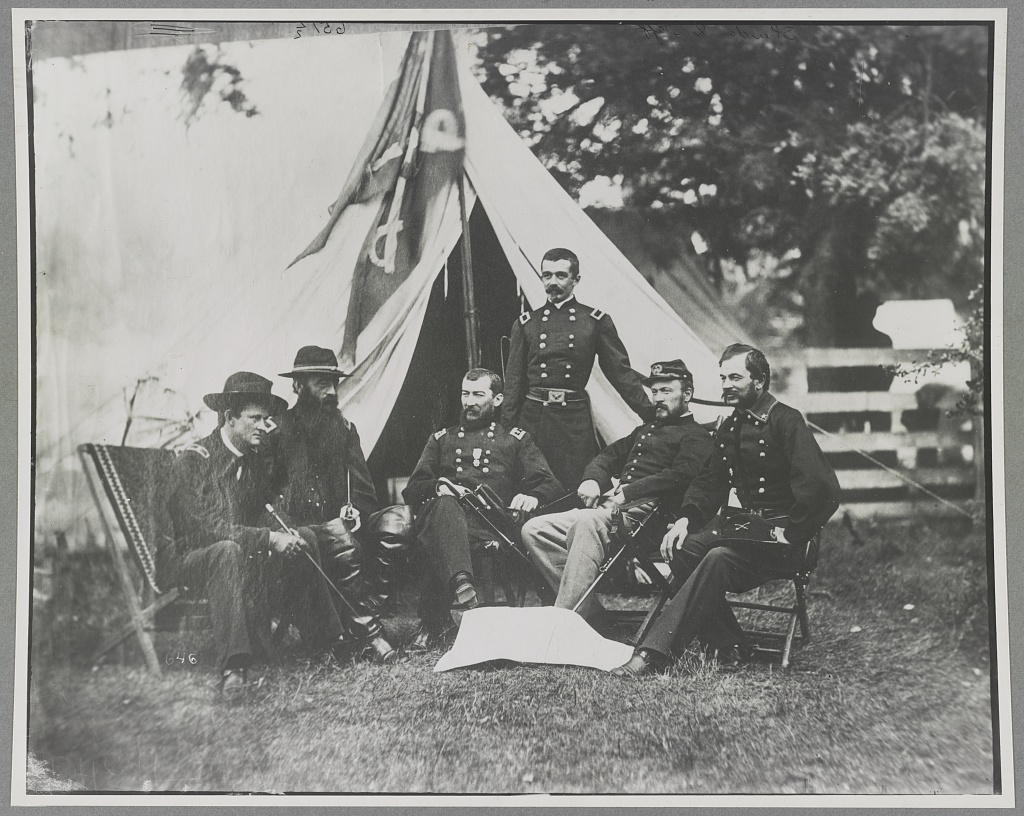
Brig. Gen. Wesley Merritt and Brig. Gen. David M. Gregg are shown respectively on the left side of this photograph.
(Library of Congress)
Despite their best effort, Merritt’s men could not budge Fitz Lee’s soldiers, who were supported with horse artillery. Sheridan himself arrived on the scene and attempted to direct the fighting but still found no success. Merritt eventually sought out Warren’s infantry to bust the clog. Warren chose Brig. Gen. John C. Robinson’s division and a couple of artillery batteries for the assignment. The infantry advanced with fixed bayonets and cleared the choke point. However, the Confederate cavalry began their withdrawal by dropping trees in the road to slow Robinson’s infantry advance, which reached the Alsop Farm at about 8:00 am.
Eventually, Fitz Lee’s horsemen and cannoneers pulled back to a ridge on the Spindle Farm. They had bought enough time for Maj. Gen. Richard H. Anderson’s corps (Anderson now leading it due to Longstreet’s wounding on May 6) to start arriving and filing into position directed by J.E.B. Stuart. For much of the remainder of the May 8, fighting would rage across the Spindle Farm as Federal assaults attempted unsuccessfully to break the Confederate line.
The lack of success on May 8 frustrated Meade, he placed the blame on Sheridan and his cavalry’s inability to clear Fitz Lee’s defense of Brock Road. Sheridan was certainly not happy with Meade either for what he saw as reckless use of some of his cavalry. Both men were known for their tempers, and it was only a matter of time before a major blow up between the two came off.
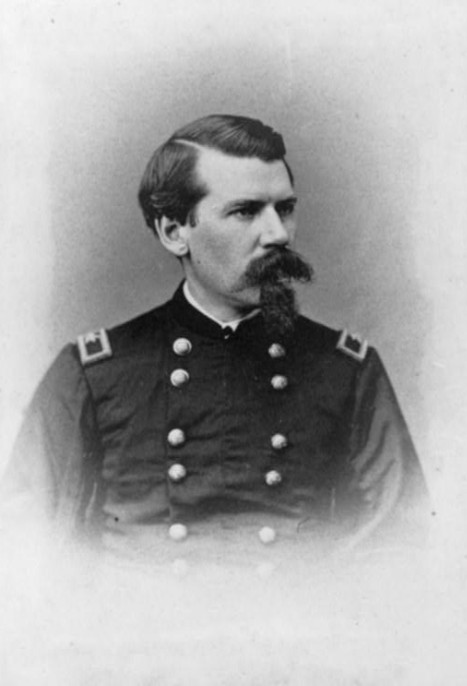
Porter wrote about Meade and Sheridan’s May 8, 1864 dust-up in his memoirs.
(Library of Congress)
Meade, apparently needing to inform Sheridan of his disappointment, sent for the cavalry commander. Sheridan arrived at Meade and Grant’s Piney Branch Church headquarters around noon on May 8. According to one of Grant’s staff officers, Horace Porter, Meade “had worked himself into a towering passion regarding the delays encountered in the forward movement, and when Sheridan appeared [at Meade’s headquarters, Meade] went at him hammer and tongs, accusing him of blunders, and charging him with not making a proper disposition of his troops, and letting the cavalry block the advance of the infantry.” Sheridan fired right back, “all the hotspur in his nature was aroused,” Porter explained. Sheridan claimed that Meade undermined him by giving orders to the cavalry “rendering ineffectual all his combinations regarding the movements of the cavalry corps. Sheridan declared with great warmth that he would not command the cavalry any longer under such conditions, and said if he could have matters his own way he would concentrate all the cavalry, move out in force against Stuart’s command, and whip it.” Porter added that Sheridan’s “language throughout was highly spiced and conspicuously italicized with expletives.”
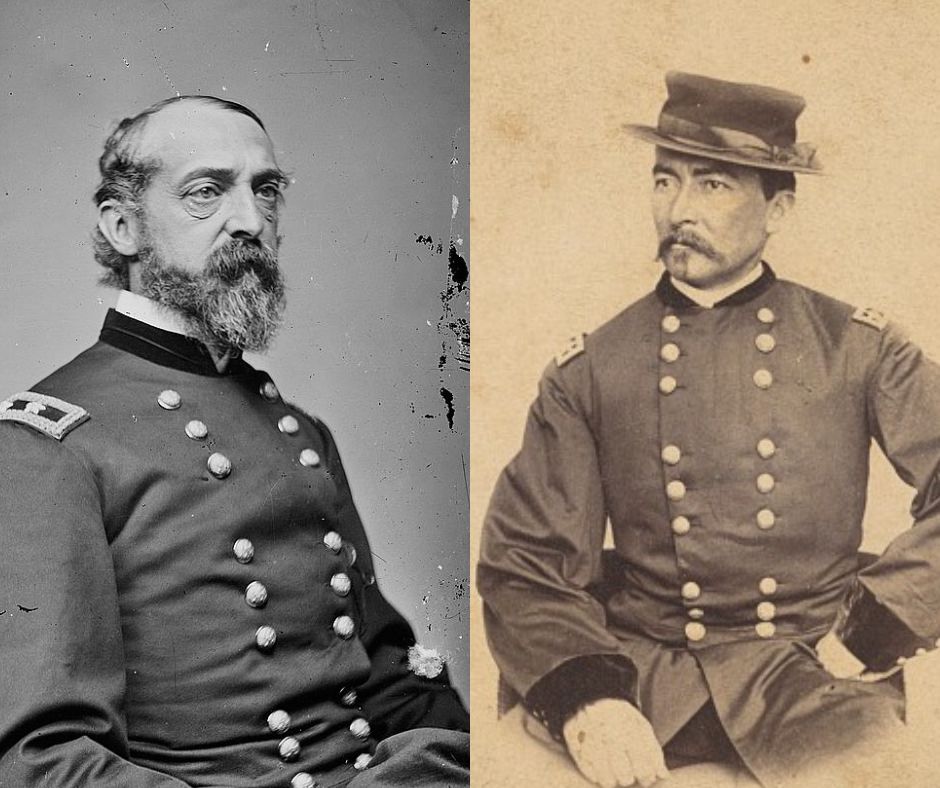
Meade and Sheridan did not see eye-to-eye from the beginning of the spring 1864 campaign.
(Libarry of Congress)
After a bit more back and forth, and Sheridan reiterating that he could whip Stuart if given the chance, Sheridan suggested Meade take over the cavalry. According to one account, Meade, apparently attempting to smooth the feathers he had ruffled, told Sheridan, “’No, I don’t mean that,’ and put his hand, in friendly fashion, on Sheridan’s shoulder. The cavalry general moved aside impatiently. . . .” and then left.
Meade immediately headed to Grant’s nearby headquarters to inform him of the kerfuffle. Meade was apparently still hot under the collar, as Porter tells it: “The excitement of the one [Meade] was in singular contrast with the calmness of the other [Grant].” Meade shared what Sheridan had told him about whipping Stuart’s cavalry. Grant replied, “Did Sheridan say that? Well, he generally knows what he is talking about. Let him start right out and do it.” Meade, probably deeply disappointed that Grant endorsed Sheridan’s desires rather than prioritize those of his army commander, had little recourse other than to follow Grant’s directive. In what must have been a stinging moment, Meade almost immediately issued orders to let Sheridan “proceed against the enemy’s cavalry.” Sheridan headed out on May 10 to do so.
After experiencing several mistakes on May 7-8 during the movement to Spotsylvania and also in the Fifth Corps attacks on Laurel Hill, Grant likely made the biggest blunder of all by allowing the vast majority of the cavalry to leave the Army of the Potomac just when its information gathering, screening, and flank protecting services were needed most. And while Sheridan did bring Stuart to battle and mortally wounded the Army of Northern Virginia’s cavalry chief on May 11 at Yellow Tavern, that arm of Lee’s army continued to remain a viable fighting force as witnessed by their victory against Sheridan at Trevillian’s Station a month later. Meanwhile, Grant and Meade were left handicapped without their “eyes and ears” for nearly two weeks at Spotsylvania.
Conclusion
As these examples demonstrate, no one was immune from making battlefield mistakes. Whether it was a corps commander like A. P. Hill at the Wilderness, or even the general-in-chief of the whole United States Army like Grant at Spotsylvania, issues such as not heeding the warnings of one’s subordinates, or showing personal favoritism instead of backing the wishes of the army’s commander, could create or exacerbate future challenges. Studying the missteps of the past can provide those of us in the present with valuable lessons to consider for the future.
Sources and Recommended Reading
Chris Mackowski. A Tempest of Iron and Lead: Spotsylvania Court House, May 8-21, 1864. Savas Beatie, 2024.
Gordon Rhea. The Battle of the Wilderness, May 5-6, 1864. Louisiana State University Press, 1994.
Gordon Rhea. The Battles for Spotsylvania Court House and the Road to Yellow Tavern, May 7-12, 1864. Louisiana State University Press, 1997.
NEWSLETTER SIGN-UP
Join our community! Sign up for our newsletter to receive exclusive updates, event information, and preservation news directly to your inbox.
STAY UP TO DATE
Celebrating 30 Years and Over 2,000 Acres of Battlefields Preserved