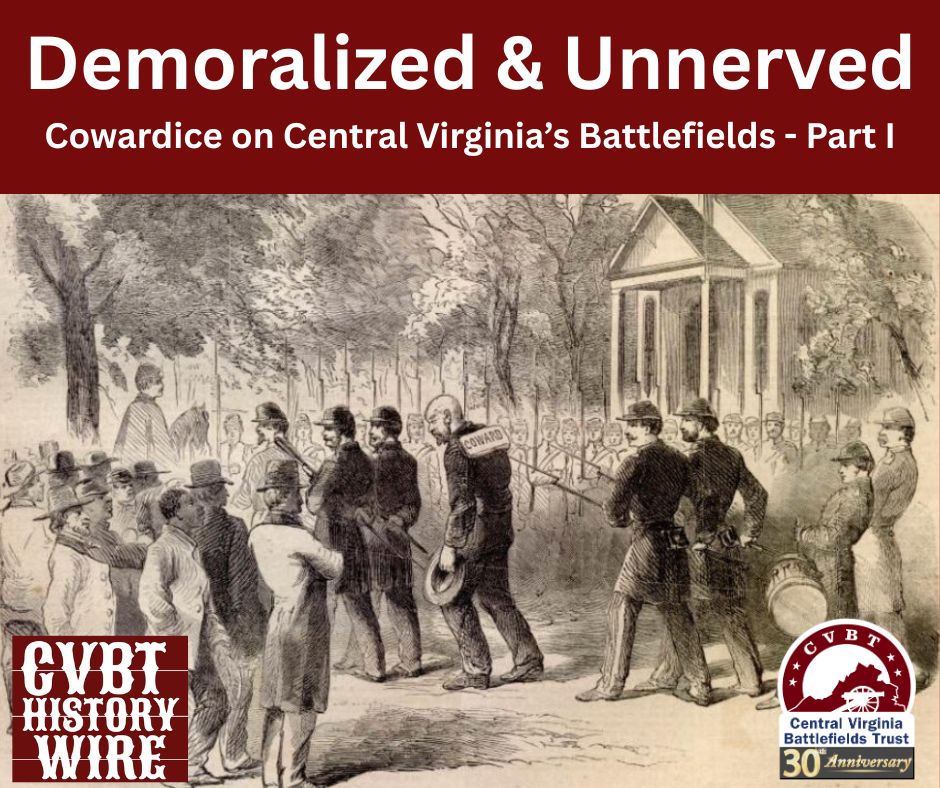
Although the incident pictured here was apparently from Maj. Gen. Ambrose Burnside’s North Carolina expedition, accounts show that similar disciplinary actions also happend in central Virginia.
(Harper’s Weekly, June 28, 1862)
Introduction
In the aftermath of the Battle of Chancellorsville, Sgt. J. A. H. Foster of the 155th Pennsylvania Infantry wrote home to his wife describing the internal and external pressures that he felt in doing his duty despite the many dangers of battle. Sgt. Foster attempted to assure her that “I am not anxious to get into another battle. I never want to be near one itself. I would just as soon be excused from the whole thing if it could be done. But as for playing out, that is the last thing I would ever think of without I was really sick. It would not do at all if the boys would see me doing that, they would despise me, and justly, too. I scorn a man and hold him in contempt who plays out at the commencement of a battle without he is really sick. You seem to think it would not be wrong to play out, but I must beg leave to differ very materially.” George Cary Eggleston, an artillerist who fought in the Army of Northern Virgina, put it a bit more forcefully in his memoir: “cowardice . . . is the one sin which may not be pardoned either in this world or in the next.”
Courage, the antithesis of cowardice, was one of the most cherished personal virtues for males in mid-nineteenth century America, North or South. Doing one’s duty, essentially testing one’s courage on the field of battle, was a commonly mentioned motivator by those enlisting in the Union or Confederate armies.
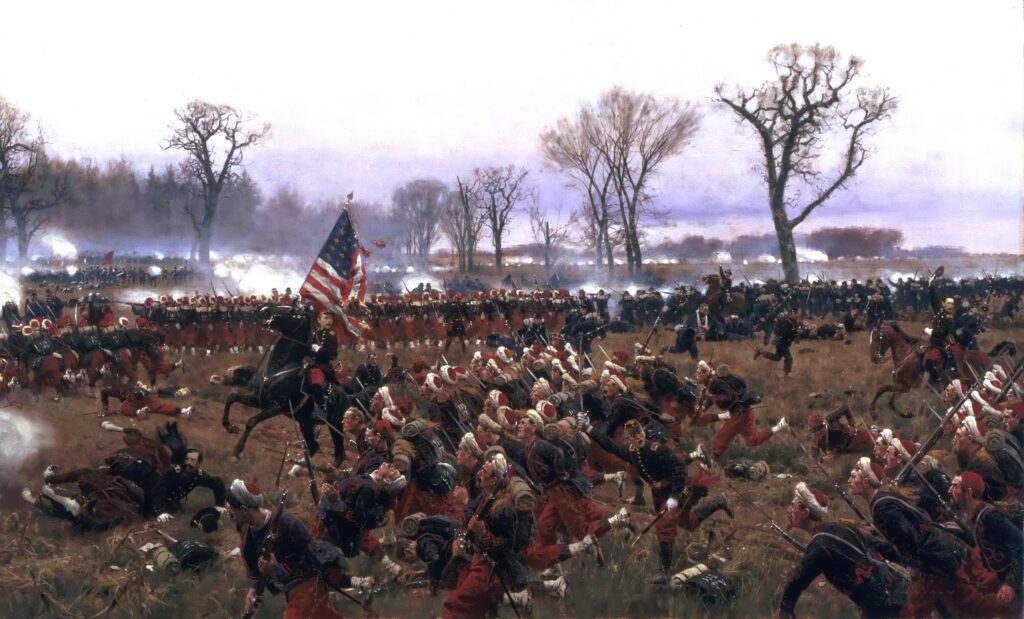
by Carl Rochling
Horrific scenes of combat played out on central Virginia’s fields and forests. Experiencing the dangers of battle left some soldiers unable to perform their duties.
(Philadelphia Museum of Art)
Due largely to the particular society and culture in which they lived, honor, and with it one’s reputation, are character traits more often associated in popular memory with Southerners and that manifested in traditions like dueling. However, courage and honor were highly admired and jealously guarded in the Free States, too, they were just usually displayed through less overt public practices than in the South. Soldiers on both sides believed that courage in the face of battlefield dangers would be a key element in winning the conflict.
The battlefields of central Virginia were the scenes of numerous acts of courage and perseverance. Their stories are well told and inspire us still today. However, among such large armies, there were also bound to be soldiers who failed their tests of courage. Whether they were among those who mentally wanted to go forward into battle yet were unable to control their bodies enough to do so, or were perhaps one of the even less willing, who sought almost any excuse to avoid the deadly threats the battlefield presented, not everyone was up for the daunting challenge.
Symptoms such as uncontrollable shaking, incapacitating paralysis, feigning sickness, cowering behind trees despite one’s responsibility to lead by example, leaving the battleline without good reason, and finding convenient opportunities to separate from their units to escape potential harm all happened and sometimes received comment. As historian Earl Hess notes, cowardly acts sometimes occurred without warning: “Men who had endured several battles while playing the role of the good soldier could unexpectedly—to themselves, to their comrades, and to their officers—bolt and run in the next engagement.” Conversely, there were those who had been unable to master their fears in earlier fights but eventually became acclimated enough to the necessary dangers of combat to not falter again. Those who are familiar with the fictional Henry Fleming, the protagonist in Stephen Crane’s classic novel The Red Badge of Courage, have an idea of how battlefield situations could trigger a soldier’s fight or flight instincts.
In this month’s CVBT History Wire we will explore some accounts of cowardice, and allegations of cowardice, that occurred on the battlefields of Fredericksburg and Chancellorsville. Examining these stories helps us better understand the diverse, complex, and challenging combat experiences that Civil War soldiers endured.
The Battle of Fredericksburg
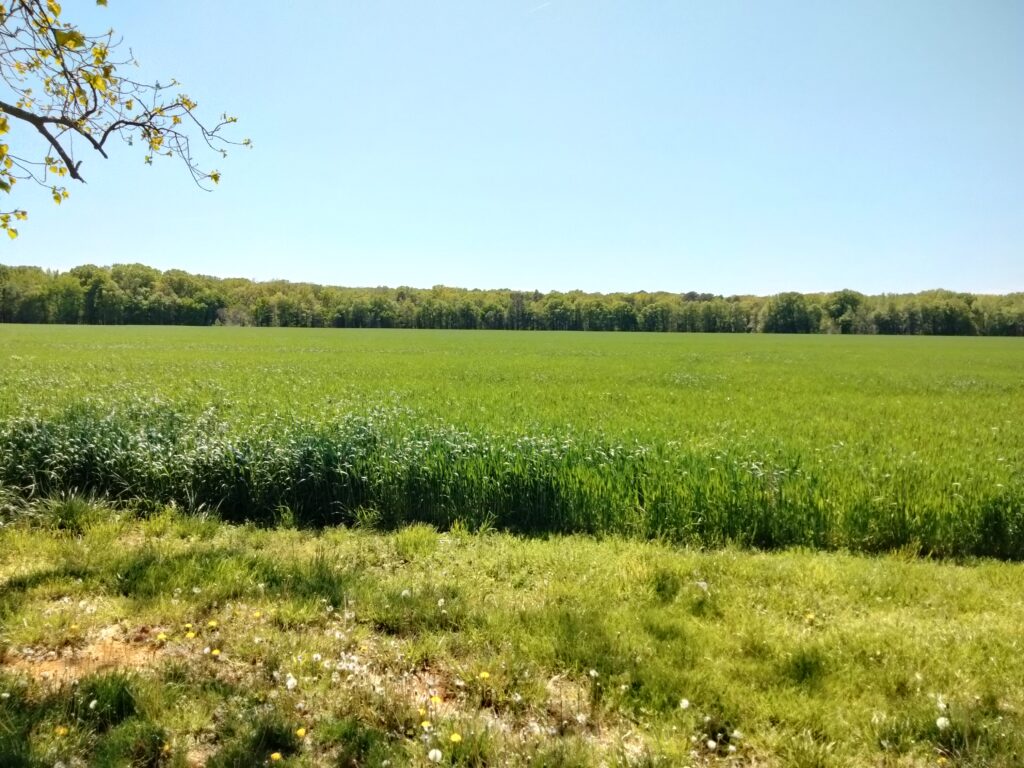
For a number of Union regiments, Fredericksburg would be their first fight. Many of the soldiers who filled the units raised during the late summer and early fall of 1862 by finally answering President Abraham Lincoln’s earlier call for 300,000 more recruits came in too late to participate at the Battle of Antietam. One such regiment was the 16th Maine. Assigned to guard railroads during the Maryland Campaign, they eventually became part of the First Brigade (Col. Adrian Root), Second Division (Brig. Gen. John Gibbon), of the First Corps (Maj. Gen. John Reynolds). Assigned to the Left Grand Division, they would fight at what would become known as the Slaughter Pen Farm portion of the Fredericksburg battlefield.
(Maine Historical Society)
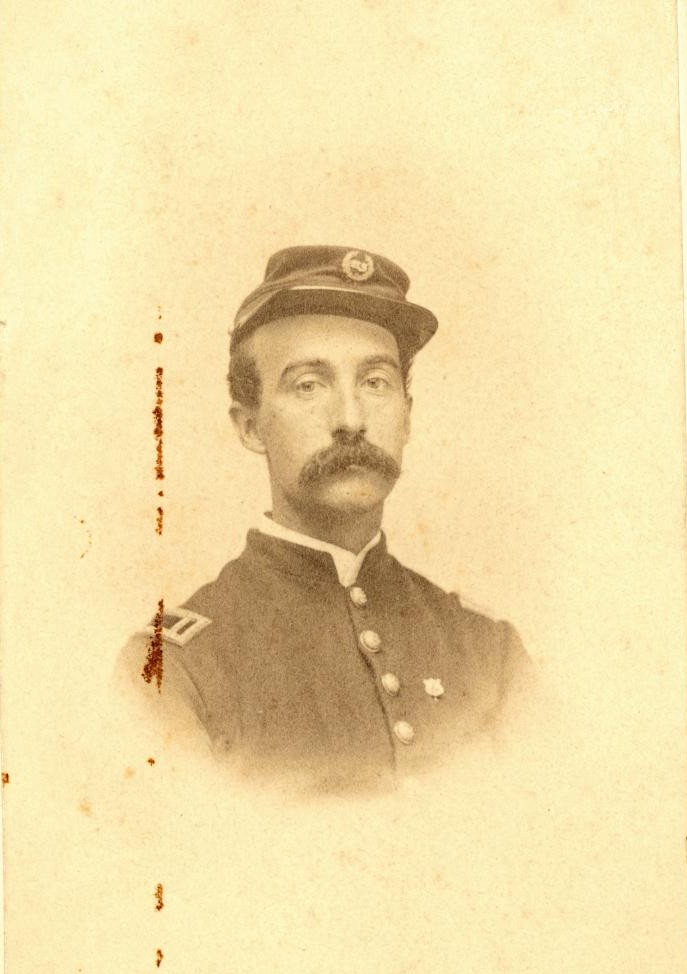
The 16th Maine’s Lt. Abner Small, recalled waiting for orders to move forward on the morning of December 13, 1862, “all the while under fire from rebel guns.” Soldiers despised such inactivity and the inability to fire back in defense. The idleness was frustrating and the anticipation was deadly to some and simply terrifying to others. While waiting, “A spent [cannon] ball came rolling along the pike. Men moved aside and watched it; mentally measuring its force; and then an unwise foot was thrust out to stop it, the iron ball rolled on, and the groaning victim was carried to the rear,” Lt. Small remembered. That soldier was not the only victim. Small also noted “Another spent ball struck a man of my regiment in the back and killed him. Shells burst and flung down spatters of pain; here a man clapped a hand to his bleeding face and cursed, and there another squirmed deeper into the mud and cried, unnerved.” Demoralized was yet another term commonly used to label those unable to face the looming uncertain dangers of battle.
Lt. Small, who was then serving as the regiment’s adjutant, remembered and later told with more detail than the above account of just such an instance involving a demoralized soldier at Fredericksburg. Small wrote: “I wondered then, and I wonder now equally, at the mystery of bravery. It seemed to me as I saw men facing death at Fredericksburg that they were heroes or cowards in spite of themselves. In the charge I saw one soldier falter repeatedly, bowing as if before a hurricane. He would gather himself together, gain his place in the ranks, and again drop behind. Once or twice he fell to his knees, and at last he sank to the ground, still gripping his musket and bowing his head. I lifted him to his feet and said, ‘Coward!’ It was cruel, it was wicked; but I failed to notice his almost agonized effort to command himself. I repeated the bitter word, ‘Coward!’ His pale, distorted face flamed. He flung at me, ‘You lie!’ Yet he didn’t move; he couldn’t; his legs would not obey him. I left him there in the mud. Soon after the battle he came to me with tears in his eyes and said, ‘Adjutant, pardon me, I couldn’t go on; but I’m not a coward.’ Pardon him![?] I asked his forgiveness.”
(Tim Talbott)
Near where Lt. Small’s account occurred, Brig. Gen. George Stoneman, who then commanded the Third Corps witnessed a panic. Fear could be contagious on Civil War battlefields. It could spread like a wildfire despite the best effort of officers and color bearers. Gen. Stoneman noted in his report of the battle that Gen. George Meade’s division had pushed beyond the Richmond, Fredericksburg and Potomac railroad tracks and was fighting on the wooded hillside. Without stating that Mead’s force went unsupported, Stoneman explained, “Shorty afterward Meade’s division began to retire, soon followed by Gibbon’s, and both in no little confusion and disorder. Every effort was made to rally them, but all to no purpose. Regardless of threat and force, and deaf to all entreaties, they sullenly and persistently moved to the rear, and were reformed near the bank of the [Rappahannock] river by their officers, many of whom used every endeavor in their power to stay their weary and overpowered troops.”
(Southern Illustrated News, January 16, 1864)
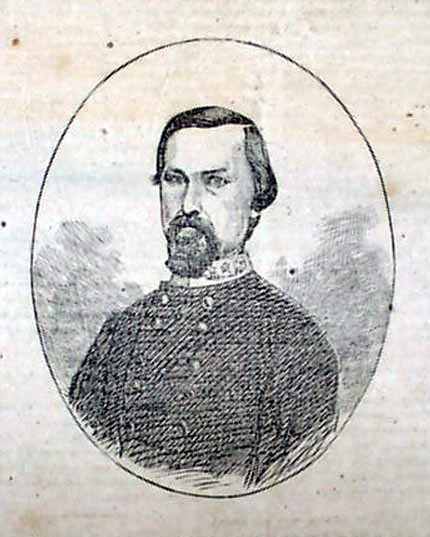
By the time of the Battle of Fredericksburg, Brig. Gen. John R. Jones had experienced a rapid rise in rank, advancing from a captain in the 33rd Virginia Infantry to commanding a brigade of Virginia regiments. His promotion to brigadier had come from a recommendation by none than Gen. Thomas J. “Stonewall” Jackson himself. However, at Antietam, while actually commanding a division, when a shell burst near him but did not wound him, he turned command over to a subordinate and left the field. That officer, Gen. William E. Starke, was soon mortally wounded. At Fredericksburg, and back in charge of a brigade that was in reserve in a wooded area, there were reports that Gen. Jones was seen cowardly hiding behind a tree. Eventually court martialed over the incident, Jones was acquitted of the charges and retained command of his regiments.
As we will see later while discussing Chancellorsville, soldiers were often unnerved in surprise situations. It is easy to understand how a soldier could lose his composure when finding himself in a disadvantageous circumstance. Even with good leadership, being flanked and taking fire from multiple directions without faltering required a cool head and the utmost courage. Examples of regiments handling such trying experiences in Civil War combat situations were not uncommon, but neither were those where fear took control.
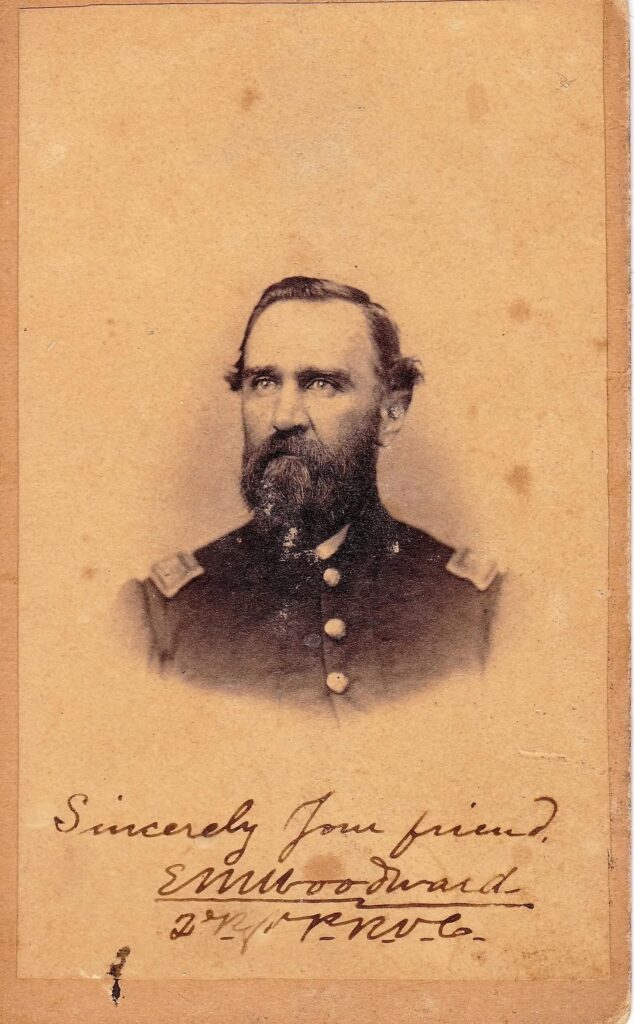
Woodward’s Medal of Honor citation reads: ” Advanced between the lines, demanded and received the surrender of the 19th Georgia Infantry (C.S.A.) and captured their battle flag.”
(Find A Grave)
Positioned at Prospect Hill and occupying the left of Gen. James J. Archer’s mixed brigade of Tennessee, Georgia, and Alabama regiments, the 19th Georgia’s left rested on a yawning wooded gap in the Confederate line that stretched an estimated 600 yards to the north with James Lane’s North Carolina brigade on the other side of the undefended opening. When Maj. Gen. George Meade’s division of Pennsylvania Reserves regiments attacked, some exploited the unprotected gap. The 2nd Pennsylvania Reserves were able to pass by the left of the 19th Georgia and get in behind their entrenched position. Other Reserves regiments were firing in the Georgians’ front. Lt. Col. Andrew Hutchins attempted to maintain order with the 19th, but as historian Frank O’Reilly explains, “Some of the soldiers panicked and fired wildly. Others failed to fire at all, too frightened to load their rifles. Officers crawled along the ditch, occasionally taking a rifle to show the men how to fire deliberately.” These combat instructions probably should not have been necessary as the 19th was an experienced unit. Unable to take the heavy fire, many of the Georgians fled up the wooded hill making easy targets for the 2nd Reserves. Some 19th Georgia men, afraid to take the chance, remained in the trench. Risking the heavy fire coming from his comrades in front, the 2nd Reserves’ Lt. Evan Woodward went forward and asked if they wished to surrender. The reply came, “If you will let us.” Over 100 prisoners were taken off the field. The 19th Georgia also had the unenviable distinction of being the only Confederate unit to lose their flag at Fredericksburg. Lt. Woodward later received the Medal of Honor for his daring initiative.
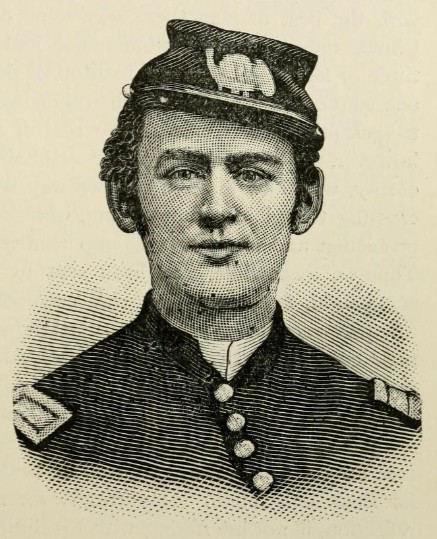
(History of the 118th Pennsylvania Volunteers: Corn Exchange Regiment. 1905)
While the 118th Pennsylvania actually saw its first combat at Shepherdstown, more awaited three months later at Fredericksburg. Capt. Francis Adams Donaldson wrote to his aunt on December 27, 1862, describing his regiment’s experience two weeks before. In what was a very candid letter, Capt. Donaldson mentioned several instances of what he viewed as less than courageous acts while attempting to assault the Confederate position below Marye’s Heights. He first brought up that “Lt. Col. Gwyn was again pretty full of liquor, which I was very sorry to see.” It was not unheard of for officers to imbibe before a battle by taking in some “liquid courage.” Donaldson did not like Gwyn when he was sober, but when drunk “he becomes very domineering, abusive, and even brutal.” Additionally, Donaldson did not like going “into battle with a drunken commander.” Donaldson also caught sight of his drummers as they crossed the pontoon bridge at the middle crossing site. There they made “several attempts . . . to shirk, and among the number, young Booth of my company. I had to handle him pretty roughly to get him along, and then he succeeded in giving me the slip afterward, just as we landed in the town, and I have never laid eyes upon him since.”
After receiving orders to load and starting to march to the front just west of town, Donaldson noticed “a number of men behind the houses at the corners of the streets, watching us as we passed by. They were stragglers, or men who had been ‘in’ and were demoralized. Their silent, sullen aspect did not encourage us much,” the captain wrote. Finally crossing a section of the canal and making their way toward the Confederate line at the base of Marye’s Heights they took a number of casualties and got pinned down. Charging past the brick kiln and taking more fire the regiment got mixed up and Donaldson ordered them to withdraw to the brick yard. While there Donaldson saw a Federal artillery battery position itself and “in less time that I can write about it, and instantly, as it were, the horses were all killed, and the men took to their heels and ran away as fast as their legs could carry them, leaving their guns and their officers, who, by the way, stood their ground and cursed the men lustily, but to no purpose.” Seeing an officer fall wounded from his horse, who Donaldson incorrectly believed was Col. Edward Cross of the 5th New Hampshire, he then saw that the officer’s command “broke and scattered in all directions and the advance ended.” Additionally, some of the soldiers of the fallen officer’s command were “loitering behind and plundering the dead.”
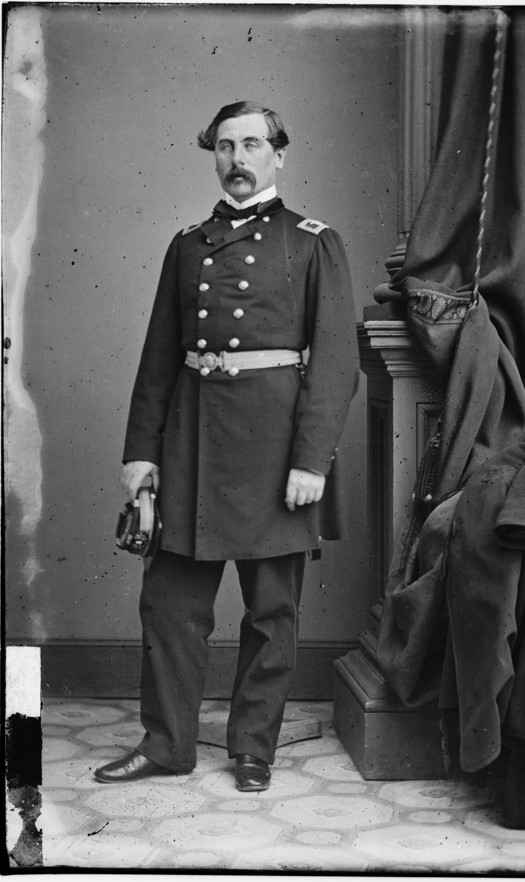
(Library of Congress)
Just as Capt. Donaldson became frustrated with his commander’s drunkenness to boost his courage, the previously mentioned Col. Edward Cross of the 5th New Hampshire noted in his private journal his disdain for Brig. Gen. Thomas Francis Meagher of the Irish Brigade for what Cross perceived as Meagher’s weaknesses. On December 13, Cross jotted down that “Gen. Hancock, accompanied by Gen Meagher rode along the ranks of the Irish Brigade & the latter addressed his troops one of those frothy, meaningless speeches peculiar to the man.” Cross clarified that his thoughts about Meagher came from experience, noting, “And here let me record the opinion formed after more than one year’s observation in the field—that there is not in the United States, certainly not in the Army of the Potomac, another of such a consummate humbug, charlatan, imposters, pretending to be a soldier as Thos Francis Meagher! Nor do I believe him to be a brave man, since in every battle field he has been drunk and not with his Brigade. I venture the prediction that the drunkenness & incompetence of Gen Meagher will sooner or later be exposed.”
Meagher’s controversial past continued at Fredericksburg. He mentioned in his report about the battle that “I myself ordered the advance, encouraged the line, and urged it on; but, owing to a most painful ulcer in the knee-joint, which I had concealed and borne up against for days, I was compelled, with a view to be of any further service to the brigade that day, to return over the plowed field over which we had advanced from the mill-race.” Whether or not Meagher’s excuse of ill health was legitimate enough to prevent him from continuing to lead his troops is difficult to determine.
The 132nd Pennsylvania’s Lt. Frederick Lyman Hitchcock, also fighting on the north end of the Fredericksburg battlefield, recalled an incident as his regiment was still among the Fredericksburg streets. He remembered that “A fine-looking fellow had been struck by a shot, which had severed one leg and left it hanging by one of the tendons, the bone protruding, and he was bleeding profusely.” Three soldiers were there, apparently trying to get him off the street. “They had hold of his arms and the other leg, but were jumping and dodging at every shell that exploded, jerking and twisting this dangling leg to his horrible torture.” Hitchcock wrote that he remembered the wounded soldier imploring those carrying him to set him on the ground to die. Hitchcock suspected the three men had ulterior motives. “They were probably a trio of cowards trying to get back from the front, and were using this wounded man to get away with [it], a not infrequent occurrence with that class of bummers,” Hitchcock believed.
Pvt. Benjamin Borton of the 24th New Jersey, a nine-month regiment that saw their first combat at Fredericksburg, noted that during their approach to the battle that there were “Screeching like demons in the air, solid shot, shrapnel and shells from the batteries on the hills strike the ground in front of us, behind us, and cut gaps in the ranks.” He further remembered that “It is not every man that can face danger like this. I saw a few so overcome by fear that they fell prostrate on the ground as if dead. I have seen men drop to their knees and pray loudly for deliverance, when courage and bravery, not supplication, was the duty of the moment.”
The Chancellorsville Campaign
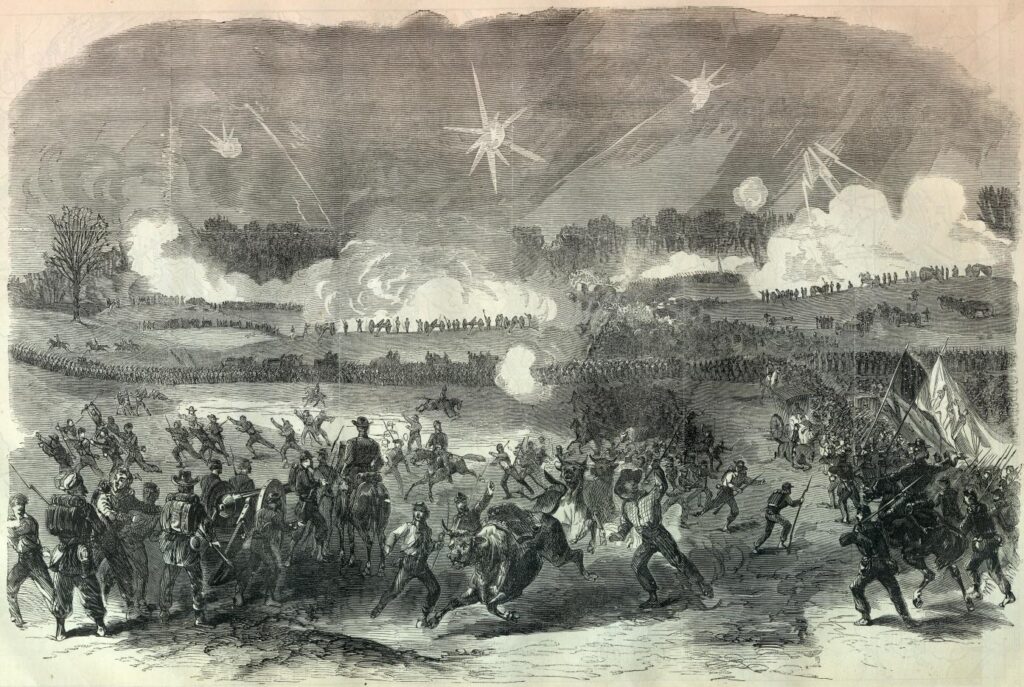
Woodcut from a sketch by Alfred R. Waud
(Harper’s Weekly, May 23, 1863)
When one thinks of claims of cowardice at Chancellorsville, thoughts often go to May 2, 1863, and the panic that ensued from the Confederate flank attack upon the Eleventh Corps that fateful evening. Federal soldiers, particularly those in the Third and Twelfth Corps who did not witness the beginning of the Eleventh Corps rout, but who were called upon to stem its tide, wrote in their letters about how cowardly their comrades had behaved. As a good deal of the Eleventh Corps was composed of regiments containing men of German descent, their ethnicity unfortunately made them targets of scorn. However, even soldiers in the Eleventh Corps attempted to distance themselves from the Germans. One soldier in the 73rd Pennsylvania wrote to a home newspaper attempting to disassociate his unit from those of German majority, explaining, “Our battalion with the help of those brave sons of Erin [Irish soldiers], held the ground till every dutch ‘sour krout’ had retreated to the woods or fallen in the attempt. For my part, I have no confidence in the fighting quality of the Dutch [German].”
Col. John Lee, of the 55th Ohio noted in his official report, “Allow me to insist that when the Eleventh Corps is charged with cowardice on the 2d instant, as is common, the Second Brigade, First Division, should not be included. The men did and will fight when they have an opportunity, but a rifle-pit is useless when the enemy is on the same side and in the rear of your line.” Similarly, Pvt. E. L. Eades, who served in the 33rd Massachusetts—a regiment that was detached at the time of the flank attack—wrote to his mother, “When you read that the 11th army corps cowardly skedaddled remember that the 2nd brigade, 2nd division [Brig. Gen. Francis C. Barlow’s] was not there and have done no fighting and consequently no running.”
In his report about Chancellorsville, Brig. Gen. Joseph Knipe, who commanded regiments in the Twelfth Corps, praised several of his staff members who “were ever by my side, ready to perform any and every duty required of them.” However, he also castigated one who he found cowardly in dangerous situations: “In referring to the members of my staff, I regret I cannot speak favorably of Captain [Alfred B.] Judd, of the Twenty-eighth New York Volunteers, my acting assistant adjutant general. This officer was never to be found where there was danger, and were it not that his term of service expires within a day or two (his regiment having been sent to the rear to-day), I would ask that he be dismissed the service in disgrace for cowardice.” Capt. Judd apparently mustered out with his regiment without punishment.
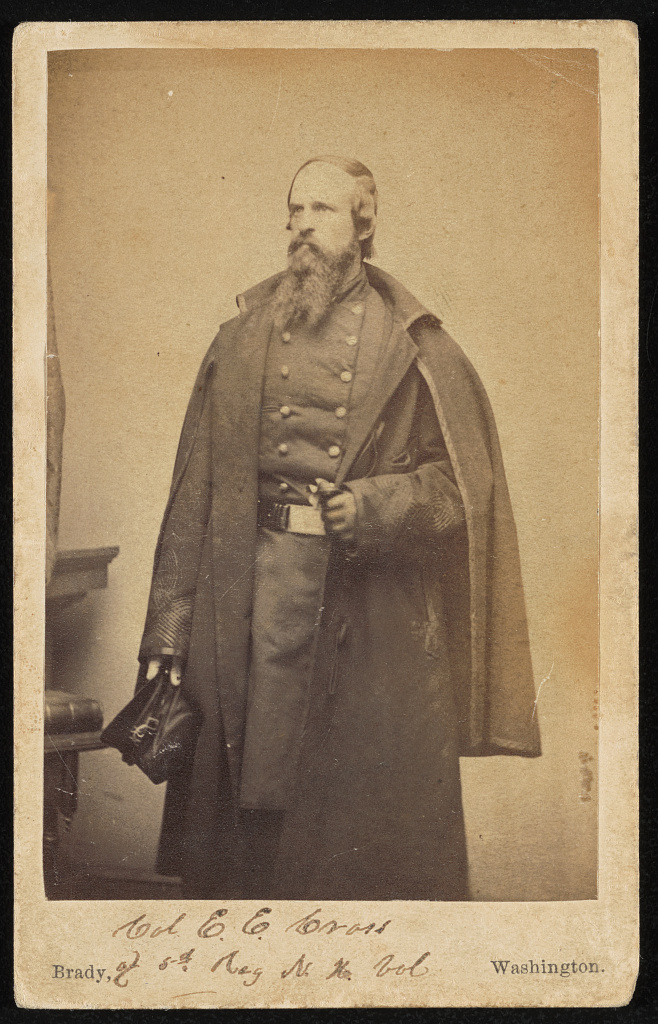
(Library of Congress)
Col. Edward Cross of the 5th New Hampshire, who we shared about above at Fredericksburg, once again found Irish Brigade commander Brig. Gen. Thomas F. Meagher’s courage lacking during the retreat from Chancellorsville. In an unpublished battle report, Cross wrote, “Let me here record that on the afternoon of [May] the 6th during a furious shelling Brig Gen T. F. Meagher lay among the enlisted men of Company G of my regiment—evidently badly scared. As soon as the firing ceased, he ran as fast as possible to the left rear where he had a private fortification constructed.”
As has been discussed, combat fear manifested itself in many different ways. Soldiers could perhaps see even better than their officers when their comrades froze up, played out, or in some other way expressed their inability to control their anxiety. Pvt. John Futch, who fought in the 3rd North Carolina, wrote to his wife from his camp at Hamilton’s Crossing about three weeks after the battle. The 3rd North Carolina saw extremely heavy fighting at Chancellorsville and losing over 230 men. In his letter, Futch wrote, “I [admit] that John B. Blake did not tel much of a lie for they was a grate deal that did not do there deuty[.] I have noticed him very Closely since the fight & I perceived that his pants is little stained But I think that he has washed them since the Battle[.]” Probably wishing to keep the embarrassing matter strictly confidential, Futch requested that his wife “dont let no Body see this.”
The combat on May 3, 1863, at Chancellorsville was some of the most desperate of the Civil War. It tested the will of even the bravest of soldiers. In his official report of Chancellorsville, the 5th Virginia Infantry’s Col. John Funk, who would assume command of the Stonewall Brigade after Brig. Gen. Frank Paxton was killed that morning, noted that “At 6 a.m. we were ordered to move across the Plank road by the right flank 300 yards, and then by the left flank until we reached a hastily constructed breastwork thrown up by the enemy.” Funk explained that “At this point we found a large number of men of whom fear had taken the most absolute possession. We endeavored to persuade them to go forward, but all we could say was of but little avail.” Col. Funk was apparently referring to some of the regiments in Gen. Samuel McGowan’s South Carolina brigade, as one McGowan’s staff officers, Lt. James Fitz James Caldwell, wrote of the incident that “The Stonewall brigade passed over us, some of them saying, with not very pleasant levity, but that they would show us how to clear away a Federal line.” However, after failing to clear the line, and as Calwell then noted, “They were forced back into the works with us.” Despite Funk’s allegation that McGowan’s men would not go forward, since Funk did not specifically mention whose troops they were, his assertion of cowardice apparently do not elicit a response in defense.
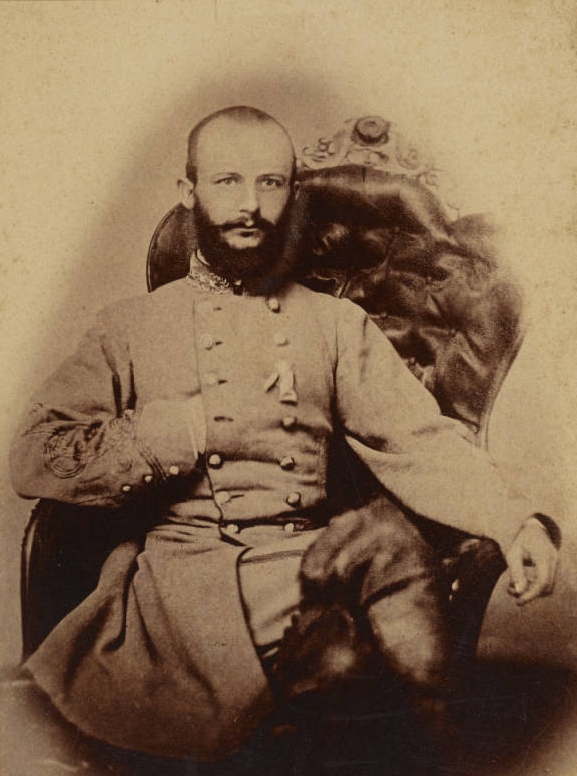
(Public Domain)
However, a claim made by Brig. Stephen D. Ramseur about Funk’s men did draw a retort. Ramsuer, who wrote his report on May 23, 1863, stated: “I continued to advance to the first line of breastworks, from which the enemy had been driven, and behind which I found a small portion of Paxton’s [Funk’s] brigade and [John R.] Jones’ brigade, of Trimble’s division. Knowing that a general advance had been ordered, I told these troops to move forward. Not a man moved. I then reported this state of things to Major-General [J. E. B.] Stuart, who directed me to assume command of these troops and compel them to advance. This I essayed to do; and, after fruitless efforts . . . requested permission to run over the troops in my front, which was cheerfully granted.”
Funk, apparently soon after the battle, learned that Ramseur had, from his perspective, wrongly disparaged his brigade’s courage, either in word or in print, so Funk sent Ramseur a sharp letter six days after the battle. Ramsuer had traveled to Richmond immediately following the battle for treatment for a wound and did not come back for about a couple of weeks. He received Funk’s letter on his return and wrote back offering his perspective. Ramsuer said that when he asked some of the soldiers “milling around behind the works and enquired as to their command, several answered, ‘I belong to the Stonewall Brig.’” Checking further down the line, they told Ramseur the same thing. Ramseur explained to Funk that it was possible that those who answered him gave false information and thus offered to have Funk’s letter read to his men in effort to correct the misinformation. Yet, in his official report, which was dated a day after this reply to Col. Funk, Ramsuer merely noted that a “small portion of Paxton’s [Funk’s] brigade” had refused to go forward. With the promotion of James A. Walker to command the Stonewall Brigade in the aftermath of Chancellorsville, Col. Funk appears to have let the issue drop.
Brig. Gen. John R. Jones, whose reluctant soldiers Ramseur had also called out, apparently did not respond to Ramseur’s report. That may have been due to additional charges of cowardice against him in an incident that happened on May 2, 1863, at Chancellorsville, and due again to Jones leaving the field of battle, but this time supposedly “owing to the ulcerated condition of one of his legs.” With two previous claims of cowardice against him (at Antietam and Fredericksburg), the third was apparently too much to sustain him in such an important position. On May 21, 1863, with Special Orders No. 137, Gen. Robert E. Lee’s assistant adjutant general Walter H. Taylor noted that Brig. Gen. John M. Jones would replace Brig. Gen. John R. Jones. The sacked Gen. Jones was not assigned a new command. The details about his eventual departure from the service are not clear. He was arrested on July 4, 1863, in western Maryland and imprisoned until the end of the war, the Confederates never seeking his exchange.
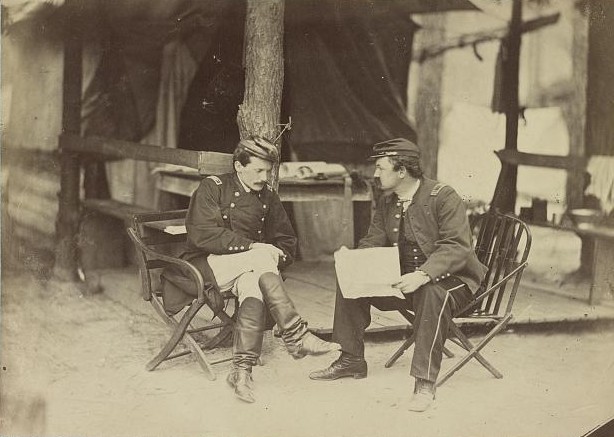
(Library of Congress)
Without a significant amount of evidence to draw upon, it is often difficult to tell where to draw the line between acts of cowardice and perceptions of cowardice. On May 3, after having fought in some hot places, the 114th Pennsylvania’s Col. Charles H. T. Collis was unable to maintain his leadership at a late point in the fight and had turned command of the regiment over to Lt. Col. Frederico Cavada. Capt. Francis Adamson Donaldson of the 118th Pennsylvania (Fifth Corps) noted in his journal seeing Collis being carried off on a stretcher. A fellow captain asked who it was. When informed it was Collis, the captain asked if Collis was shot. “Shot in the neck,” one stretcher bearer replied, perhaps implying that Collis was ill or drunk. Putting the stretcher down, Collis got up and Col. Charles Prevost of the 118th asked Collis where his regiment was. “Just ahead, Sir, heavily engaged but I being sick was obliged to turn over command . . . and go to the rear,” Collis replied. Collis displayed his sword scabbard for the officers to see. It was “much bent, as having been struck by a bullet,” wrote Donaldson. Despite the evidence of hard fighting, Capt. Donaldson believed Collis’s “whole appearance and manner at this time denoted fear of the most abject kind.” He added that “The men smiled contemptuously as they passed him by, and I felt exceedingly sorry they had been witness to the humiliating loss of honor and self-respect of a man so widely known as Col. Chas. H. T. Collis.” Collis was later placed under arrest by Brig. Gen. David Bell Birney for leaving his command without permission when Collis claimed being “insensible, suffering from exhaustion.” A court martial trial that lasted until June 1, 1863, in which Collis defended himself, ultimately acquitted Collis of charges of “misbehavior before the enemy.”
Fighting with Brooks’s Division in the Sixth Corps during the Second Battle of Fredericksburg on May 3, 1863, the 1st Massachusetts Light Artillery posted on the far Federal left that morning, near the Slaughter Pen Farm portion of the Fredericksburg battlefield of five months earlier. Here the artillerymen met stiff Confederate resistance. Corp. John “Jack” W. Chase wrote to this brother four days later about this fighting and what followed later in the day: “I will just say that we never saw any fighting before that was a patch to this.” Chase explained that on May 3rd “we had the 15 [New] Jersey to support us and the damn cowards run and left us and at one time we could not fire there was so many of them in the way but the Col[onel] finally got them out of the way and we managed to get off with a whole Battery but at one time it looked rather doubtful.” Chase was thankful, “for in more than one Instance this past week I began to think that Jack had wrote his last letter but here I am again.” Unfortunately, the 15th New Jersey did not submit a report about the fighting, which may or may not have given their perspective.
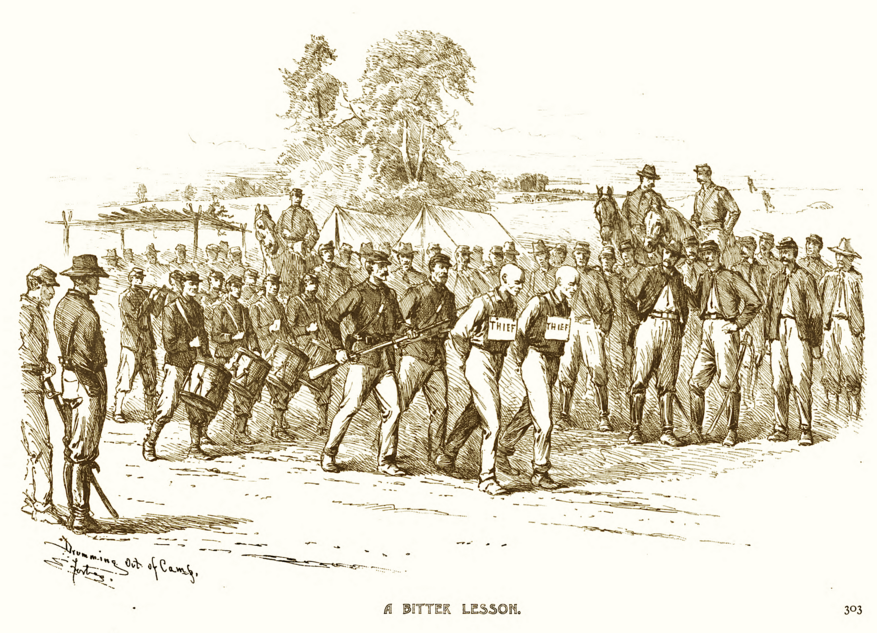
Sketch by Edwin Forbes
Although Forbes sketched thieves here, those found guilty of cowardice often received a similar punishment.
(30 Years After: An Artists Story of the Great War by Edwin Forbes, 1890)
As we have seen, displays of cowardice sometimes had significant repercussions, particularly for officers whose primary job was to lead by example. The universal thought was, how could one expect enlisted men to display courage when their leaders did not? The 77th New York’s surgeon, George T. Stevens, mentioned an “incident of much interest” that occurred after the Sixth Corps had made an excursion across the Rappahannock River in early June and then returned to their Stafford County Camps. There, they witnessed the public humiliation of an unnamed lieutenant from the 21st New Jersey who “had been tried by a court-martial, and convicted of cowardice at the battle on May 3d.” No specifics were provided on how the lieutenant failed to carry out his duties.
To observe the spectacle, “The whole brigade was brought out at the hour for evening parade, and formed in a hollow square.” The convicted lieutenant was brought to the center of the square and his sentence was read, which stipulated that he “he be dismissed the [from] service in disgrace.” Stevens wrote that the brigade’s adjutant general carried out the execution of the order by taking the lieutenant’s sword and breaking it “over his head; his shoulder-straps and buttons were then cut off, and his pistol broken and thrown away.” Additionally, as further shaming, “The sentence, and the manner of its execution, were ordered to be published in newspapers of the county where the regiment was raised.”
Apparently, that same evening, Stevens’ own 77th New York punished Company F’s Lewis Burke “for cowardice in the same battle.” Burke was “brought before the regiment . . . his sentence read, his buttons and blue cord on his coat cut off, and a placard marked ‘COWARD’ hung on his back. A guard, with fixed bayonets pointing at his back, then marched him off, the band playing ‘The Rogues’ March.’” Stevens also noted that Burke completed his enlistment at the Dry Tortugas “at hard labor, and without pay or allowance.” These punishments seemed to have their desired effect, as Stevens explained, “It had never been so forcibly impressed upon our minds, how much better it was to die nobly than to live in disgrace.” Thinking of their comrades who had fallen on May 3, 1863, and then seeing the dishonored soldiers, Stevens noted, “‘How are the dead to be envied!’”
Conclusion
Historian James McPherson utilized his reading of over 25,000 letters and 250 diaries to craft his classic study on Civil War soldiers’ motivations, For Cause and Comrades: Why Men Fought in the Civil War. In it he contends that although soldiers “wrote much about courage, bravery, valor . . . soldiers wrote even more about cowardice—the mark of dishonor.” He goes on to state that “Many soldiers lacked confidence in their courage. But most of them wanted to avoid the shame of being known as a coward—and that is what gave them courage.” Other historians might argue that there were multiple factors that motivated soldiers to enter dangerous combat situations and that a soldier’s level of courage depended on many different variables at any given time. However, most would agree that avoiding being labeled as a coward was indeed a strong incentive to do one’s duty well.
Along with the gallant, the courageous, the brave, and the honorable, as these accounts clearly show, sometimes men faltered in combat situations and became the skulkers, the shirkers, the deserters, the coffee coolers, the play outs, and the panic-stricken. The principle of “Death before dishonor” was an ideal that not all soldiers could live up to all the time.
Sources and Suggested Reading
Peter S. Carmichael. The War for the Common Soldier: How Men Thought, Fought, and Survived in Civil War Armies. University of North Carolina Press, 2018.
Earl J. Hess. Shattered Courage: Soldiers Who Refused to Fight in the American Civil War. University Press of Kansas, 2026.
Christian B. Keller. Chancellorsville and the Germans: Nativism, Ethnicity, and Civil War Memory. Fordham University Press, 2007.
Gerald F. Linderman. Embattled Courage: The Experience of Combat in the American Civil War. Free Press, 1987.
James M. McPherson. For Cause and Comrades: Why Men Fought in the Civil War. Oxford University Press, 1997.
Parting Shot
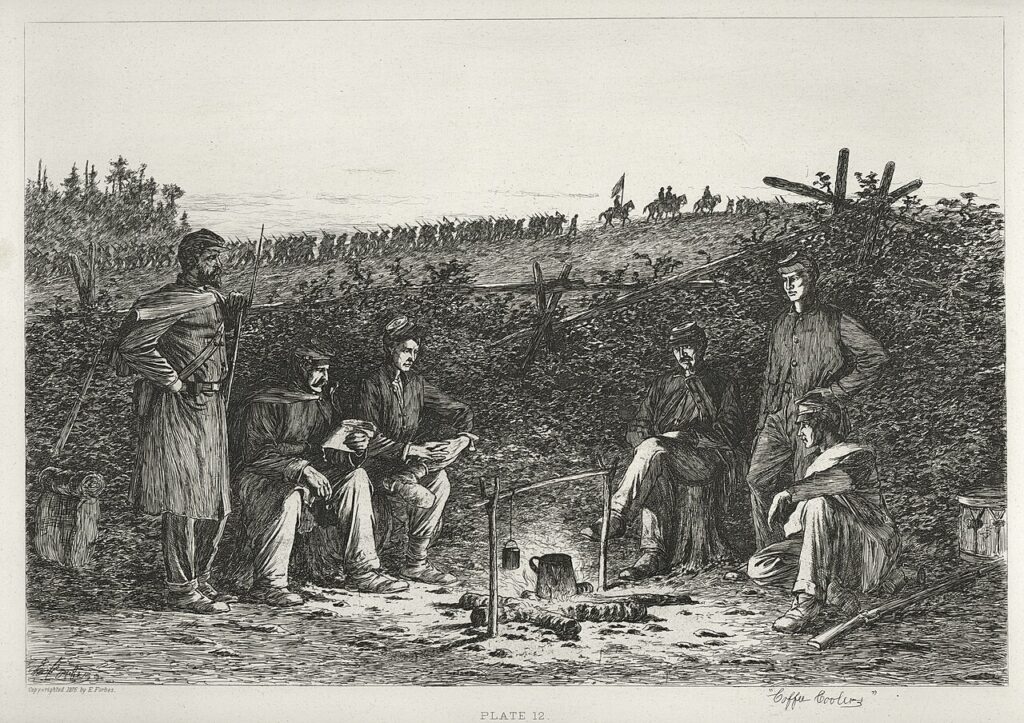
Sketch by Edwin Forbes
(Public Domain)
“It was [the coffee cooler’s] policy to seem eager to advance into action; but no comrade ever saw him in a battle; and he bore no scars, save the sting of bees that he had received in robbing a hive of its stores. He would boast of his bravery like Falstaff- but when artillery rumbled his utterances ceased, and as the column closed up he became much agitated.”
Edwin Forbes, 30 Years After: An Artist’s Story of the Great War

NEWSLETTER SIGN-UP
Join our community! Sign up for our newsletter to receive exclusive updates, event information, and preservation news directly to your inbox.
STAY UP TO DATE
Celebrating 30 Years and Over 2,000 Acres of Battlefields Preserved