
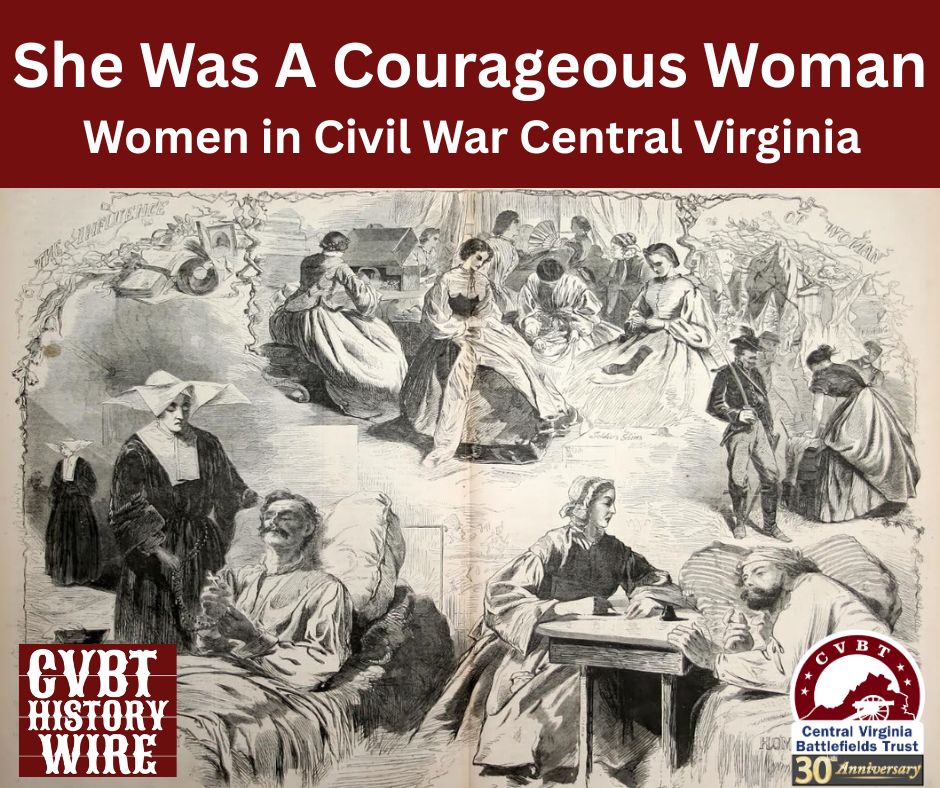
Woodcut from sketch by Winslow Homer
A variety of ways in which women contributed to the war effort is shown in this drawing.
(Harper’s Weekly, September 6, 1862)
Introduction
A teenaged Sue Chancellor found herself, her sisters, mother, and other neighborhood women and children in an unenviable position on May 3, 1863. Their home, which then also served as the headquarters for the Army of the Potomac’s commander Maj. Gen. Joseph Hooker, became the eye of the storm at the Battle of Chancellorsville.
That morning, Sue and the other civilians were ordered to the basement of the house for their safety. Later in life Sue recalled that once in the basement they soon received orders to evacuate it when the house caught fire. “Cannon were booming, and missiles of death were flying in every direction as this terrified band of women and children came stumbling out of the cellar,” Sue remembered. Once outside, the scenes they saw “beggars description. The woods around the house were a sheet of fire, the air was filled with shot and shell, horses were running, rearing, and screaming, the men a mass of confusion, moaning, cursing, and praying.” Sue and the others were quickly led to safety by Lt. Col. Joseph Dickinson, one of Hooker’s staff officers. They crossed the Rappahannock River at US Ford and eventually found lodging with friends. Sue Chancellor’s harrowing experience is just one of many experienced by women in central Virginia during the four years of the Civil War.
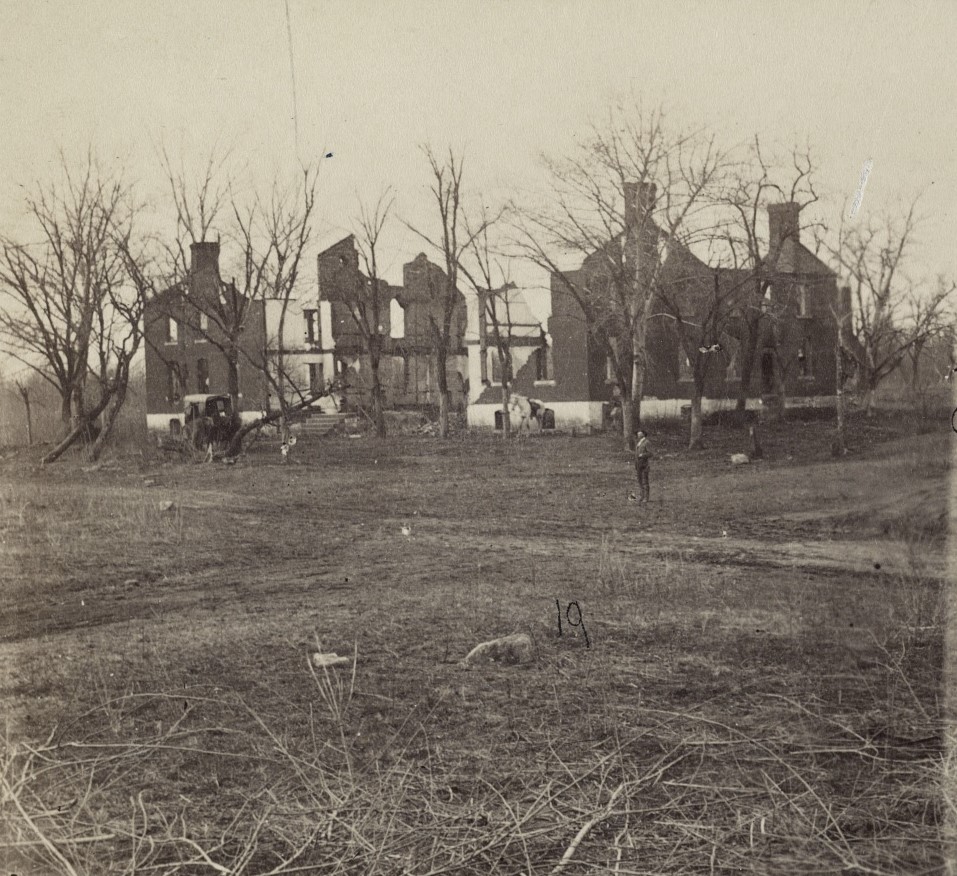
Sue Chancellor and her family escaped their burning home during the Battle of Chancellorsville.
(Library of Congress)
Although we all realize it, at the same time we sometimes simply misremember just how monumental of an event the American Civil War truly was. It being so is partly evidenced by the large numbers and diversity of people who ultimately became involved in it in one way or another. Virtually every American was touched by it and its results.
Mid-nineteenth-century America’s racial and gender conventions dictated that war was a white male sphere. However, those standards changed drastically as the war progressed and intensified. Due to the magnitude of the conflict, and thus a need for supplemental labor, and of course the persistence and perseverance of women willing to aid their respective causes, they would come to play significant roles in many aspects of the war.
As alluded to above, at that time, battlefields were not viewed as places for women. Yet we know that at least several hundred women who challenged societal standards by disguising themselves as men and enlisting as arms-bearing soldiers during the war. Others served in hospital situations caring for the sick and wounded. Some took their nursing duties out of the hospitals and worked directly on battlefields where they felt their skills could provide the most help. Yet others got caught in battlefield maelstroms through miscalculations or just plain bad luck.
Women on the Battlefields and in Camps
Despite the many risks, some women felt that direct participation was the best way to make contributions and show their allegiance to their country. One example is Anna “Annie” Etheridge, who amid the gun smoke, noise, and flying projectiles at the Battle of Chancellorsville, served as a vivandiere and nurse for the 3rd Michigan Infantry. After the battle, she helped a wounded soldier from another regiment in the division who was eternally grateful. Somehow George H. Hill’s thank you letter to Annie ended up in the possession of 63rd Pennsylvania’s 1st Sgt. David Strachan. Strachan was unfortunately mortally wounded at the Battle of the Wilderness before he could give the letter to Annie, but someone found it on Strachan and eventually, the letter passed to her. In the letter, Hill wrote: “At Chancellorsville, I was shot through the body, the ball entering my side, and coming out through the shoulder. I was also hit in the arm, and was carried to the hospital in the woods, where I lay for hours, and not a surgeon would touch me; when you came along and gave me water, and bound up my wounds. I do not know what regiment you belong to, and I don’t know if this will ever reach you.” Hill continued that, “But should you get this, please accept my heartfelt gratitude; and may God bless you, and protect you from all dangers; may you be imminently successful in your present pursuit.”
Other soldiers also apparently noticed and appreciated Annie’s battlefield efforts. In a May 10, 1863, letter to his mother, the 17th Maine’s Charles Mattocks wrote about seeing Etheridge in action at Chancellorsville: “I saw one young lady in the very front of battle dressing wounds and aiding the suffering where few Surgeons dared show themselves. That girl is Anna Etheridge, a second—a more than—Florence Nightingale. You may have read of her. She is always to be seen riding her pony at the head of our Brigade on the march or in the fight. Genl. [Hiram] Berry [who was killed at Chancellorsville] used to say she had been under as heavy fire as himself.”
Women continued to display conspicuous courage on central Virginia’s battlefields in the spring of 1864. Remembering the Battle of Spotsylvania, Thomas Galwey of the 8th Ohio Infantry wrote, “At one time the shower of musket-balls, shrapnel, and every sort of projectile falling in the midst of us was trying to the nerves of the coolest. Just then I heard a man calling, ‘Annie, come this way.’ Galwey admitted, “To hear a woman’s name at such a time was rather startling,” so he “looked around” and “Sure enough there was a woman!” Galwey described Annie as “about twenty-five years of age, square featured and sun-burnt, and dressed in Zouave uniform in the Vivandiere style.” According to Galewey, she was trying to help two soldiers in the 114th Pennsylvania find their regiment. “Hers was the only face in the vicinity which seemed in any way gay. She was laughing and pointing very unconcernedly, as she stumbled over axes and spades, and other obstacles, on her way through the trench! She was either wonderfully courageous or else she did not understand her danger,” Galway wrote admiringly.
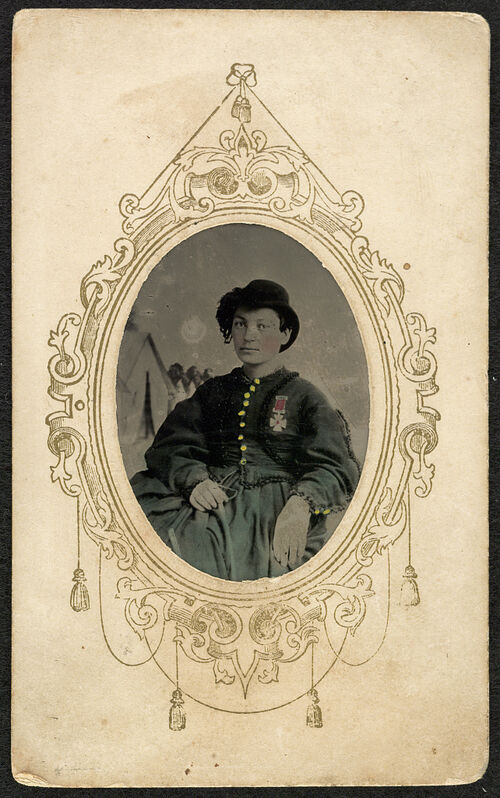
Annie Etheridge received numerous comments for her bravery and caregiving work on Central Virginia’s battlefields.
(Library of Congress)
Since the 114th Pennsylvania soldiers seemed to know this woman well, one wonders if Galwey perhaps confused Annie Etheridge with Marie “Mary” Tepe, who served as a vivandiere, in two Pennsylvania regiments, one of which was the 114th, a Zouave unit. Born Marie Brose, in France in 1834, she married Bernhard Tepe and the couple emigrated to Philadelphia in the 1850s, where Mr. Tepe began a tailor business. When he enlisted in the 27th Pennsylvania, Marie went with him and served the regiment in a variety of roles. She nursed sick soldiers, she sold goods, including tobacco, alcohol, and food to the soldiers. She also did cooking, laundering, and sewing work for pay. A falling out occurred between Marie and her husband, possibly over missing money she had earned. Whatever the reason, Marie left the 27th and later joined up with the 114th Pennsylvania, also known as Collis’ Zouaves.
Mary Tepe was on the Fredericksburg battlefield with the 114th, where she received a wound to her ankle, but she healed in time to return for Chancellorsville. One of the soldiers remarked about her: “She was a courageous woman, and often got within range of the enemy’s fire whilst parting with the contents of her canteen among the wounded men. Her skirts were riddled by bullets.” Accounts also place her on the field at Gettysburg and Spotsylvania. Marie left the army after her new partner, Corp. Richard Leonard, received a discharge.
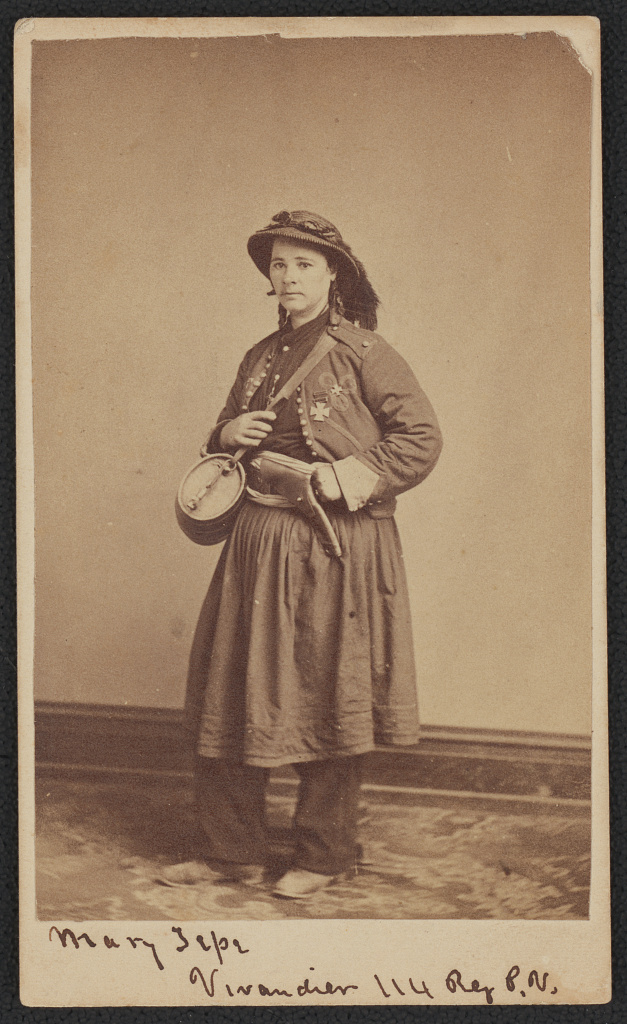
(Library of Congress)
There is quite a bit of evidence that at least a few women served as arm-bearing soldiers in central Virginia. Samuel Partidge, who served as the quartermaster for the 13th New York Infantry wrote on April 10, 1863, that in the 118th Pennsylvania, a regiment in his brigade, there “is a young and good looking corporal, whose courtesy and military bearing have struck the officers very favorable. . . .” Partridge explained that said corporal reported sick, was sent to the hospital, examined, and found to be pregnant. He added, “In the course of the night Corporal Blank gave birth to a fine boy – genuine child of the Regiment.” Apparently this female soldier enlisted the previous August and “here amidst the ten thousand things which ought to have shown her sex, she’s preserved it undiscovered for seven months. Bully for her.”
In his history of the 16th Maine Infantry, Maj. Abner Small noted that the “members of the Sixteenth were not all of the masculine persuasion. Company I boasted of the presence of the one of the gentler sex in the ranks who did good service at Fredericksburgh.” He went on to share an excerpt from the Richmond Whig newspaper that explained the discovery happened while the female soldier was held at Belle Island prison. The story also ran in the Richmond Examiner. While the newspapers disagreed on the woman soldier’s age—one claiming 16, while the other stated 19—they were in agreement on most of the other details. The Examiner explained that the soldier’s real name was Mary Jane Johnson and she “had been a prisoner for some time.” Apparently, she went to war “following her lover to shield and protect him when in danger. He had been killed in battle and now she would have no objection to return to the sphere for which by nature, by her sex, had better fitted her.” She was transferred to Castle Thunder prison for holding, but the paper supposed she would go north at the next flag of truce opportunity, probably meaning the next formal prisoner exchange.
Civilians Caught in the Storm
Some area women had the choice to flee or stay when the Union and Confederate armies invaded their worlds in 1862, 1863, and 1864. As was the case with many of Fredericksburg’s women, Jane Howison Beale fled the city on the evening of December 11, 1862, with her children. From her house on Lewis Street, the party traveled in a commandeered ambulance over to Hanover Street, and then along the soon-to-be-famous Sunken Road—scene of such terrible fighting two days later. She recorded in her diary that, “We were shoved in the vehicle without much ceremony, and the horses dashed off at a speed that at another time would have alarmed me, but now seemed all to slow for our feverish impatience to be beyond the reach of those terrible shots which were still tearing through the streets of the town, one struck a building just as we passed it, another tore up the ground a short distance from us.”
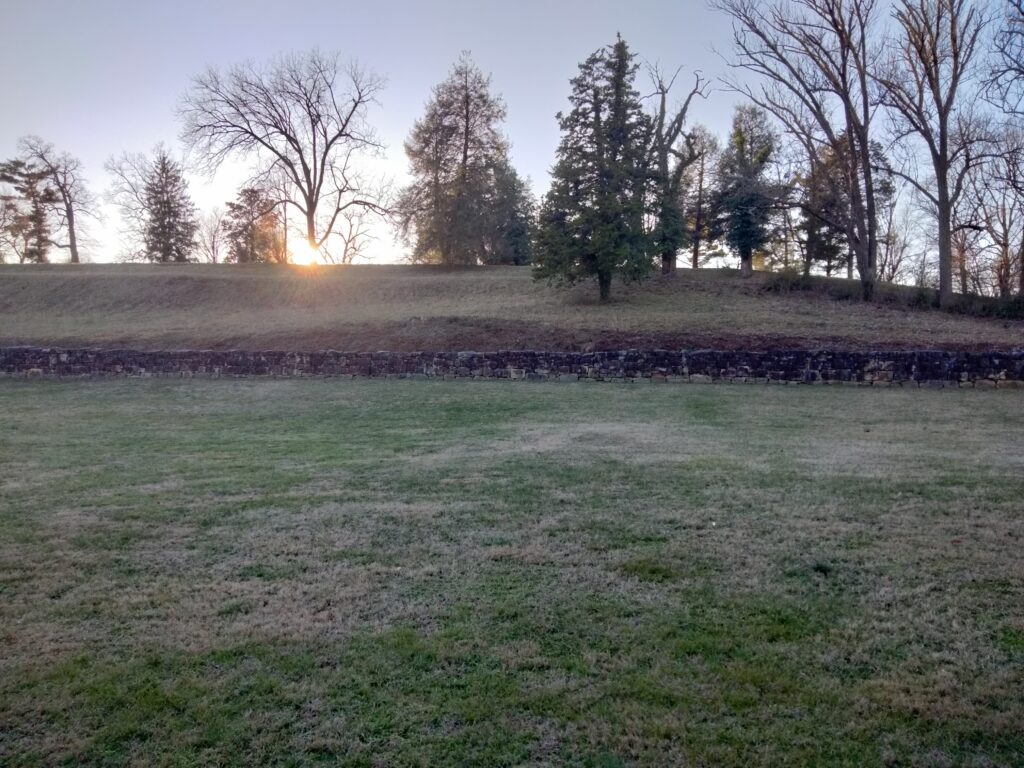
Jane Howison Beale’s trek out of Petersburg on December 11, 1862, took her along what is now called the Sunken Road at the base of Willis Hill and Marye’s Heights.
(Tim Talbott)
Beale felt relief after proceeding beneath the Willis Hill Cemetery. “As we passed beyond the line of the town and the turn in the road put the ‘Willis Hill’ Promontory of land, between us and the firing, a sense of security came into my mind and a deep and heartfelt thankfulness for our deliverance from this great evil, carried my spirit to the throne of Heaven in humble grateful prayer,” she wrote. Jane Beale and her children were among the fortunate. They found shelter in the home of a friend. Other Fredericksburg refugees made camps in the woods or took cover, if possible, in nearby churches like Salem Church.
In his memoir, Pvt. Isaac Bradwell, 31st Georgia, recalled that Capt. Edward Payson Lawton fell at what is now known as the Slaughter Pen Farm during the Battle of Fredericksburg. However, Capt. Lawton actually ended up captured and transported to a Union hospital in Alexandria, Virginia, where he died the day after Christmas 1862. Previously informed of her husband’s wounding, Evelina Lawton traveled by train from Savannah, Georgia to Virginia, finding out at Fredericksburg that Capt. Lawton was within Union lines. Ms. Lawton secured a pass but arrived in Alexandria too late to nurse her husband. Despite her grief, she secured his body for transportation home. After arriving back in Stafford County on January 7, 1863, the following day Col. William Teall, a Federal officer and son-in-law of Gen. Edwin Sumner, detailed soldiers from the 10th New York Infantry to escort Mrs. Lawton and her husband’s body to the Rappahannock River. Teall accompanied Ms. Lawton to the Fredericksburg side, crossing by boat where the upper pontoon bridge once spanned the river. Once across, Gen. Jospeh Kershaw received them. Eventually Mrs. Lawton and Capt. Lawton’s body made their way by train back south where he was buried in nearby Robertville, South Carolina.
Since central Virginia’s battles played out on citizens’ private property, no one was exempt from the possibility of that clashes could occur in their midst.
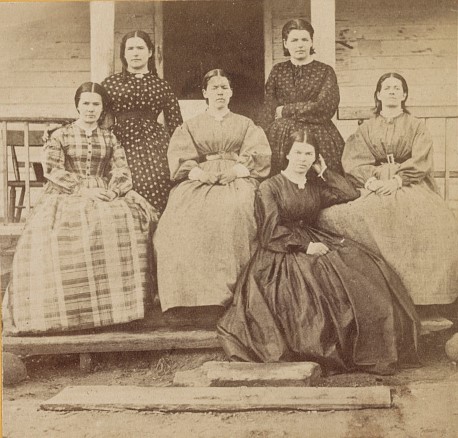
This 1866 photograph shows several of the Hawkins and Downer women who witnessed the Chancellorsville fighting.
(Library of Congress)
Among the homesteads that ended up engulfed in Confederate Gen. Thomas J. “Stonewall” Jackson’s Chancellorsville flank attack on May 2, 1863, was that of the Hawkins and Downers, near Wilderness Church. Thomas Downer, Martha (Hawkins) Downer, Sarah Downer, and Huldah Hawkins were all listed as occupants when the 1860 census was recorded. However, apparently, a number of other Hawkins female kin were residing there during the battle.
As Jackson’s massive assault was gaining steam, some of the Federal soldiers were making coffee near the Hawkins House while others were slaughtering army cattle for rations near Wilderness Church. It is not clear what her intention was, but according to a postwar account Huldah Hawkins was apparently among the first to spot the assault column and she waived her apron in an attempt to get the attention of the Union soldiers carving the cattle and yelled, “Here they come!” Whether she was sending a warning or encouraging the attackers is not known. As the soldiers scrambled to get their rifles and equipment to prepare a defense, the Hawkins clan found shelter in the cellar of the house where they stayed until the assault storm passed.
Women and girls who happened to be in the paths of Civil War armies often remembered their war time experiences for the rest of their lives. Coming from rather humble origins, the Widow Tapp and her small family found themselves in the whirlwind of war when Union and Confederate forces clashed around their cabin in Spotsylvania County. Displaced by the Battle of the Wilderness (May 5-6, 1864), the Tapp family returned to their home, which was still standing, but amidst a scene of destruction wrought by the contending belligerents.
Similarly at the Wilderness, the Higgerson Farm became invaded. Benjamin and Parmelia Higgerson raised their four children in a small one and a half story frame building. Two enslaved individuals also lived on the Higgerson’s farm. Benjamin, 50 years old in 1860, died in 1862, leaving Parmeila a widow. James, an adult son of Benjamin’s from a former marriage, who served in the 9th Virginia Cavalry, died from smallpox a couple of days before Christmas 1862. Parmelia Higgerson was present when her house ended up caught between the lines of the contending armies. On May 5, 1864, Confederate brigades under Junius Daniel and John Brown Gordon, and Federals in Roy Stone’s brigade of Pennsylvanians from James Wadsworth’s division slammed into each other at the Higgerson farm. John Nesbit of the 149th Pennsylvania (Stone’s Brigade) recalled that they “marched down toward the rebel lines . . . passed a small cabin . . . with a picket fence enclosing the house and garden.” Nesbit noted that his company “moved right over the fence and garden, smashing the fences and trampling the garden stuff under their feet.” As Parmelia saw the Federal soldiers damage her property she castigated them and said that they would soon be going the other direction. It was not long before her prophecy came true.
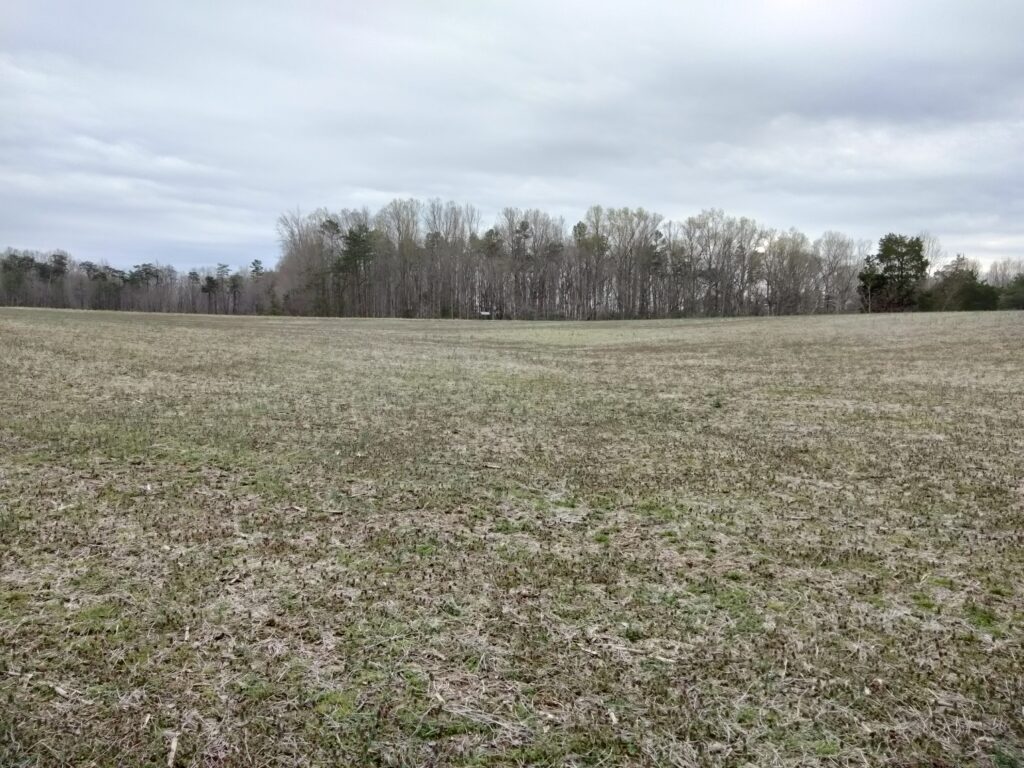
(Tim Talbott)
At the time of the Battle of Spotsylvania, Sarah Buckner Spindle lived on her farm just north of town on Brock Road. She was the second wife of Benjamin Spindle, who had purchased over 300 acres from its previous owner, his first father-in-law. Benjamin Spindle died in early 1860, leaving the house and 50 acres to Sarah, and even more land to their two children. That year’s census also lists three other adults and two children in the household. Nineteen enslaved individuals worked on the farm. The Army of the Potomac’s Fifth Corps arrived on their heels, making several assaults across the Spindle farm. During the fighting on May 8, Federal sharpshooters occupied the house, with Sarah Spindle still in it. The Confederates, determined not to allow their foes to use the structure to advantage, sent artillery shells into it, which caught it on fire. John Coxe, who served in 2nd South Carolina remembered, “And then I saw a sight I never wanted to see again. A woman bareheaded, her long hair streaming behind, ran out of the big house and across the field between the two fighting armies and reached shelter in the woods on the Po River.” Apparently, the Spindle House was never rebuilt.
A woman who chose to stay on her Spotsylvania farm and documented her experiences was Katherine (Kate) Couse, who had lived at her “Laurel Hill” homestead since she was a little girl. The Couse family was different than most of their neighbors, they had moved from New Jersey to Virginia and in 1840 they purchased a farm. Just over 20 years later when war came, they espoused the Union cause. When the armies started fighting at Spotsylvania in May 1864, Laurel Hill ended up just behind the front lines. The farm soon became the sight of the Fifth Corps field hospitals. As one might imagine, Kate’s world changed drastically in a short amount of time.
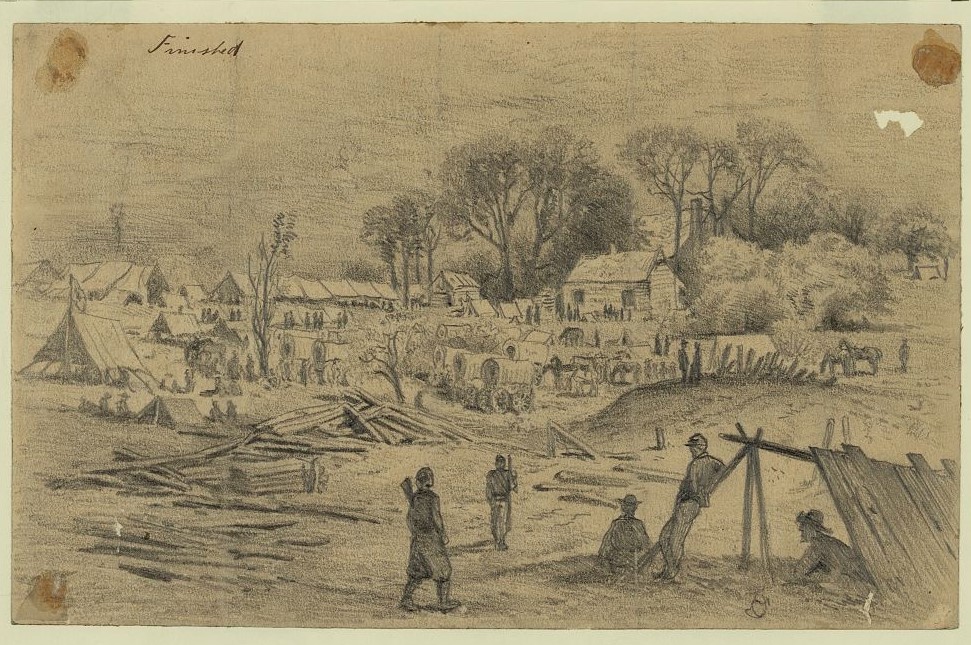
Sketch by Edwin Forbes
Laurel Hill, the Couse house and farm, became site of Fifth Corps field hospitals.
(Library of Congress)
In noting the happenings during the eventful duration of the battle, one of Kate’s most heart-rending comments came on May 12, 1864. “Oh! God there is now the most murderous battle raging. The continuous roar of cannons the still more terrific musketry sounds awful indeed. My feelings are intensely awful beyond description. The drums are beating, the bands at intervals–the poor wounded heroes are now coming in ambulances, they stand with stretchers ready to remove them to the tents, on the amputation tables. I can see them lying stretched out ready to be operated on.” Sketch artist Edwin Forbes was on hand to document the scene visually and Kate mentioned meeting Forbes. Four days later Kate wrote, “These great armies leave ruin, desolation in their track. The whole country has a laid waste look. There are graves all around us. How many of the poor soldiers who started over in fine hopes and spirits now sleep the last sleep on old Laurel Hill.”
Merciful Angels – Women in Nursing
When speaking about women’s contributions in central Virginia it would be unfortunate not to mention the vital role women played as United States Sanitary Commission (USSC) workers. Their efforts made a significant impact on the Union war effort by providing soldiers’ aid. While the leadership of the United States Sanitary Commission (USCC) was primarily male, women served as the backbone of the organization. Working for the USSC gave Unionist women a valuable outlet to express their patriotism. In addition, the USSC offered women new opportunities to obtain skills previously denied due to traditional gender roles. Managing, accounting, coordinating, and organizing soldiers’ aid efforts helped women grow as professionals and realize their individual earning potential in the work world. Following the war, many USSC women continued to find outlets for their activism. Some utilized the organizing skills they obtained through the USSC to champion women’s suffrage and petition against child labor. The effect that the women of the USSC had on American society reached far beyond the four years of the conflict, but they offer an excellent example of the power and influence individuals possess to create change.
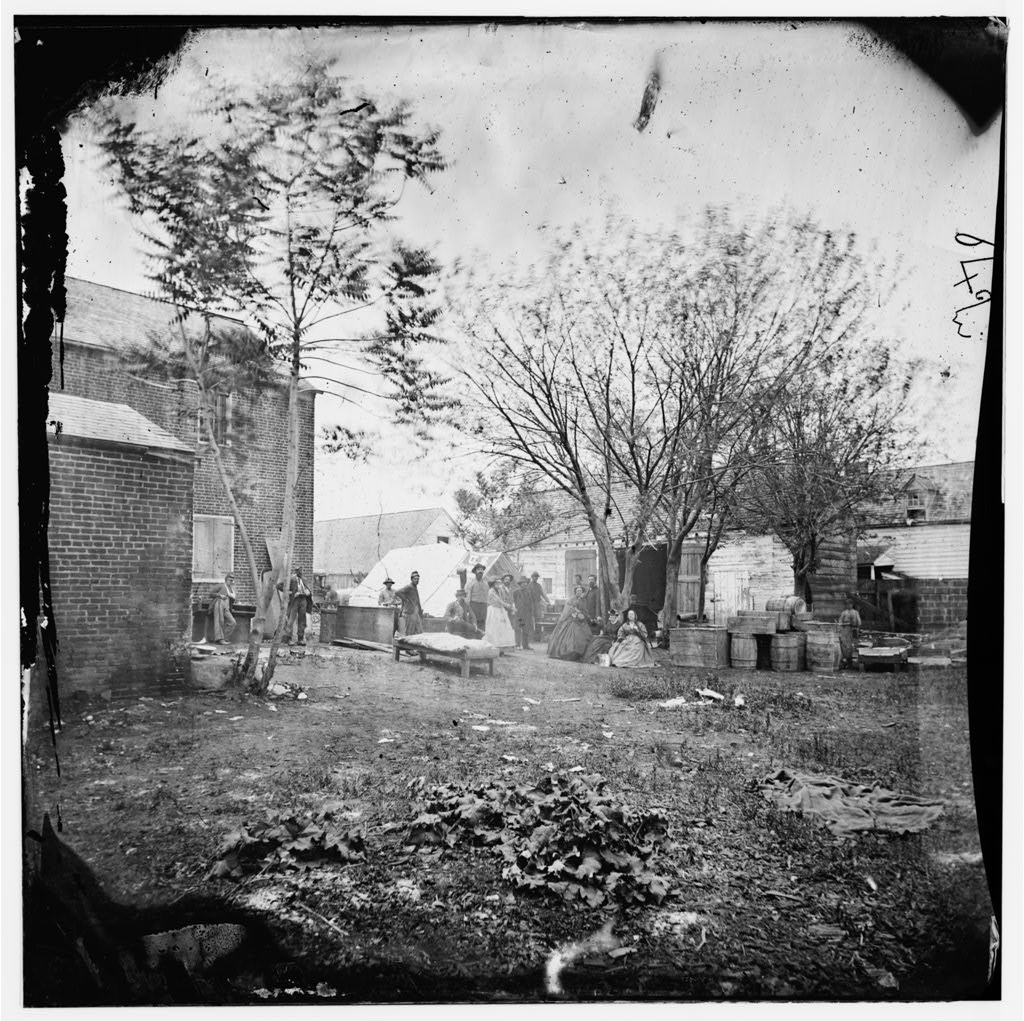
This May 1864 photograph shows a group of USSC workers, including women, in Fredericksburg.
(Libary of Congress)
Shot through the body at the abdomen during the Battle of the Wilderness, Corp. Josiah B. Hall, 57th Massachusetts, recalled part of his hospitalization in Fredericksburg and the unexpected kindness exhibited by a local visitor. Hall remembered, “For the first few days at Fredericksburg it was almost impossible to obtain bandages. The women with a few exceptions were bitter rebels and would do all they could to prevent us from finding or buying a single piece of cloth. The bandage with which my own wound was bound up was part of the white skirt belonging to an elderly lady who brought roses into the [St. George’s] Episcopal Church where I was lying, a Mrs. McCabe. Seeing the need of a bandage, she loosed her skirt, cut it into strips, and handed it to my father, who proceeded to dress my own and the other soldiers’ wounds.”
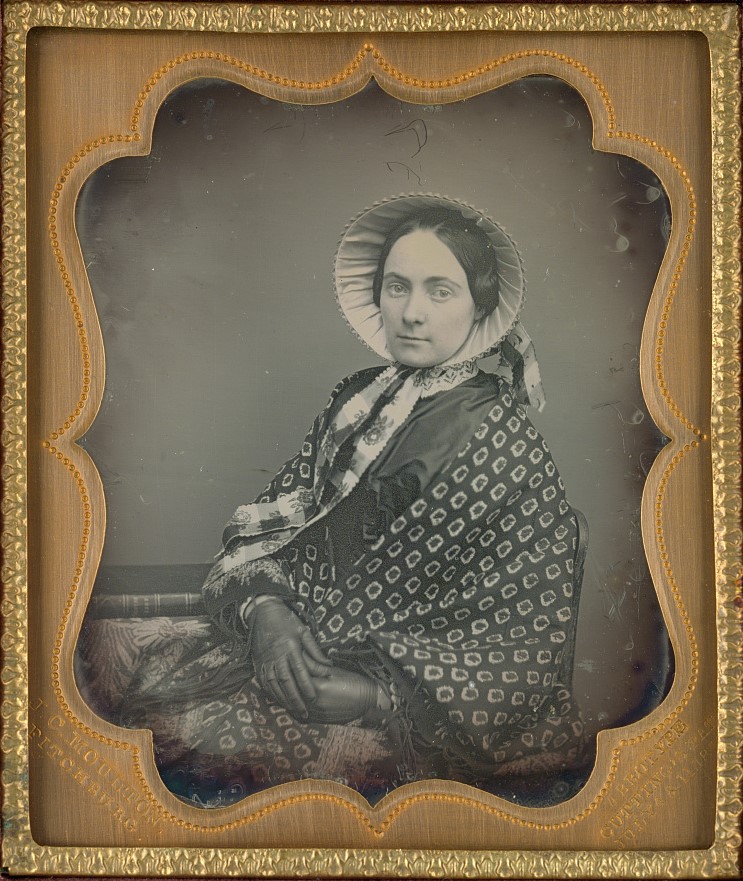
Gilson was one of the most active nurses of the Civil War.
(Library of Congress)
While at the Marye House in Fredericksburg during May of 1864, Dr. William Howell Reed, then working with U.S. Sanitary Commission, first came in contact with nurse Helen Gilson. She left quite an impression on the doctor: “First with one, with at the side of another, a friendly word here, a gentle nod and smile there, a tender sympathy with each prostrate sufferer, a sympathy which could read in his eyes his longing for home love, and for the presence of some absent one—in those few minutes hers was indeed an angel of ministry. Before she left the room she sang to them, first some stirring national melody, then some sweet or plaintive hymn to strengthen the fainting heart; and I remember how the notes penetrated to every part of the building. Soldiers with less severe wounds, from the rooms above, began to crawl out into the entries, and men from below crept up on their hands and knees, to catch every note, and to receive the benediction of her presence—for such it was to them.”
As the fighting in May 1864 raged in Spotsylvania County and then moved to fresher fields of fury further south, a measure of misery remained. For a time, Fredericksburg became a center of care for thousands of wounded soldiers. Julia Wheelock, a nurse for the Michigan Relief Association, commented that: “All the public buildings—the Court-House, churches, hotels, warehouses, factories, the paper mill, theatre, school-buildings, stores, stables, many private residences— and, in fact, everything that could give shelter was converted into receptacles for the wounded, until Fredericksburg was one vast hospital.”
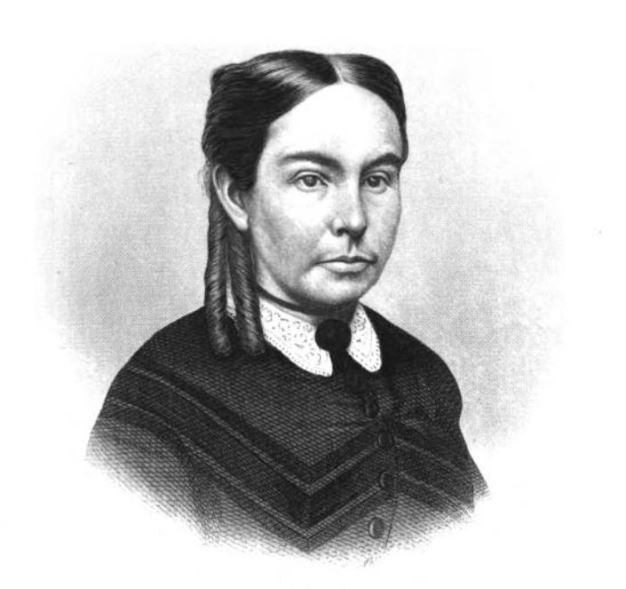
Wheelock called Fredericksburg “one vast hospital” in May 1864.
(From The Boys in White: The Experience of a Hospital Agent in and around Washington, 1870.)
Wheelock wrote that “Such scenes of wretchedness and of terrible suffering I have never before witnessed. I found the wounded lying upon the hard floor without pillows, and many without a blanket, so closely crowded together that there was scarcely room to pass between them. Officers and soldiers laying side by side.” On top of dealing with the pain of their wounds, Wheelock found the soldiers were hungry, “many having eaten nothing in three or four days previous to their arrival here.” To help ease their suffering she gave out food that “consisted almost entirely of chicken soup and crackers, in dealing out, which I made no distinction, but gave to all as far as my supplies would go.”
In the improvised hospital at Fredericksburg’s Planter’s Hotel, Wheelock noted seeing “several wounded in the face, among whom is Sergeant Clark, also of the Eighth [Michigan]. The ball lodged somewhere in the mouth, and has not yet been found. It is very distressing to see him; his tongue is swollen to an immoderate size, and protrudes from his mouth. He is unable to speak, or take nourishment, except liquids. There are hundreds of cases, each peculiarly sad, and each presenting itself as an object of sympathy.” The volunteer nurses like Wheelock provided that much needed sympathy and tender care.
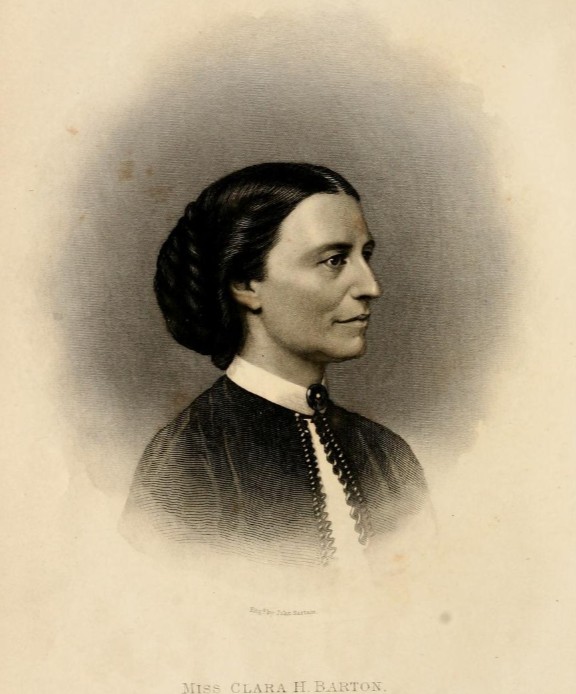
Barton worked as a nurse in the Fredericksburg area in both 1862 and 1864.
(From Woman’s Work in the Civil War: A Record, 1867)
The famous Clara Barton offered her nursing skills to the wounded in and around Fredericksburg in 1862 and 1864. During her May 14-15, 1864, visit she found soldiers who were recently wounded during the Battle of the Wilderness and at Spotsylvania, many of them Ninth Corps men. She noted their deplorable state. Far too many of them lacked proper attention and they were festering with gangrene and were hungry. Barton wrote in her journal that she “carried a basket of crackers – and gave two apiece as far as they went – and some pails of coffee. they had had no food that day. . . .” She also noted that “There is not room in the city to receive the wounded – and those that arrived yesterday mostly were left lying in the wagons all night at the mercy of the drivers, it rained very hard – many died in the wagons and their companions, where they had sufficient strength had raised up and thrown them out into the street – I saw them lying there early this morning.” Barton penned that “The surgeons do all they can but no provision had been made for such a wholesale slaughter on the part of anyone, and I believe it would be impossible to comprehend the magnitude of necessity without witnessing it.”
Realizing that she could not provide much real help without medical supplies, Barton set off for Washington on May 16. Once there she spent a few days lobbying for money and assistance. She arrived back in Fredericksburg on the night of May 21, just as the Army of the Potomac started moving south again. The following day she made unsuccessful efforts to get rations authorized and made connections with relatives and friends from back home. By that time the railroad from Falmouth to Aquia was repaired, allowing patients to be transferred more easily via that route to ships that would then take them to Washington and Alexandria hospitals and providing a much better option than the muddy, rutted overland route in bumpy wagons and ambulances to Belle Plain Landing.
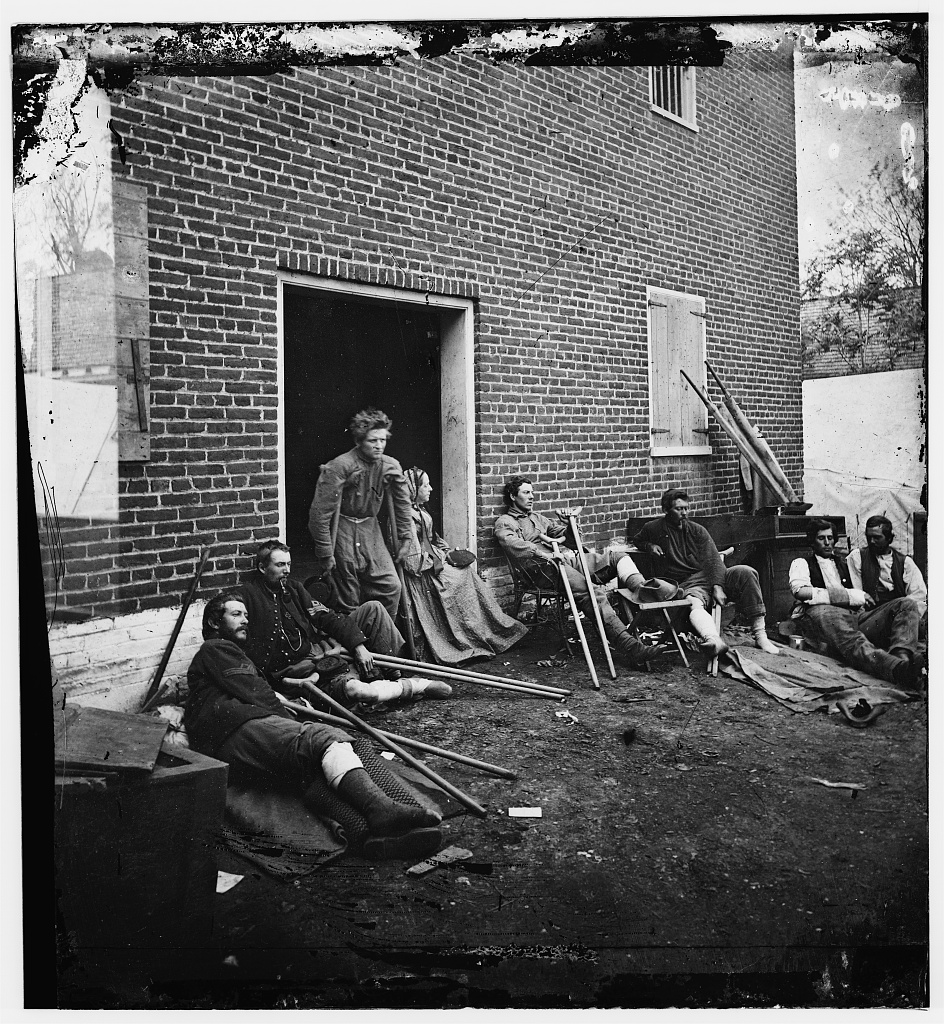
(Library of Congress)
Abby Hopper Gibbons and her daughter Sarah “Sally” Hopper Emerson were among a group of civilian women and men who answered the call to help the wounded at Fredericksburg in May 1864. They arrived about the time that Clara Barton made it back from Washington. Sally Gibbons wrote to her father a few days later describing some of the challenges she and her mother faced while trying to help the wounded. “You can form no idea of the work we had to do in Fredericksburg,” Sally explained. She noted that “I had a hundred and sixty men, all on the floor and not a bed to be seen; four storehouses and one third story, packed so close that the men nearly touched each other; in one room with twenty-three men, fourteen amputations ; not a breath of air until Mr. Thaxter knocked out the windowpanes and afterwards the sashes.”
Desperate times called for desperate measures. Sally explained the need to take what they could from the town to try to comfort the patients: “We stole straw to fill ticks, stole boards to make bunks, stole bedsteads, took nails from packing boxes, and yesterday every man was comparatively comfortable.” Work conditions were difficult. “The filth exceeded anything you ever dreamed of—stench terrific,” she penned. Sally praised the Sanitary Commission as “the only decent feature of the place,” and shared that “Some of the Christian Commission have worked splendidly too. The Sanitary agents washed men, dressed wounds, and did everything. They have saved hundreds of lives, for provisions were terribly scarce and nothing was to be had in the city.”
Conclusion
The final chapter of the 1867 book Woman’s Work in the Civil War: A Record begins: “So abundant and universal was the patriotism and self-sacrifice of the loyal women of the nation that the long list of heroic names whose deeds of mercy we have recorded in the preceding pages gives only a very inadequate idea of women’s work in the war.”
And so it is with this brief article, which merely highlights some of the women–both Union and Confederate–who experienced the Civil War as it happened in central Virginia. Despite their courage, assiduous efforts to take care of their families, aid the sick and wounded, and simply survive the many threats to mind and body that come with war, they were not usually eligible for the honors and legacies that often come from serving one’s country. However, undoubtedly, they deserve to be remembered too.
Some Sources and Suggested Reading
Kerri S. Barile and Barbara P. Willis, eds. A Woman in a War-Torn Town: The Journal of Jane Howison Beale – Fredericksburg, Virginia, 1850-1862. The Donning Company Publishers for Historic Fredericksburg Foundation, 2011.
L. P. Brockett and Mary C. Vaughn. Woman’s Work in the Civil War: A Record. Ziegler, McCurdy, and Company, 1867.
Donald C. Pfanz. Clara Barton’s Civil War: Between Bullet and Hospital. Westholme, 2018.
Julia S. Wheelock. The Boys in White: The Experience of a Hospital Agent in and around Washington. Lange and Hillman, 1870.
Parting Shot
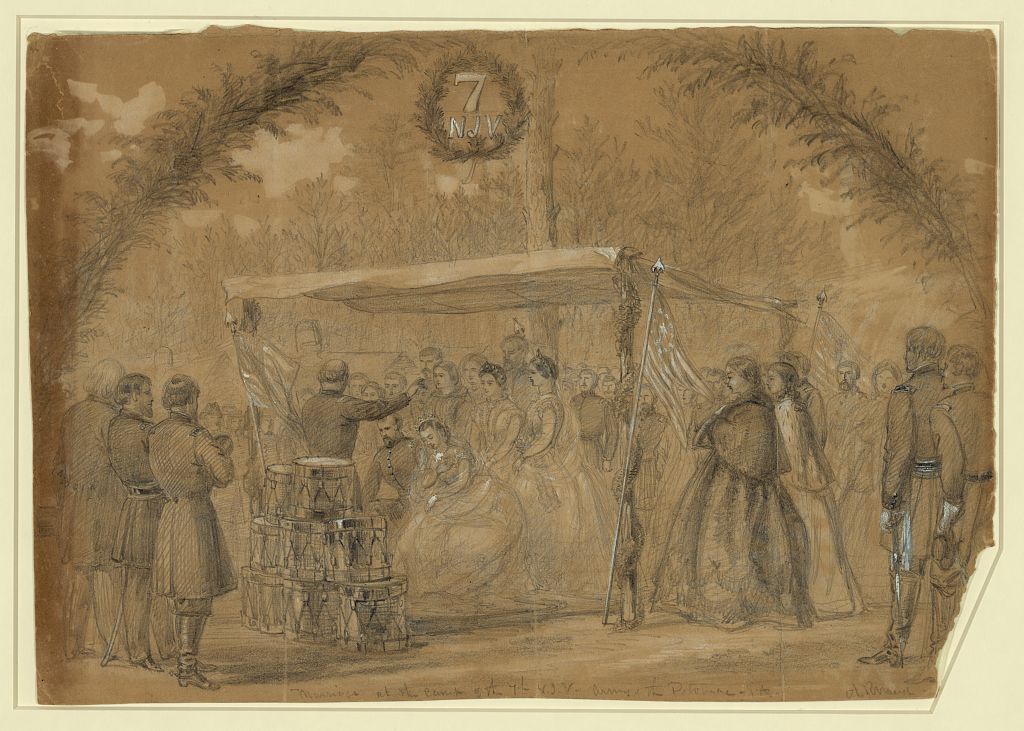
Sketch by Alfred R. Waud
Civilian women, particularly officers’ wives, were frequent visitors to Civil War army winter camps. Their presence boosted morale and strenghened connections to the home front. However, army weddings like this one, which happend in Stafford County on March 18, 1863, were not that common.
(Library of Congress)
NEWSLETTER SIGN-UP
Join our community! Sign up for our newsletter to receive exclusive updates, event information, and preservation news directly to your inbox.